Monday, January 14, 2013

XIAN, CHINA: Ancient Capital with Terracotta Soldiers and More

Ancient City Gates, Xian, China
This is a look at a trip from the past, China in 1995, when we visited Shanghai, Beijing, and Xian.  Although many things have changed in China since then, the terracotta soldiers in Xian remain one of China’s most memorable sights.  Here is my diary account of our visit in the summer of 1995, beginning with our flight to Xian from Beijing.

I had a window seat on the plane.  It was a clear day.  We crossed a low mountain range and then flew over a broad plain of brown fields.  When we emerged from the airport in Xian, it was like walking into an oven– 100 degrees Fahrenheit and no humidity.  The airport is an hour’s drive from the city.  We passed endless flat fields punctuated by grave markers of ancient emperors.
Our hotel, the Jinjiang, was next to the zoo on the northeast side of the city.  For supper we ate at a Chinese restaurant in the hotel where a woman was playing a zither-like instrument.  In the morning, we had a Western style breakfast.  The dining room was filled with a busload of Swedish folk dancers on tour.
Terracotta Soldiers, Xian, China from the Qin Dynasty, 3rd Century BC
We left at 8:30 for the terracotta warriors–located about 30 km outside the city.  They had been discovered in 1974 by farmers digging a well.  The weather was overcast and somewhat cooler than the day before.  Because of construction on the main road, we drove along a bumpy narrow road through pomegranate groves and got to the museum by the back way.  At the site (flanked by numerous souvenir stands) there were three main buildings–#1 with the vast army; #2 where archeologists were currently digging (not included on our tour); and #3 which showed a partially excavated site.  Although photos are strictly forbidden, one could pay 150 yuan (about 20 dollars) to be photographed in front of the soldiers so we did one group photo that was delivered to our hotel that night. One can also purchase photos.  Our last stop was a museum of weapons (still razor sharp because of their advanced knowledge of metallurgy) and miniature 3-D displays of how the terracotta figures were made. 

Museum model showing how terracotta figures were painted
After lunch we drove to the Banpo museum to see the excavation of a Neolithic village 5000 years old.  While we were at the museum it started to rain (although only for 10-15 minutes), cooling the air somewhat.  The whole region was suffering from drought.  Most fields around Xian were bare and one quarter of the city was virtually without water.  Our guide was staying in the hotel because he had no water at home in which to bathe.

Weaving Silk Rugs, Xian, China
 We then went to a jade “factory” cum souvenir shop where we watched women making silk rugs.  After that we proceeded to the Provincial Museum, a huge modern structure filled with sculptures, ceramics, and other historical items. The following morning we visited the old city gate and wall, where we climbed to the top for the view.  Buildings on top of the gate had been used to house the garrison guarding the entrance to the city.  (The city walls date from the time Xian was the capital city of China, between the sixth to tenth centuries AD.)  To enter the city one had to go through one gate to an inner courtyard and then another gate to the city.  If an enemy came through the first door, the gate could be closed and soldiers could shoot down on them from the walls above.  The watch towers along the wall were set to be an arrow’s shot distance apart.  A moat also surrounded the city.

Wild Goose Pagoda, Xian, China
We then went to the Wild Goose pagoda, another Buddhist temple, and after that to a lacquer factory.  We then had lunch and headed for the airport.  We had had a full two days in the ancient capital.

Note: Since our visit to Xian in 1995 we’ve seen two excellent traveling exhibitions of the Terracotta soldiers at the Bowers Museum in Santa Ana, California.  I’d love to go back to China someday and see them again in their original home.

Monday, January 7, 2013

ANZA BORREGO STATE PARK, California: Desert Wildlife and More

I grew up in Minneapolis, Minnesota, and it was not until I moved to California as an adult that I had any extended contact with the desert. At first I couldn't imagine that anything could possibly live in such a barren, alien land. But as I began to visit the desert at different times of year--in summer when the heat is so intense it almost takes your breath away, in winter when snow blankets the surrounding mountain peaks, and in spring when the profusion of flowering plants make the desert seem like a garden--I grew to love the desert.

View from the deck of the Visitor Center, Anza Borrego State Park
One of my favorite places to go is Anza Borrego State Park in southern California, about three hours from my home in Los Angeles.  It is the largest state park in California.  I always make a point to stop at the visitor center with its beautiful cactus garden and wide angle view across the landscape.

Ocotillo
The tiny town of Borrego Springs sits in the middle of the park, but for miles around the land is wild and full of desert plants and wildlife.  It is a great place to hike and, in the spring, to look for wildflowers.  After rainy winters carpets of tiny blooms cover the desert floor.  The beavertail, barrel and chollo cactus sprout blooms at their tips.  And the tall ocotillo plants burst with brilliant orange flowers.   Springtime is also the perfect time for birdwatching as hummingbirds hover over blooming flowers, cactus wrens and orioles bring food to their babies, and roadrunners race across the path.
Beavertail Cactus

Several years ago I wrote a book for children, WATCHING DESERT WILDLIFE, about my fascination with the way living things have adapted to the lack of water and extreme temperatures of the desert. Art and I traveled to deserts throughout the West to photograph and research the book. I loved getting up early to catch the sunrise--one of the best times for photography and also for watching wildlife. Footprints in the sand showed where nighttime animals had walked and with luck we knew we might see some of these creatures before they settled down for the day. We often saw coyotes on their way back to their daytime lairs and we listened to birds singing their early morning songs. My role on these excursions was to look for wildlife and also to be a photographer's assistant. In one case, as I backed away from one of our subjects I inadvertently stepped on a cactus!  It took several days to get all the spines out of my foot!

Lizard basking in the sun
If you are lucky, you might see some desert bighorn sheep (the borregos after which the park is named) while you are in the park. I have seen them on several visits.
For information about visiting the park, click here.

Monday, December 31, 2012

CONNECTING CULTURES: Mobile Museum Brings the World to Kids

On a recent visit to my neighborhood middle school (Palms Middle School, Los Angeles, CA) I walked into the library and was amazed to discover that it had been temporarily converted to a multi-cultural museum.  Instead of books, the long tables were filled with bowls, drums, bells, masks, puppets, clothing, musical instruments, and hundreds of other objects from all over the world, each with a label describing its use and where it came from.  Vertical panels displayed more items. I love to go to museums, and here was a mini-museum right in my neighborhood. What a perfect way for students to learn about the diverse world we live in!


Valerie Lezin, Director, Connecting Cultures Mobile Museum
Connecting Cultures Mobile Museum (CCMM) offers students a unique hands-on experience with a comprehensive collection of more than 2,000 artifacts from more than 70 countries...right in their own schools. Students need only walk down the hall to a museum-quality exhibition representing every human endeavor across ancient and modern times. No buses. No lost days of instruction. With three discrete, thematic exhibitions and presentations, CCMM encourages students to become familiar with both the historic and current customs of their own families, their classmates, and those of the world.

Because no picture in a textbook can substitute for the experience of handling an object or viewing it in three dimensions, CCMM gives students an opportunity to hold a piece of history and world culture in their hands, serving to personalize and vivify what they have read in their textbooks.

In the 2011-2012 school year, the CCMM visited fourteen schools in the LAUSD.  In 2012-2013, it is expanding its program to reach even more schools.  Kids love it.  Teachers love it. For everyone, a visit to the CCMM is a virtual trip around the world.  For a wonderful article about CCMM's visit to a school in Ventura in the fall of 2012, click here.


Monday, December 24, 2012

Folk Art from the Czech Republic: A Christmas Creche

Paper Cut-Out Creche from the Czech Republic
HAPPY HOLIDAYS 2012!
Note:  This piece was originally posted in December 2010 on my Art and Books blog.  I thought I would share it again as our family celebrates Christmas and gets out our creches, which remind us of the many places around the world that they come from and which embody the joy of the season.

It’s Christmas season and time to get out our creche collection. We just added a new one, a paper cut out creche from the Czech Republic. A week ago we got back from a trip to Prague and Berlin, where we spent Thanksgiving. Christmas lights were up, street stands and shops were filled with traditional Christmas foods (stollen, lebkuchen, mulled wine) and whole stores specialized in hand made decorations, including various forms of creches. I have always been fond of folk art and the simple forms, bright colors have been an influence on my own art. I look forward to cutting out the new creche with my grandchildren when we get together for Christmas.

Monday, December 17, 2012

Melbourne Zoo and Healesville Animal Sanctuary, Melbourne, Australia

Echidnas at the Melbourne Zoo
(Here is one of my diary entries from our three-month stay in Melbourne in 1999.)

Last week I made my first visit to the Melbourne zoo.  It has recently been renovated so that most of the animals are now in natural enclosures.  I am particularly interested in the native species and enjoyed watching a group of echidnas (creatures that look a bit like porcupines with long noses) scurry around their enclosure.  Apparently, when they are alarmed, they curl up into spiny balls, an effective defense against most predators.  Echidnas (also known as spiny anteaters) are the only other egg laying mammal besides the platypus.

Echidna foot, designed for digging
One of the echidna keepers was chatting with patrons.  Somebody asked him a question which he interpreted as needing a closer look, so he simply went over to one of the echidnas and grabbed it and brought it over.  He said that after you've done it once you get used to it and never use gloves again.  He had just fed the echidnas their dinner--not ants, but a gloppy mixture of protein chow and other stuff--and it was neat to see the animals stick out their long, pink tongues and reel in the food.


Wombat, Melbourne Zoo
The zoo also has a nice wombat exhibit where you can see the wombats (animals that resemble a cross between a dog and a bear) both in their underground warrens and above ground.  There are many good exhibits at the zoo including an incredible butterfly house where the air is filled with hundreds of colorful butterflies that will actually land on your finger or hair if you stand quietly. The Melbourne Zoo has a bobcat, but somehow it seems out of place in the southern hemisphere!  They also have a fishing cat (from Asia I think) with four lively kittens who like to bat things around in the small pool in their enclosure. Of course, except for the dingo, there are no native non-marsupial predators in Australia. The zoo also has  an enormous aviary where you can see birds up close, but we have actually seen many of the same birds in the wild.  Last weekend we had our first sighting of wild kookaburras and heard their eerie, loud, laughing call.

Healesville Animal Sanctuary

Dingo taking a walk, Healesville Animal Sanctuary
We saw the kookaburras on the way to the Healesville Animal Sactuary which is about 45 minutes east of Melbourne in the beautiful Yarra Valley.  The Yarra Valley is a fruit and wine growing region that is very similar in its appearance to Sonoma and Napa counties in Northern California.  We stopped for lunch along the way at a place called The Dairy, which is an actual working dairy that has a small restaurant where one can sample their cheeses and look out across the landscape.  We arrived at Healesville toward the end of the afternoon which turned out to be clever planning because we found a great many of the animals active and busily moving around in their enclosures.  Healesville only has native Australian animals, and most of these are nocturnal so it is usually difficult to find them awake.  We were surprised to find even the koalas climbing around in their branches.

Monday, December 10, 2012

CHABOT SPACE and SCIENCE CENTER: Oakland, California

Explore the Solar System at the Chabot Space and Science Center
Have you ever wanted to try on an Apollo mission space suit, crawl through a “black hole”, or learn what it is like to be weightless in space?

You can "try on" this Apollo Space Suit
The Chabot Space and Science Center, located in the Oakland Hills above San Francisco Bay, is full of hands-on exhibits related to space and climate.  We recently spent the day there with our 6-year old granddaughter viewing and interacting with the exhibits, watching the Secrets of a Cardboard Rocket (an imaginary tour of the solar system) in the Ask Jeeves Planetarium, learning about climate in Bill Nye’s Climate Lab, and having lunch in the Skyline Bistro. 

The main lobby features large models of the planets and shortly after we arrived, one of the many helpful volunteers showed us the exact spot (or close to it) where the Mars rover had landed.  We then proceeded to Destination Universe, which introduced us to the cosmos through stunning space images of stars, galaxies, nebulae and more. By turning the wheel of a giant kaleidoscope we converted images of various nebulae into an amazing colorful video display.  We made a short video.

Make your own electricity in this exhibit
Upstairs on the second level, we learned about the Apollo space mission and saw models of the Galaxy space capsule.  On the third level, we explored Bill Nye’s Climate Lab, learning about all the different ways we can contribute to saving energy.  On the way in, we had received our "Climate Scout I.D.'s" which allowed us to "vote" or express our opinion at each display.

On clear nights you can view the stars through the telescopes
The Chabot is also home to a number of large, research-quality telescopes open to the public.  The day of our visit was overcast, so the ordinarily spectacular view of the Bay was hidden and the sun-watching scopes were not on. But inside the dome  computers displayed live satellite images of the sun’s surface, where we could see sunspots, prominences and the flares of surface explosions.  Nighttime viewing of the moon and stars is also available at scheduled times.

Monday, December 3, 2012

LA COUNTY MUSEUM OF ART: Levitated Mass, The 2000 Sculpture and More, Los Angeles, CA

Levitated Mass by Michael Heizer, LACMA, Los Angeles, California
On a recent Sunday, I decided it was time to go see Levitated Mass, the giant suspended rock recently installed on the north lawn of the Los Angeles County Museum of Art (LACMA) by artist Michael Heizer. The mid-afternoon sun cast a long shadow along the open tunnel walkway under the rock and illuminated the west face with a golden light.  As we arrived, a mother was coaching her son to hold up his arms Atlas-like so she could take a photo making it appear that he was holding up the rock.  All along the walkway, people were posing for photos.  A large part of the impact is the sheer size of the rock compared to human scale.  Our favorite photo op was the rock reflected in the glass doorway of the nearby Resnick Pavilion. For a review of the rock in the LA Times, click here.

Levitated Mass Reflected
Viewing the rock is free to anyone walking through the park, but to see the inside of the museum you have to buy tickets, which we did.  Our first stop was the Broad Contemporary Museum where we took the room-sized glass elevator to the third floor.  I was impressed by the number of families waiting for the elevator only to discover that the kids were in it just for the ride!  When we got to the top they all raced outside to the red-painted deck (which has an impressive view of the mid-town LA and the Hollywood Hills) and ran down the stairs to the bottom.

Standard by Ed Ruscha
In the gallery to the right of the elevator is the Michael Heizer exhibit, Actual Size, giant photos of rocks taken in the 1970's.  Each one depicts a boulder “actual size” with a person holding a sign giving the exact dimensions.  In the other gallery on the third floor is the Ed Ruscha exhibit, Standard, a retrospective of his prints and paintings, including his iconic prints of the Hollywood sign from the 1960's and of a Standard gas station, with its multiple layers of meanings.


The 2000 Sculpture by Walter De Maria
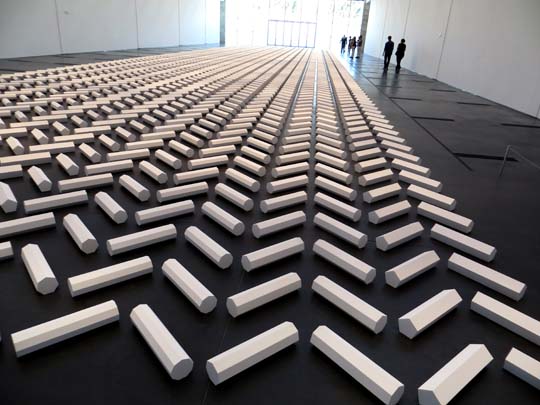
Our last stop was on the first floor of the Resnick Pavilion to see the retrospective exhibit of Ken Price sculptures, colorful abstract blobs, some looking like oversized children’s jacks, others like giant hands or paws, as well as imaginative ceramic cups and dinner sets, also very colorful.  The other exhibit on the first floor is Walter De Maria’s The 2000 Sculpture, an assemblage of 2000 white bars in precise rows.
One close-up view of the 2000 Sculpture
The remarkable effect of the exhibit is how it changes with your position.  My husband Art was particularly impressed by the piece and took a series of photos showing the sculpture from different views. His thoughts inspired by the sculpture:  Life is an endless set of new perspectives. If you think you know the drill, then you will discover a different drill. It is within your power to find a new perspective from a reordering of old viewpoints. This will surprise you and others. Your insight and creativity will be praised. 

Streetlamps at Entrance to LACMA
When we moved to Los Angeles more than thirty years ago, the County Art Museum was basically one building.  Gradually, more buildings and more galleries have been added so that now it is a whole complex.  At the entrance on Wilshire Boulevard one walks through a forest of vintage street lamps, collected by artist Chris Burden. On this trip we limited ourselves to viewing just a few exhibits.  Luckily, the museum is not far from where we live so we can go often.

For information about planning a visit to LACMA, go to their website.  The Ed Ruscha, Ken Price and Michael Heizer Actual Size exhibits will be up until January 2013.  The 2000 Sculpture by Walter De Maria will be up until April 1, 2013.