Showing posts with label music. Show all posts

Monday, March 25, 2024

ON TOUR IN EUROPE WITH THE NATIONAL SYMPHONY, 5 CITIES, 14 DAYS--Guest Post by Tom and Susan Weisner

The Elbphilharmonie, Hamburg Symphony Hall, Germany.

Our friends, Susan and Tom Weisner, went along with their son Jeffrey and granddaughters and family on a tour of Europe with the National Symphony in February 2024. Jeff plays the double bass in the National Symphony Orchestra (NSO) in Washington, DC. Seven flights, six train trips, and many bus transfers later, here are some highlights from five cities along the way of the 14-day tour.

La Sagrada Familia, Barcelona, Spain--still under construction.

Mercado de la Boqueria, Barcelona.

First stop, Barcelona, Spain, capital of the Catalan region of Spain. The Antoni Gaudi designed and imagined La Sagrada Familia Cathedral is a highlight, as is the Ramblas walking street off of Catalan Square, and the Mercado de la Boqueria open market.

View of Toledo, Spain.

The Gothic style cathedral, Toledo, dates from the 1200s.

The narrow streets of Toledo--cathedral dimly visible in background.

We then took a train to Madrid, and a half day train ride and tour of Toledo – a wonderful historic Spanish city about 40 minutes from Madrid.

Berlin Wall Museum.

We all then flew to Berlin with the NSO. We visited the cold war era Berlin Wall museum and model of the former “Checkpoint Charlie” crossing; the new glass dome on the German Parliament or Reichstag Building, and the Holocaust memorial site near the Brandenburg Gate. 
In Berlin we toured the new German Parliament glass dome which looks directly into the parliament chamber.

Holocaust Memorial, Berlin.

We also took our granddaughters to the Computer Games Historical Museum in the former East Berlin on the Karl Marx Allee, the Illusions museum, and the Spy Museum (sorry, no photos)! There are huge shopping and walking streets and parks in Berlin as well. The rest of the family flew home from Berlin – school and work!

In Cologne, on the way to the train station.

Next Susan and I took the train to Cologne, Germany, where we met up again with the orchestra, and went to a concert in their  beautiful concert hall. We then took the train for one day to Kassel, Germany, for a brief visit, where Tom’s father and grandparents had lived until they fled Hitler in 1938.

La Scala, Milan, Italy.

The NSO chartered a plane to Milan, Italy, to play a concert at La Scala for one night. The La Scala experience was great, but no time for anything else to see in Milan, because we flew the next morning to Hamburg, Germany, the last stop on the tour. We and the NSO stayed at the Elbphilharmonie, an amazing new building. (See first photo.) The Elbphilharmonie in Hamburg, Germany, which opened in 2017 with multiple concert halls and hotel all built on top of an existing former warehouse. The hotel is in the building with the symphony halls, and the public can walk up to see the views of the city.

Concert hall, Hamburg.

The Brahms Music Museum in Hamburg, Germany. Can you name the seven famous composers?

Inside the Brahms Music Museum.

Many thanks to Susan and Tom for sharing highlights of their trip with The Intrepid Tourist!

Monday, November 18, 2019

VIENNA, AUSTRIA: Art, Food and Music

Vienna, Austria. Saint Stephen's Cathedral
Why go to Vienna? The answer is easy--the food, the music, the art and architecture. Vienna, center of the former Austro-Hungarian Empire, is still one of Europe’s great capital cities. The glory of its powerful past is reflected in the magnificence of its churches, public buildings, and surrounding parks and plazas. Large and impressive, they form the heart of the city center. Most are constructed of white stone and they tower over plazas and courtyards. In typical Baroque fashion, every ledge, parapet and rooftop is decorated with some sort of statuary.
Ceiling in the foyer of the Vienna Opera House
In early October we spent two days in Vienna with our friends from Berlin, who had been there before and showed us around. (This was our first time in Vienna.) We enjoyed great music ( La Boheme at the sumptuous Vienna opera house, the Haydn Quartet playing in the Brahms Hall at the Vienna Musikverein, and a concert of Vivaldi’s Four Seasons at St. Stephen’s Cathedral.)
Vienna is famous for its pastries, most notably Sachertorte, a chocolate cake originally made at the Sacher Hotel
In between, we toured the historic sights of this beautiful city and feasted on schnitzel and other Viennese delights. At our last supper together on Saturday night, I ordered marmeladepalatschinken--a very close relative of the egg pancakes made by Art's grandmother, and just as delicious.
One of the many buildings of the Hofburg Palace complex
Our first day was bright and sunny (although crisp!)--perfect for a walking tour of the city. We joined a small group with an English speaking guide at the Vienna tourist center, and she led us through the labyrinth of streets of the inner city, filling us in on the historic significance of the buildings.
The Baroque Karlskirche (Church of St. Charles)
We woke up to rain on our second day in Vienna, but since our main activity was planned for inside--a trip to see the Red Vienna exhibit--the rain didn’t matter, except that, instead of walking, we took a trolley around the “ring” to the museum. The Ringstrasse is a circular grand boulevard that serves as a ring road around the historic inner district of Vienna. The road is located on sites where medieval city fortifications once stood, including high walls and the broad open field ramparts, criss-crossed by paths that lay before them.
For our visit to Vienna we stayed in the Beethoven Hotel, conveniently located just outside the center of the city. (Vienna's musical history was evident everywhere--we ate breakfast at the Mozart Cafe (coffee, fresh rolls, hard boiled egg), saw statues of Wagner and other composers at the opera house, and visited the church where Haydn performed.) Our stay in Vienna was short but full and we saw a lot. Here are pictures of a few of the many highlights:
Augustinerkirche. In 1634, the Augustinerkirche became the parish church of the imperial church. Many Habsburg weddings took place there. The hearts of 54 members of the royal family are held in special urns in the Herzgruft, or “Heart Room,” in St. George’s Chapel of the Augustinerkirche
One of the Lipizzaner horses going to morning exercise and training for performances in the Winter Riding School at Hofburg Palace.
Royal crown on display at the Emperor's Treasures Museum, a collection of the Habsburg family jewels and other treasures. My favorite treasure was a giant narwhal tusk, once believed to be a unicorn's horn.
The Virgilkapelle, dating back to 1220-1230, was discovered when digging for a new subway in 1973. It has been preserved and has a small museum.
A sampling of delicacies at Meinls Gourmet Nacht, a delicatessen. Upstairs is a restaurant where we had a delicious lunch overlooking the center promenade of Vienna's commercial area.
Inside Saint Stephen's Cathedral at night.
Das Rote Wien (Red Vienna) documents the period of time of social reform in housing, education, health and community life, beginning with the first free elections in 1919. The Social Democratic Labor Party emerged with an absolute majority, creating the possibility to implement many of their ideas from before the First World War, helping to improve the living conditions of the working class.
One of the exhibits at the Vienna Museum. For more about the exhibit click HERE. The photographs, models, books and other objects in the exhibit are all well labelled in both German and English.


Monday, July 15, 2019

FIVE DAYS IN ROME, Part 2: Guest Post by Paige Arnold


Bike riding on the Appian Way, Rome, Italy
My granddaughter Paige (age 13) and her parents recently went on a trip to Rome, and while she was there Paige kept a diary of their activities. Paige is a competitive swimmer, so although she was on vacation, she tried to fit in practice when she could. I thank her for sharing her thoughts and photos of the trip with The Intrepid Tourist. 

On our third day in Rome we went to the Borghese Gallery, but since we had tickets to go at 3:00, we decided to go to another museum first. It was a museum of musical instruments, which had many pianos and harps and such from a long, long time ago.
Harpsichord at the National Museum of Musical Instruments, Rome.
I really liked how the pianos and organs had paintings and art on the covers--it just made them that much prettier.  After that we went home for about ten minutes and then walked to the Borghese museum.  
Ceiling paintings in one of the twenty rooms of the Borghese Gallery.
At the Borghese Gallery, there were many beautiful statues and paintings and lots of rooms to wander through and look at things.   

Stone sculpture of person carrying a lion pelt (Borghese Gallery)
There was an app you could download to experience an audio tour that guided you through the rooms, which gave you a detailed explanation of the important pieces.  Since lots of people were using the audio tour, it was very quiet for those who didn’t, which was nice. 
Villa Borghese Park
There was also a park behind the museum with statues and trees, and we found that walking through it was very enjoyable.  For lunch, we had gotten sandwiches before, so when we got home we just ate those.  The sandwich place we went to was a “make your own” place, but it was a bit difficult since we didn’t know Italian.  They cut the meat right in front of us with one of those sharp spinning metal wheels, which was fascinating to watch.  After eating lunch, we relaxed for a while then went out to dinner at the same place that we had gone to the first day.  

The fourth day, I was in charge.  Early in the morning (at least early for me), my dad and I went out to the park near our house for me to draw and for him to take pictures of the Colosseum.  We spent about thirty minutes there, and then headed back to get ready to go out for a swim.  This time, we knew exactly which place we were going to and exactly how to get there.  We arrived, I swam for a bit, and then we went home.  I wanted a bit of a relaxing day, so we spent the rest of our day in the apartment, and ate a measly dinner that we managed to put together from the ingredients already in the kitchen.   
Bike riding past ancient ruins on the Appian Way
The last day, we woke up late and went on a bike ride on the Appia Antica road, which is the ancient road that connected Rome to Brindisi (also known as the Appian Way.)  It was a very bumpy ride, since the road was paved with cobblestone. On the way back, we stopped at a little restaurant off the side of the road, where the waiter was very kind and talked to us in English about how he used to live in California around where we live. He showed us a book he was mentioned in, and told us lots of stories about the author. In all, the trip was very interesting and it taught me how different Rome is from the U.S.
(Additional photos by Matt Arnold.)
Paige at the Vatican

Monday, December 17, 2018

IRELAND, Part 2: The West and Southwest, Guest Post by Tom and Susan Weisner

Ireland. Irish musicians play in bars and restaurants everywhere!
In September, our friends Tom and Susan Weisner took a driving trip in Scotland and Ireland. They have graciously agreed to share a few of their photos and thoughts about the trip. Here is their report of the second half of their ten days on the road in Ireland.

The Cliffs of Moher in County Clare on the southwest coast of Ireland are beautiful, but incredibly windy and cold. They were a long day’s drive from Galway, where we were staying.
Susan and Tom at the Cliffs of Moher on the Southwest Coast of Ireland
Another beautiful day's drive was to Roundstone, Ireland, a small village along the Connemara District coastal drive outside of Galway. 
Shop in Roundstone, Ireland, with Irish music, crafts, blankets and wool weaving.
It was a good place for crafts and gift shopping--like this place for example.
Beer, books, eggs, marble, wool, for sale!
The Ring of Kerry is a beautiful all-day drive around the southwest coast, departing from the town of Killarney, which is about 2.5 hours drive from Galway. Charlie Chaplin had a place in a small town along the way that he visited all his life. Who knew?!
With Charlie Chaplin statue
Killarney lakes and castle in County Kerry are part of a  Killarney National Park (the first national park in Ireland) and make a beautiful day's outing, with walks to ruins of Abbeys and the lake itself.
Killarney
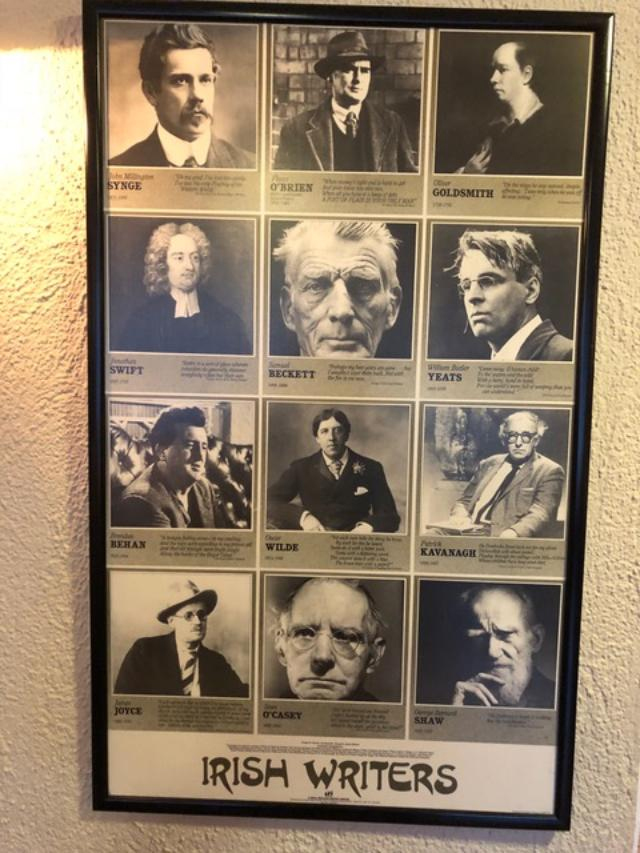
Did we mention the importance of Irish writers to be found in restaurants, bars, hotels? In a lovely Irish restaurant at our last stop, the town of Kilkenny, southwest of Dublin, we saw this poster.
Some Famous Irish Writers
Here are some of the beautiful Irish throws, blankets, scarves and Irish music CDs that we brought back home in the extra suitcase we had to buy!

Beautiful Irish textiles
Many thanks to Tom and Susan for sharing the highlights of their Scotland/Ireland trip!

Monday, May 2, 2016

PHOENIX, ARIZONA: MUSICAL INSTRUMENT MUSEUM – Guest Post by Caroline Hatton


Miniature glass orchestra from Murano, Italy, at the Musical Instrument Museum, Phoenix, AZ
My friend and fellow children’s book writer Caroline Hatton visited the Musical Instrument Museum in Phoenix in April of 2016 and sent me this fascinating report along with a few of her photos.

Phoenix had long been on my list of weekend getaway destinations because I wanted to visit Taliesin West, which was the winter residence of legendary American architect Frank Lloyd Wright. When the trip became reality, I wondered, what else is there to see or do? Online search results pointed me to the Musical Instrument Museum.
Burmese wooden string instrument
Normally I spend no more than one or two hours in a museum before I get saturated. Therefore, I was stunned by the fact that I spent three hours at the MIM and delighted by how much I enjoyed it.

Afri-can guitar made by recycling a car-engine-oil can

The museum includes the following:
- Geographic Galleries (with displays organized by continent and country)
- a Mechanical Music Gallery
- an Artist Gallery (about individual performers)
- a gallery for special exhibitions (you have to pay extra to see it)
- an Experience Gallery (where you can experience the noise made by kids pounding drums—those in the room and those in your ears)
- a Conservation Lab (where experts repair instruments)
- a Store


In the geographic area, I was most attracted to the displays about a few countries to which I have an emotional attachment based on personal history. I went straight to the exhibit on Mongolia, because my heart still lingers there, galloping on a spirited horse over the infinite steppe under the eternal blue sky, after a trip of a lifetime there less than a year ago. Like the displays on other countries, the one about Mongolia featured traditional instruments and costumes, engaging photos and paragraphs, and captivating video clips of songs, dances, and instrumental music.

Left to right: Fiddle horse heads from Inner Mongolia (China), Mongolia, and Kazakhstan
The Mongols prize their horses, so it’s no wonder they make and play a horse-head fiddle with horse hair strings called morin khuur, decorated at the top with a horse’s head sculpted out of wood, ready to get your pulse pounding with the intoxicating rhythm of hoof beats racing the wind. I looked for other horse-head instruments made by Mongols living in neighboring countries and found examples from Inner Mongolia (the part of China just south of Mongolia) and Kazakhstan (west of Mongolia).


New Zealand Maori trumpet used as a megaphone to shout insults at enemies
The world-wide diversity of instrument types, materials, designs, sounds, uses, and the emotional impact of their music on me was mind-blowing. So many things were so much fun to discover! I loved hearing Australian country singer Slim Dusty croon about his father Noisy Dan, and watching a wedding party in New Zealand perform a Maori haka (traditional ancestral war dance and cry). Other memorable examples appear in my photos.

Malaysian nose flute

I did not spend much time in galleries other than the geographic ones. The most interesting part of the Allegro Cafe, for me, was the courtyard cacti and succulents, not to eat, but to photograph.
Since I saw less than half of what the MIM offers, I’ll go back if I ever return to Phoenix. To broaden my horizons beyond horse’s heads, I’ll look for all the instruments that include horse hair as strings or decorations.