Showing posts with label Tom and Susan Weisner. Show all posts

Monday, March 25, 2024

ON TOUR IN EUROPE WITH THE NATIONAL SYMPHONY, 5 CITIES, 14 DAYS--Guest Post by Tom and Susan Weisner

The Elbphilharmonie, Hamburg Symphony Hall, Germany.

Our friends, Susan and Tom Weisner, went along with their son Jeffrey and granddaughters and family on a tour of Europe with the National Symphony in February 2024. Jeff plays the double bass in the National Symphony Orchestra (NSO) in Washington, DC. Seven flights, six train trips, and many bus transfers later, here are some highlights from five cities along the way of the 14-day tour.

La Sagrada Familia, Barcelona, Spain--still under construction.

Mercado de la Boqueria, Barcelona.

First stop, Barcelona, Spain, capital of the Catalan region of Spain. The Antoni Gaudi designed and imagined La Sagrada Familia Cathedral is a highlight, as is the Ramblas walking street off of Catalan Square, and the Mercado de la Boqueria open market.

View of Toledo, Spain.

The Gothic style cathedral, Toledo, dates from the 1200s.

The narrow streets of Toledo--cathedral dimly visible in background.

We then took a train to Madrid, and a half day train ride and tour of Toledo – a wonderful historic Spanish city about 40 minutes from Madrid.

Berlin Wall Museum.

We all then flew to Berlin with the NSO. We visited the cold war era Berlin Wall museum and model of the former “Checkpoint Charlie” crossing; the new glass dome on the German Parliament or Reichstag Building, and the Holocaust memorial site near the Brandenburg Gate. 
In Berlin we toured the new German Parliament glass dome which looks directly into the parliament chamber.

Holocaust Memorial, Berlin.

We also took our granddaughters to the Computer Games Historical Museum in the former East Berlin on the Karl Marx Allee, the Illusions museum, and the Spy Museum (sorry, no photos)! There are huge shopping and walking streets and parks in Berlin as well. The rest of the family flew home from Berlin – school and work!

In Cologne, on the way to the train station.

Next Susan and I took the train to Cologne, Germany, where we met up again with the orchestra, and went to a concert in their  beautiful concert hall. We then took the train for one day to Kassel, Germany, for a brief visit, where Tom’s father and grandparents had lived until they fled Hitler in 1938.

La Scala, Milan, Italy.

The NSO chartered a plane to Milan, Italy, to play a concert at La Scala for one night. The La Scala experience was great, but no time for anything else to see in Milan, because we flew the next morning to Hamburg, Germany, the last stop on the tour. We and the NSO stayed at the Elbphilharmonie, an amazing new building. (See first photo.) The Elbphilharmonie in Hamburg, Germany, which opened in 2017 with multiple concert halls and hotel all built on top of an existing former warehouse. The hotel is in the building with the symphony halls, and the public can walk up to see the views of the city.

Concert hall, Hamburg.

The Brahms Music Museum in Hamburg, Germany. Can you name the seven famous composers?

Inside the Brahms Music Museum.

Many thanks to Susan and Tom for sharing highlights of their trip with The Intrepid Tourist!

Monday, September 21, 2020

16 DAYS IN MOROCCO, Part 2: Guest Post by Tom and Susan Weisner

Fez, Morocco.
Our friends Tom and Susan Weisner went on a tour of Morocco last year and have kindly agreed to share a few of their wonderful photos and memories of the trip. Part 1 posted last week. This is Part 2.
Our guide.
Our trip to Morocco was  part of a group tour organized by Reed College, where Tom was a student in the 1960s. There were 15 in our group, including Paul Silverstein, an anthropologist who teaches at Reed and who does fieldwork in Morocco. We had a great Moroccan guide too!

Fes
Rug merchants, Fes.
Susan dressed up inside a weaving store somewhere in the souk.
Fes is the second largest city in Morocco, 1.4 million, historic cultural center, former capital until 1912. Souk (market) and Medina (old quarter) of Fez is a World Heritage site –a huge, endless twisting world inside!
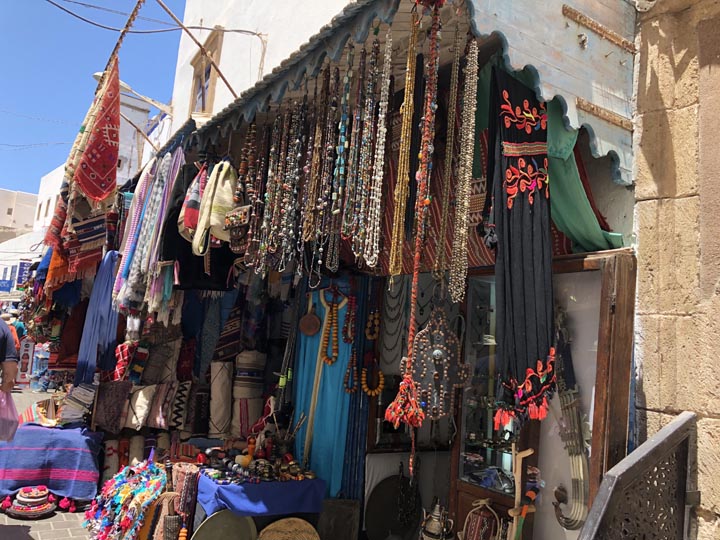
Want some rugs, slippers, shoes, jewelry, DATES, weaving and cloth - or about any other thing you could think of? It’s in some alley somewhere. But just  try and find your way back out!

Berber Villages (Meknes-Tafilalet)
Our group had lunch in a Berber village.
Two friends in our small tour group playing dress-up inside the Berber village.
Paul Silverstein, Reed anthropologist, did field research in this Berber area in the South near the Atlas Mountains. This led to side events such as Paul taking Tom to meet Moroccan informants of his, journalists, etc. He took our group into enclosed walled villages (Meknes-Tafilalet) and we had lunch inside – tea in a field basically. Awesome. There was a small “museum" inside as well.

 Ouarzazate
Ouarzazate, nicknamed the "door of the desert"
Our “rock” hotel was like a fort!
Ouarzazate is a historic city in the Southern Berber area in Morocco, in the High Atlas Mountains. Gateway to the Sahara desert to the South. Famous “Kasbah” there. It was also turned into a location site for making movies with an exotic, middle east/desert setting (Gladiator; Game of Thrones, etc.).
Ksar of Ait-Ben-Haddou outside Ouarzazate in the walled Berber communities of the South of Morocco.
Then driving over the Atlas Mountains – steep, curvy. Susan loved it. (Not really.)

Marrakech
Marrakech market square
The VAST main market square famous in Marrakech; we spent several hours there. There is a huge souk (bazaar or marketplace) surrounding it.
Susan bought some green plates here.
Susan and Tom with camel.
Yes; there are camels but this is just at a tourist rest stop where you could take a picture with one. We never got near any actual desert oasis with camels. There are stray cats EVERYWHERE.
We all got various stomach problems in Morocco. There was a Burger King near our hotel in Marrakech. An exotic one, of course, but just what we needed. We got dinner there. Mmmmmmm.

Essaouira
Essaouira is on the Atlantic coast of Morocco. It is a beautiful city – historic French and colonial. 
One of the many shops in the Essaouira medina. (Medina is an old Arab word for the non-European part of a North African city.)
Viagra for men and women available in the Medina..
Susan sees a totally torn up violin in a case at a museum in Essaouira.
And yes, there are goats that climb in the trees and eat stuff along the roads….
 For Part 1 of 16 DAYS IN MOROCCO, see the post for 9/14/20..

Monday, September 14, 2020

16 DAYS IN MOROCCO, Part 1: Guest Post by Tom and Susan Weisner

Chechaouen, "The Blue City", Morocco
Our friends Tom and Susan Weisner went on a 16 day tour of Morocco in June 2019 and have kindly agreed to share a few of their wonderful photos and memories of the trip. This is Part 1. Part 2 will post next week.

Our trip to Morocco was part of a group tour organized by Reed College, where Tom was a student in the 1960s. There were fifteen in our group, including Paul Silverstein, an anthropologist who teaches at Reed and who does fieldwork in Morocco. We had a great Moroccan guide too!

Rabat, Capital of Morocco
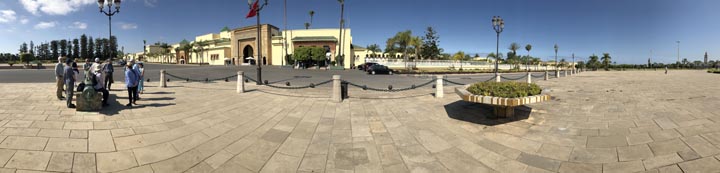
Palace near Rabat.
Morocco is a kingdom with some parliamentary government. This is the palace near Rabat. There are other palaces as well.
Rabat fort and inner city at night.
The tomb of Mohammad VI (former king) is in Rabat. Rabat has a huge market in old city walls with narrow streets.

Casablanca, the largest city in Morocco
Susan and Tom at the mosque in Casablanca.
King Hassan II built the second largest mosque in the world in Casablanca (Mecca is #1). It is marble, vast, on the Atlantic coast. Non-Muslims can only enter as part of an official tour.
Typical Moroccan dish.
A beautiful restaurant.
We enjoyed wonderful food! Tajines! (Tajine dishes are slow-cooked savory stews, typically made with sliced meat, poultry or fish together with vegetables or fruit.)
Synagogue
Hundreds of thousands of Jews once lived in Morocco, but most left during and after WWII, going to Israel, Europe and elsewhere. Morocco does not recognize Israel, but the Israeli passport is recognized since so many from the diaspora do sometimes return. We saw a number of museums and synagogues that are protected. Morocco is about the only Muslim Middle East country that has religious pluralism in the constitution.
Catholic church in Casablanca
There are thousands of black sub-Saharan African immigrants arriving in Morocco, trying to get to Europe. Many are Christian. This is a Catholic Church in Casablanca for them. A very rare sight.

Romans in Morocco: Volubilis, Ancient Roman City near Meknes
Roman ruin with mosaic floor.
The Romans, of course, settled all of North Africa including Morocco. We visited Volubilis near the city of Meknes, for example, an entire former Roman city with over 40K inhabitants.Volubilis is a World Heritage site.
Ancient Roman Empire included northern portions of Morocco.
Morocco is in the lower left corner of this map in red.

Tangiers
American National Historic Landmark in Tangiers.
A landmark to the American legation is inside the Medina, or interior market in Tangiers. It was the first American government office outside the US. It is also the site of a Paul Bowles museum.
View of Tangiers
Morocco gained independence from France in 1956 and Rabat became the new capital. replacing Tangiers as the capital city. You can see Tangiers city in white in the distance from our beautiful hotel on the Mediterranean. Spain is faintly visible on the far horizon just a few miles away across the Strait of Gibralter.

Chechaouen
Chefchaouen is a city in Morocco that's famous for its blue hue. While it was founded in 1471, it didn't get its distinctive color until 1492, when it received an influx of Jews escaping the Spanish inquisition, who brought a tradition of painting buildings blue.
Chechaouen, the Blue City, is between Tangiers and Meknes.  Beautiful! We saw many stalls and shops as we walked through the narrow alleys everywhere. Lunch and tea there.
Market stall in Chechaouen.
Purses, shoes and more!
Part 2 of 16 DAYS IN MOROCCO will post next week.


Monday, March 30, 2015

GUATAMALA: Lake Atitlan and the Guatamalan Highlands. Guest Post by Tom and Susan Weisner

Local market, Lake Atitlan, featuring tomatoes, corn, onions, avocados, chile verde and other locally grown produce.
A few weeks ago, our friends Tom and Susan Weisner traveled to Guatamala and have graciously shared some of their photos. Tom, an anthropologist at UCLA and specialist in children and families, is on the Board of ChildFund International. The first part of the trip to Guatamala involved visiting families and program sites supported by ChildFund along with other members of the ChildFund Board. In the second part of the trip, Tom and Susan went to Lake Atitlan, staying at the very nice Arca de Noé Hotel and Restaurant in Santa Cruz la Laguna.  This area is rightly famous for its natural beauty and colorful Mayan villages. Tom and Susan visited villages around the lake and took a hike with a local guide. Lake Atitlan is the deepest lake in Central America at 1120 feet. It sits in the caldera of an ancient volcano. The surface of the lake is at an elevation of 5125 feet. Here are a few of Tom and Susan's photos and comments about their trip.
Lake Atitlan. Our breakfast table view from the Arca de Noe Hotel and Restaurant, San Cruz Atitlan. No road circles the lake, so communities are reached by boat or mountain roads.
Santiago Atitlan is the largest community around lake Atitlan and is noted for its worship of Maximon, a Mayan saint-healer. An effigy of Maximon is carried through the streets during Santa Semana (Holy Week).
Back-strap weaving cooperative, San Juan la Laguna, Guatemala. Lake Atitlan is surrounded by many villages in which Maya culture is still prevalent and traditional dress is worn.
Susan with pictures of plants and fruits used to dye fibers for weaving.
Susan showing photos of our grandchildren to a local Mayan family, Guatamalan Highlands.
Mural showing a bone setter healing a youth, Lake Atitlan.
Our lovely hotel room at the Arca de Noé Hotel & Restaurant overlooking Lake Atitlan, Guatemala.
Tom enjoying breakfast. A typical breakfast at the hotel was veggie omelets with tacos and local bread and coffee.