|
| Chechaouen, "The Blue City", Morocco |
Our friends Tom and Susan Weisner went on a 16 day tour of Morocco in June 2019 and have kindly agreed to share a few of their wonderful photos and memories of the trip. This is Part 1. Part 2 will post next week.
Our trip to Morocco was part of a group tour organized by Reed College, where Tom was a student in the 1960s. There were fifteen in our group, including Paul Silverstein, an anthropologist who teaches at Reed and who does fieldwork in Morocco. We had a great Moroccan guide too!
Rabat, Capital of Morocco
 |
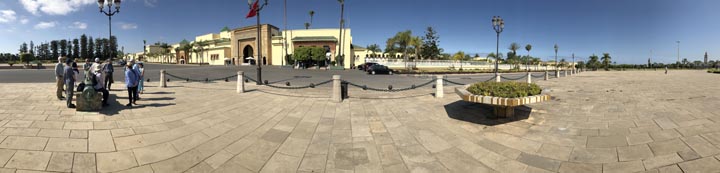
| Palace near Rabat. |
Morocco is a kingdom with some parliamentary government. This is the palace near
Rabat. There are other palaces as well.
 |
| Rabat fort and inner city at night. |
The tomb of Mohammad VI
(former king) is in Rabat. Rabat has a huge market in old city
walls with narrow streets.
Casablanca, the largest city in Morocco
 |
| Susan and Tom at the mosque in Casablanca. |
King Hassan II built the second largest mosque in the world in
Casablanca (Mecca is #1). It is marble, vast, on the Atlantic coast. Non-Muslims can only enter as part of an official tour.
 |
| Typical Moroccan dish. |
 |
| A beautiful restaurant. |
We enjoyed wonderful food! Tajines! (
Tajine dishes are slow-cooked savory stews, typically made with sliced meat, poultry or fish together with vegetables or fruit.)
 |
| Synagogue |
Hundreds of thousands of Jews once lived in Morocco, but most left during and after WWII, going to Israel, Europe and elsewhere. Morocco does not recognize Israel, but the Israeli passport is recognized since so many from the diaspora do sometimes return. We saw a number of museums and synagogues that are protected. Morocco is about the only Muslim Middle East country that has religious pluralism in the constitution.
 |
| Catholic church in Casablanca |
There are thousands of black sub-Saharan African immigrants arriving in Morocco, trying to get to Europe. Many are Christian. This is a Catholic Church in Casablanca for them. A very rare sight.
Romans in Morocco: Volubilis, Ancient Roman City near Meknes
 |
| Roman ruin with mosaic floor. |
The Romans, of course, settled all of North Africa including Morocco. We visited
Volubilis near the city of Meknes, for example, an entire former Roman city with over 40K inhabitants.Volubilis is a World Heritage site.
 |
| Ancient Roman Empire included northern portions of Morocco. |
Morocco is in the lower left corner of this map in red.
Tangiers
 |
| American National Historic Landmark in Tangiers. |
A landmark to the American legation is inside the Medina, or interior market in
Tangiers. It was the first American government office outside the US. It is also the site of a Paul Bowles
museum.
 |
| View of Tangiers |
Morocco gained independence from
France in 1956 and Rabat became the new capital. replacing Tangiers as the capital city. You can see Tangiers city in white in the distance from our
beautiful hotel on the Mediterranean. Spain is faintly
visible on the far horizon just a few miles away across the Strait of Gibralter.
Chechaouen
 |
| Chefchaouen is a city in Morocco that's famous for its blue
hue. While it was founded in 1471, it didn't get its distinctive color
until 1492, when it received an influx of Jews escaping the Spanish
inquisition, who brought a tradition of painting buildings blue. |
Chechaouen, the Blue City, is between Tangiers and Meknes. Beautiful! We saw many
stalls and shops as we walked through the narrow alleys everywhere.
Lunch and tea there.
 |
| Market stall in Chechaouen. |
 |
| Purses, shoes and more! |
Part 2 of 16 DAYS IN MOROCCO will post next week.