
Pre-Incan ruin at Tiwanaku, Bolivia
With many thanks to our friend Owen Floody for another exceptional contribution to The Intrepid Tourist.
No, I didn’t see Butch Cassidy or the Sundance Kid, but I did visit the area in which they disappeared on Bolivia!, a June 2024 trip run by Wilderness Travel and expertly led by Andrea Heckman and Danny Viveros. The trip was challenging due to low temperatures and high altitudes (9,500-16,400 feet). But our efforts were repaid by outstanding landscapes and a wide range of historical and cultural experiences extending from pre-Incan ruins to cutting edge Bolivian foods and wines.
The tour began in La Paz, where we struggled to adjust to the altitude and “Incan” slopes and steps. We soared above the city on its impressive cable-car system and explored Old Town areas including the Sagarnaja artisan district and “witches’ market.” But the high point was a day at Tiwanaku, a pre-Incan (peaking in 500-950 AD) ruin between La Paz and Lake Titicaca.
From La Paz, we flew to Sucre, the main streets of which were busy hosting an auto race. Our activities here included visits to the fine ASUR Museum of Indigenous Arts and Casa de la Libertad, an important site in Bolivia’s struggle for independence. Inspired by the beautiful textiles in the museum, we escaped the car races by traveling to the nearby town of Maragua, where we had a delightful visit with a local weaver.
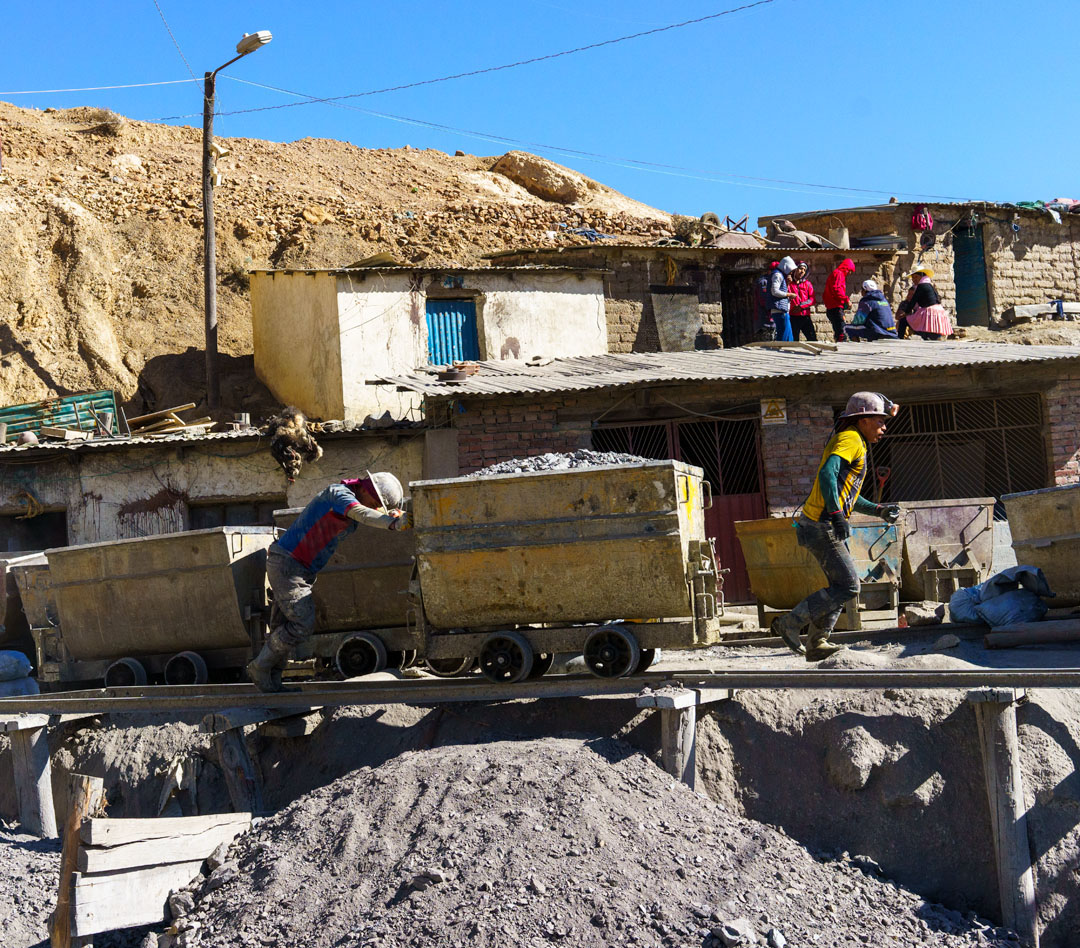 |
| Silver mining at Potosi, Bolivia. |
From Sucre, a long drive took us to Potosi. The first thing that any visitor to Potosi notices is the city’s dominance by hulking Cerro Rico (Rich Mountain). This dominance extends far beyond first impressions. From the 1545 discovery of silver here, the resulting mines made Potosi rich and bankrolled the Spanish empire for hundreds of years: In the 16th – 18th centuries, it is estimated that 80% of the world’s silver came from Cerro Rico. Mining continues, though the diminished return requires effort (note the young miners straining and running) and exacts significant health tolls.
Though the highlight of our stop in Potosi was a visit to a still-active mine, a close second was a tour of the National Mint. On display here are some of the huge wooden mule-driven machines used to press silver ingots into sheets for coin stamping. While these and sample products might be expected at such a site, a lovely chapel and some interesting religious art were more surprising. Perhaps the most memorable of the latter was La Virgen del Cerro, a painting in which the central figure’s shape mimics that of Cerro Rico.

 |
| The Salar (salt flats) |
The next phase of the trip was my favorite. This took us to the Salar de Uyuni and Eduardo Avaroa National Reserve. The first is the largest salt flat on earth, extending over 4100 square miles. It is flat, flat, flat and white, white, white, punctuated just occasionally by rocky “islands” that are impossible to judge for size or distance due to the lack of familiar landmarks. Despite, or perhaps because of, its uncompromising uniformity, it is a fascinating landscape.
 |
| Laguna Colorado |
Other than the Salar, some of the sites we visited on this leg included a train “cemetery” in Uyuni, a cave near Colchani containing mummified human remains dating back many (possibly 3000) years, a field of fancifully shaped rocks, a thermal area, and a series of colored lakes, some sporting flamingos. Among the lakes, the most impressive was the famous Laguna Colorado (Red Lake).
 |
| Night sky, Bolivia |
One of the outstanding characteristics of this area is its isolation. This reduces light pollution, making it an ideal site for night-sky photography. I made one such effort from a vantage point just 20 yards from our hotel. Whether for photography or not, any visitor to this area must step outside at night and look up!
 |
| Isla del Sol at Lake Titicaca |
Finally, it was on to our last stop, Lake Titicaca. On the way, we enjoyed the blessing of new cars at the Copacabana cathedral. But our focus was the lake and its major islands, the Isla del Sol and Isla del Luna (Islands of the Sun and Moon), both of which offer impressive Incan ruins. On the Isla del Luna, the major site is the Temple of the Virgins, dedicated to the Virgins of the Sun. A striking aspect of this is its division into chambers, each presumed to have been the residence of a woman living on the island.
 |
| View of Lake Titcaca from Isla del Sol |
The Isla del Sol gave us wonderful (though not always welcome) exercise: Those Incan steps again. But it also exposed us to what I thought was the most impressive of the Incan ruins we encountered. These included a beautifully constructed road, an altar that may have been the single holiest site in the Incan empire, and an extensive complex of buildings called El Laberinto (The Labyrinth). It is hard to imagine a structure that better combines beauty in structure and location. Apparently, the Incans appreciated a good view.
So maybe the Incan steps were worth the effort after all.


