Showing posts with label Inca. Show all posts

Monday, July 8, 2024

BOLIVIA: Inca Ruins, Salt Flats and More, Guest Post by Owen Floody

Pre-Incan ruin at Tiwanaku, Bolivia

With many thanks to our friend Owen Floody for another exceptional contribution to The Intrepid Tourist.

No, I didn’t see Butch Cassidy or the Sundance Kid, but I did visit the area in which they disappeared on Bolivia!, a June 2024 trip run by Wilderness Travel and expertly led by Andrea Heckman and Danny Viveros. The trip was challenging due to low temperatures and high altitudes (9,500-16,400 feet).  But our efforts were repaid by outstanding landscapes and a wide range of historical and cultural experiences extending from pre-Incan ruins to cutting edge Bolivian foods and wines.

The tour began in La Paz, where we struggled to adjust to the altitude and “Incan” slopes and steps.  We soared above the city on its impressive cable-car system and explored Old Town areas including the Sagarnaja artisan district and “witches’ market.” But the high point was a day at Tiwanaku, a pre-Incan (peaking in 500-950 AD) ruin between La Paz and Lake Titicaca.

From La Paz, we flew to Sucre, the main streets of which were busy hosting an auto race. Our activities here included visits to the fine ASUR Museum of Indigenous Arts and Casa de la Libertad, an important site in Bolivia’s struggle for independence. Inspired by the beautiful textiles in the museum, we escaped the car races by traveling to the nearby town of Maragua, where we had a delightful visit with a local weaver.
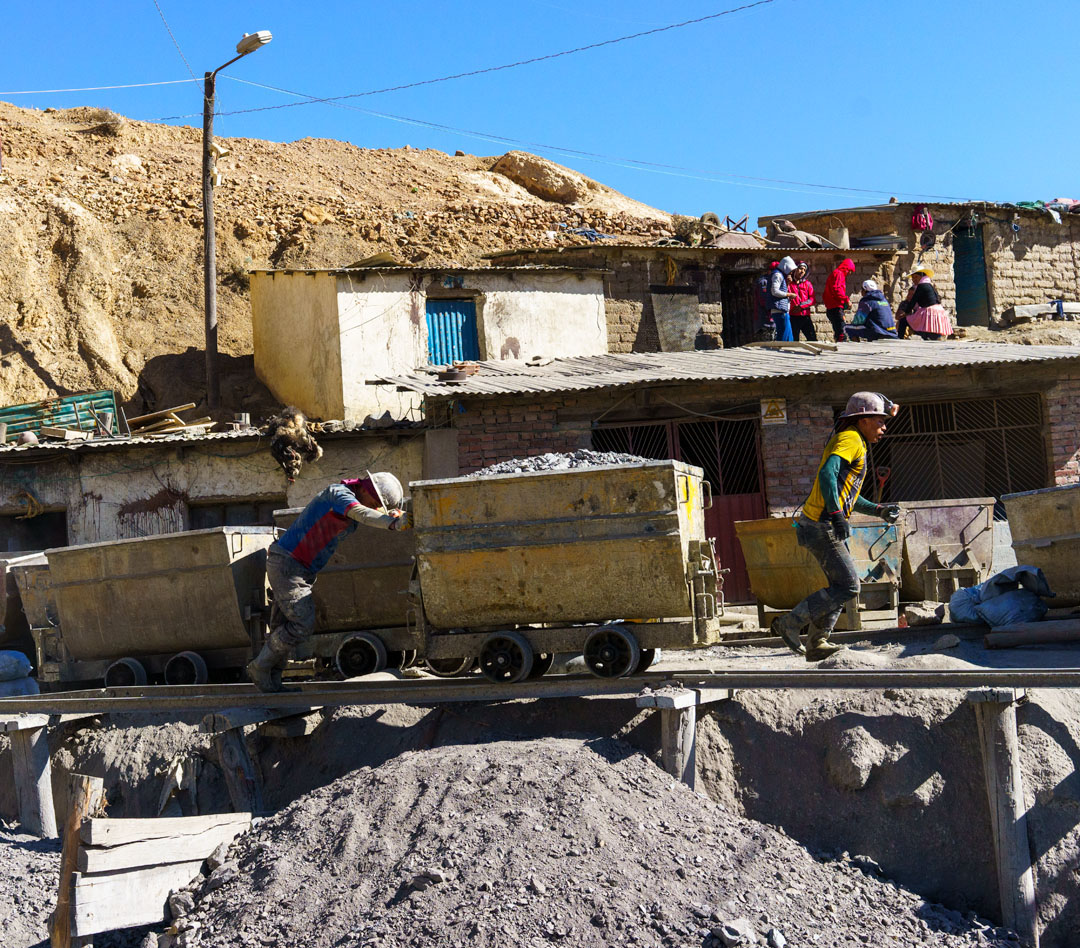
Silver mining at Potosi, Bolivia.

From Sucre, a long drive took us to Potosi.  The first thing that any visitor to Potosi notices is the city’s dominance by hulking Cerro Rico (Rich Mountain). This dominance extends far beyond first impressions. From the 1545 discovery of silver here, the resulting mines made Potosi rich and bankrolled the Spanish empire for hundreds of years: In the 16th – 18th centuries, it is estimated that 80% of the world’s silver came from Cerro Rico.  Mining continues, though the diminished return requires effort (note the young miners straining and running) and exacts significant health tolls.

Though the highlight of our stop in Potosi was a visit to a still-active mine, a close second was a tour of the National Mint.  On display here are some of the huge wooden mule-driven machines used to press silver ingots into sheets for coin stamping. While these and sample products might be expected at such a site, a lovely chapel and some interesting religious art were more surprising. Perhaps the most memorable of the latter was La Virgen del Cerro, a painting in which the central figure’s shape mimics that of Cerro Rico.


The Salar (salt flats)

The next phase of the trip was my favorite.  This took us to the Salar de Uyuni and Eduardo Avaroa National Reserve. The first is the largest salt flat on earth, extending over 4100 square miles. It is flat, flat, flat and white, white, white, punctuated just occasionally by rocky “islands” that are impossible to judge for size or distance due to the lack of familiar landmarks.  Despite, or perhaps because of, its uncompromising uniformity, it is a fascinating landscape.

Laguna Colorado

Other than the Salar, some of the sites we visited on this leg included a train “cemetery” in Uyuni, a cave near Colchani containing mummified human remains dating back many (possibly 3000) years, a field of fancifully shaped rocks, a thermal area, and a series of colored lakes, some sporting flamingos.  Among the lakes, the most impressive was the famous Laguna Colorado (Red Lake). 

Night sky, Bolivia

One of the outstanding characteristics of this area is its isolation.  This reduces light pollution, making it an ideal site for night-sky photography. I made one such effort from a vantage point just 20 yards from our hotel.  Whether for photography or not, any visitor to this area must step outside at night and look up!

Isla del Sol at Lake Titicaca

Finally, it was on to our last stop, Lake Titicaca.  On the way, we enjoyed the blessing of new cars at the Copacabana cathedral.  But our focus was the lake and its major islands, the Isla del Sol and Isla del Luna (Islands of the Sun and Moon), both of which offer impressive Incan ruins. On the Isla del Luna, the major site is the Temple of the Virgins, dedicated to the Virgins of the Sun. A striking aspect of this is its division into chambers, each presumed to have been the residence of a woman living on the island.

View of Lake Titcaca from Isla del Sol

The Isla del Sol gave us wonderful (though not always welcome) exercise: Those Incan steps again.  But it also exposed us to what I thought was the most impressive of the Incan ruins we encountered.  These included a beautifully constructed road, an altar that may have been the single holiest site in the Incan empire, and an extensive complex of buildings called El Laberinto (The Labyrinth). It is hard to imagine a structure that better combines beauty in structure and location. Apparently, the Incans appreciated a good view. 

So maybe the Incan steps were worth the effort after all. 

Monday, January 30, 2023

THE IDAHO POTATO MUSEUM: NO SMALL POTATOES, Guest Post by Caroline Hatton at The Intrepid Tourist

Idaho Potato Museum, Blackfoot, Idaho. Many visitors want their photo taken with the big baked potato.

My friend Caroline Hatton, a children’s writer and frequent contributor to this blog, immersed herself in the world of potatoes and took the photos in this post in October 2022.

If you happen to be driving around Idaho, consider visiting the Idaho Potato Museum in the town of Blackfoot, the Potato Capital of the World, on Interstate 15. I spent an hour there enjoying a wealth of information about the humble, yet glorious potato, and admiring the quality of the displays.

Left: 1930s McCormick potato cultivator; Middle: 1930s Oilver one-row pick planter to be pulled by two horses; Right: 1900s sulkey plow to be pulled by two horses.

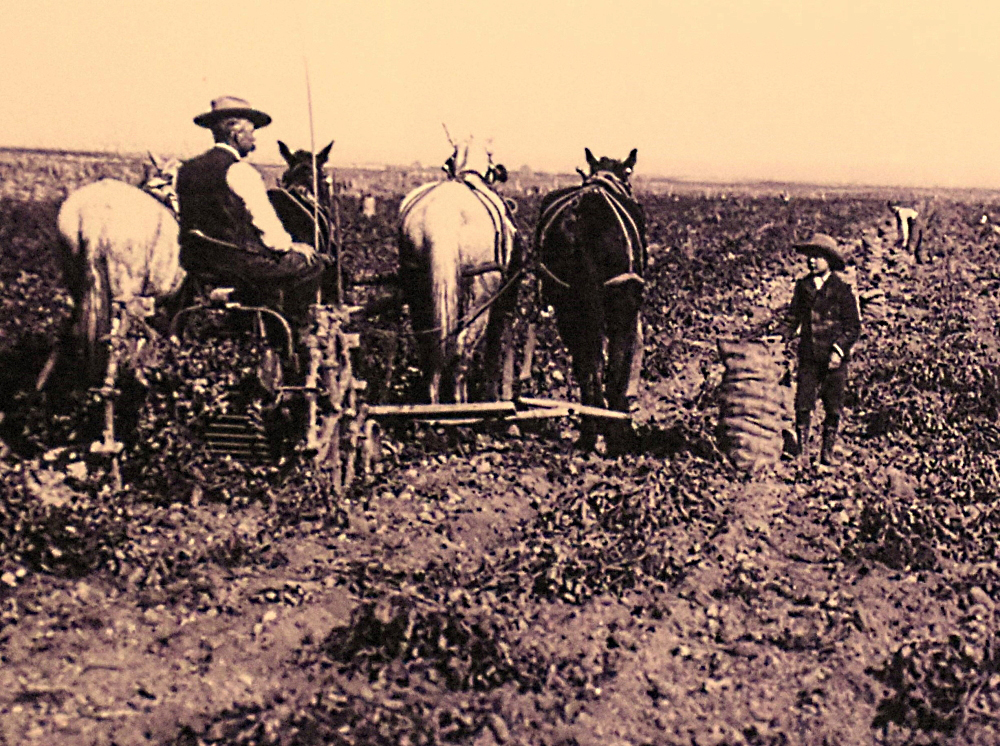
The museum is located in a former train depot, an old building next to railroad tracks. Even before entering, I got to see a number of antique agricultural implements displayed outdoor. Developed by potato growers, the earliest ones were pulled by up to four horses.

1930s Pugh one-row potato harvester to be pulled by two horses.

Besides the fact that I love rust for its look, hints of stories past, and photo opportunities, I had fun visualizing how the contraptions might work. The harvester in the above photo, when pulled forward, would drive the shovel-like front end into the soil, digging up potatoes. As they “climbed” onto the shovel, potatoes dug-up later would push potatoes dug-up earlier toward the back, off the shovel, up a conveyor belt of metal rungs gently sloping up. The bumping and bouncing would perhaps shake dirt off the potatoes. At the top of the conveyor belt, the potatoes would tumble into a larger receptacle.

The potato originated in the Andes in South America, where the Inca potato footplow or chakitailla, was used long before the 15th century and is still in use today.

The museum is small but stuffed with historical, scientific and commercial info. The potato originated in the Andes in South America where native peoples cultivated it around 200 BC. In the 1500s, Spanish conquistadors seeking gold reached Peru. They brought home a treasure: the potato. In the 1600s, it spread through Europe, Africa, China, India, and Russia, and from Ireland to Bermuda, then Virginia. The first recorded potato planting in North America was in Nova Scotia, on the Atlantic coast of Canada, in 1623.

Four horses pull a three-row potato planter designed and built by a grower, around 1935.

Today potatoes are grown in all 50 U.S. states. Idaho offers ideal potato growing conditions: a light volcanic ash soil, aquifer water for irrigation, hot days and cool nights in the summer, and a network of railroads to take potatoes to markets.

Left side: Colorado potato beetle stamps, postcards, and postmarks to educate the public about this pest. Right side:  Stamps featuring a potato merchant (top left) or potatoes.

Irish stamp commemorating the Irish Potato Famine of 1845-1850.

Of some 125 potato-growing countries around the world, the five top producers are China, India, Russia, Ukraine, and the United States. The potato changed the world and made it to Mars, at least in the movie, “The Martian.”

Half of the museum's collection of stove-top potato bakers.

One third of the museum's collection of sour cream dishes.

The museum exhibits include a collection of collections (potato peelers, stove-top bakers, sour cream ceramic dishes, what may well be the largest collection of potato mashers in the world, postage stamps, toys, vintage posters of science activities for children…) and record-setting potato items (such as the largest potato chip ever made, a Pringle listed in the Guinness Book of World Records, and a bronze sculpture replica of the largest potato ever grown in Idaho).

The gift shop sells lots of potato-themed T-shirts, souvenirs (potato peelers), and food items (potato soup or pancake mixes, seasonings). The café serves baked potatoes best ordered hours in advance so they’re ready when you are. It’s a few dollars more for access to the toppings bar, or for the topping of the day for fearless gourmets. For smaller appetites, the menu includes French fries, potato cupcakes and potato ice-cream.

I didn’t eat at the café, but visiting the Idaho Potato Museum inspired me to reminisce about yummy potato dishes I tasted in my travels (such as plokkfiskur in Iceland, a fish and potato casserole) and plan to make them at home (any day now).

All text and photos, copyright Caroline Arnold. www.theintrepidtourist.blogspot.com


Monday, May 13, 2019

MACHU PICCHU: Guest Post by Tom Scheaffer

Machu Picchu, Peru
My brother Tom loves to travel and is a true intrepid tourist. He is currently on a trip to South America, which has included stops in Ecuador, Peru and Paraguay. In Peru he and his friends visited Machu Picchu, the World Heritage ancient Inca site in the Andes. I have never been to Machu Picchu but would love to go some day. Several Intrepid Tourist readers have shared their experiences at Machu Picchu in past articles. I am always impressed that even though the place is the same for everyone, each person's experience is unique, depending on the time of year, the weather, and what they personally bring to the visit. Here are a few of Tom's comments and photos.
 
Today we took the train from Cusco down to Machu Picchu. (The elevation of Cuzco is over 11,000 feet (3399 meters);  the elevation of Machu Picchu is 7,972 feet (2,430 meters) above sea level.)
Taking the train to Machu Picchu
We are staying in a really nice hotel right by the river looking at a beautiful green mountain.

View from the hotel window.
Tomorrow morning we go up to the temple and spend the day hiking around up there.
Machu Picchu, viewed from above. For scale, note the size of the people compared to the ruins.

Machu Picchu was built by the Incas more than 500 years ago. It was part of a large network of settlements throughout the Andes.
A path leads down into the valley below Machu Picchu
Amazingly, no mortar was used for building the walls of Machu Picchu

In 1983, Machu Picchu was declared a UNESCO World Heritage Site.

For more about Machu Picchu, click HERE.

For Owen Floody's report on Machu Picchu (TIT Jan 2, 2017), click HERE.
For Scott Chandler's report on Machu Picchu (TIT Nov 28, 2016), click HERE.

Monday, November 28, 2016

PERU: Lima, Machu Picchu, Cuzco, Guest Post by Scott Chandler

Machu Picchu, Peru
For two weeks in September, Art’s colleague Scott Chandler and his wife Sonja traveled to South America, visiting sites in Peru and in the Galapagos in Ecuador. Scott is an excellent photographer and has graciously given me permission to share some of his photos. Scott's photos were taken with an Olympus digital camera. For more of his photos of this trip and of his other adventures, you can go to his website: www.shcphotography.com/Landscapes . Here is his report on the Peru half of his South America trip. The Galapagos report will post next week.
The Andes
We went to Machu Picchu and the Galapagos September 6 through the 22nd of this year, spending our first week in Peru. We started in Lima then went high up in the Andes where we visited the Sacred Valley.
Machu Picchu
Then we spent a day or so overnight at Machu Picchu and stayed in the famous sanctuary lodge which is fabulous and across the street from the entrance to the ruins.
Cuzco, Plaza de Armas
From there we went to Cuzco, the capital of the Inca empire. We visited numerous archaeological sites and were schooled on how precise they built their structures.
Cuzco at night: Fountain in front of the  Iglesia La Compañía de Jesús
We went on this trip with the tour company Tauck. First part of the trip was on land and we had excellent accommodations and food; the Galapagos part was on a yacht/ship that held 40 people. We would sail during the night to different islands and disembark to visit each island during the morning; the day would also include snorkeling. It is fair to say the trip was totally fantastic. I would love to do it again.
Hats for Sale