Showing posts with label ivory. Show all posts

Monday, August 26, 2024

CLOSE-UP WITH WILDLIFE IN NAIROBI, KENYA: Part 2, Nairobi National Park, Guest Post by Humberto Gutierrez Rivas

Rhinos and Cattle Egrets, Nairobi National Park, Kenya

With many thanks to Humberto Gutierrez Rivas for his report and terrific photos of his family's trip to Kenya last January. His post about their wildlife experiences near Nairobi is in three parts, the first appearing last week, Part 2 today, and Part 3 next week.

This past January our family had the trip of a lifetime to Kenya for 12 days to visit friends in Nairobi, go on safari, and visit the island of Lamu.  There were many highlights of this trip, and one that got it started happened right there in the city of Nairobi.  

Less than 8 hours after our arrival, we were met at the front door of our friends’ house by Amos, our guide, and his safari van.  Our friends had coordinated a day expedition for us to Nairobi’s National Park, the Sheldrick Elephant Orphanage center, and Giraffe Center.

Amos drove us from the north to the south part of the city to get us to the park, so we also got to see the early morning activities of people walking to bus stops, walking to work, and opening shops along the road.

Nairobi National Park

Grey-crowned crane in the park grassland.

After leaving the Sheldrick Elephant Orphanage, we headed for the entrance to Nairobi National Park. The park was created in 1946 and is almost the size of San Francisco. It’s fenced on the sides that border with the city and is open to the southwest to allow the movement of animals during migration.

Nile crocodiles sunbathe on the shores of the park lagoon.

Soon after we entered the park’s main gate, Amos raised the roof of the van so that we could stand and be on the lookout for animals in the open and not from behind the windows.  There are no bathrooms or housing structures inside the park--just dirt roads. At that point, I realized that the only thing between us and the animals is the chassis of the van. It’s a truly immersive experience, but at times you are reminded that the park is close to the city when you see in the background the city buildings. 

Black-headed heron and Nile crocodile rest on the lagoon sandbank.

Hartebeest.

Nobody is allowed to get out of the van. Amos drove around the park and called out and directed our attention to different animals roaming and resting in their natural environment.  

Impala.

Masai giraffe.

Although we didn’t get to see lions, cheetahs, hyenas, and elephants, we enjoyed many other animals. 

Ivory burning site and mound of burned ivory. 2016 was the last ceremonial burning, with more than 100 tons of ivory.

We spent most of the day at the park, and on our way out of the park to visit the giraffe center, we stopped at the Ivory Burning Site.  It’s a memorial site dedicated to Kenya's commitment to conservation and to end ivory trade by burning confiscated elephant and rhino ivory. Ivory has been burned several times since 1989, and now you can see the mounds of ivory ashes left behind from these burnings. It truly brings to focus the role of conservation.

Monday, September 23, 2019

GETTING TO KNOW GREENLAND - PART 2: NUUK Guest Post by Caroline Hatton


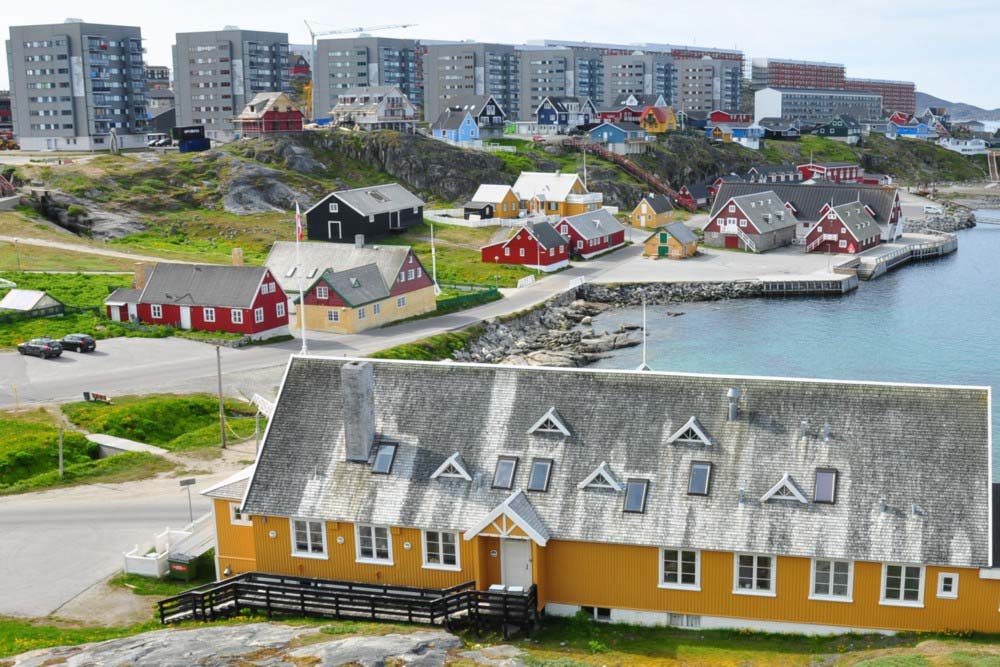
Nuuk, the capital of Greenland, has been growing since Danish colonial times

My friend and fellow children’s book author Caroline Hatton and her husband Bill visited Greenland in July 2019. She took all the photos in this post.

Flying from Narsarsuaq to Nuuk. Image courtesy of NASA, with red added.
After three days in Narsarsuaq enjoying a rich variety of experiences, we flew 1 hour 15 minutes up the west coast to Nuuk (pronounced nuke), the capital.

Can you find a heart-shaped lake?
Airplane seats are not assigned on domestic Air Greenland flights. We picked right-window seats, hoping to see the fringes of the Greenland Ice Sheet. Sights were awesome beyond words, with countless glaciers, snow caps, lakes, and braided rivers. Any lake size, shape, and shade of blue I can dream up, I could probably find somewhere in Greenland.

Founder’s statue (hilltop), Nuuk’s oldest Danish church, pale blue residence of the Danish government observer who monitors whether the government of Greenland (an autonomous country within the Kingdom of Denmark) operates within its rights and in accordance with international agreements signed by Denmark, and oldest house in Nuuk (yellow, at right)
The guide who drove us around Nuuk showed us a statue of the city’s founder, Hans Egede, a Danish-Norwegian Christian missionary who came in the late 1700s to convert the Vikings, but arrived a few centuries after they’d packed up and left. The original village, named Godthåb (Good Hope), thrived as a trading post during Danish colonial times.

Katuaq, the cultural house of Greenland, hosts events in Nuuk.
Now named Nuuk, the capital of Greenland is home to almost a third of the nearly 60,000-strong Greenland population. Most Greenlanders are indigenous Inuit, some ethnically Danish, and some of mixed Inuit and Danish ancestry. 

Our guide drove past the university, explaining how education is free for Greenlanders, including at universities in Denmark for disciplines not taught in Greenland. Health care is free for Greenlanders, including in Denmark for treatments not available in Greenland.

Ivory carvings at the Greenland National Museum
We visited the Greenland National Museum where info is available in  English that is not only perfect, but inspired and eloquent. The collections cover all 4,500 years of the history of Greenland. My favorites were the ivory carvings, wooden dolls, costumes, and antique examples of qajaq (kayak). Apparently, most visitors want to see the 15th-century mummies, which include a baby.
Statue of the Mother of the Sea, the goddess of the sea in Inuit mythology. In Nuuk’s colonial harbor, at high tide.
With more time, I would have liked to hike in the stunning, steep, sharp mountain ranges around Nuuk, and to visit the Nuuk Art Museum. Anyone interested in shopping for souvenirs, clothing, or art works would need an extra day.

Pages 10-11 of TULORIARUSEQ by HL Bastian & JN Præstegaard. The picture makes it easy to guess what the Greenlandic word “emalje” means. But what’s “mattusoorujorujussuuvoq?”
After one night in Nuuk and before flying north to Ilulissat, I explored the children’s play corner in the airport terminal. There were more books than toys! Some books were in Greenlandic, the official language, used in schools, and some in Danish, taught to older students.
Greenlandic was never written down until a Christian missionary, Samuel Kleinschmidt, invented a spelling system and translated parts of the Bible into Greenlandic. Because Greenlandic is written as it is pronounced, reading and writing are easier to master for those who speak the language. Yet with so many words a few kilometers long, I especially admire young Greenlanders for learning to read!

For more info