Showing posts with label children's books. Show all posts

Monday, September 4, 2023

HÚS ÁSGRÍMS JÓNSSONAR A PAINTER’S HOME IN REYKJAVIK, ICELAND Guest Post by Caroline Hatton at The Intrepid Tourist

Mt. Esja, seen from Vinaminni by Asgrimur Jonsson, 1910.

My friend Caroline Hatton, a children’s writer and frequent contributor to this blog, visited this museum and took the photos in this post
in June 2023.

I love visiting homes-turned-museums, because I can imagine the notable occupants moving through their days and using each area. Hús Ásgríms Jónssonar was the home of Ásgrímur Jónsson (1876-1958), the first Icelandic painter to pursue art for a living.

Before walking from my hotel to the museum, I looked up its location at Bergstaðastræti 74. All I would have to do was go right, left, then right on that Berg… Berg… Berg-something street, and spot the little house halfway down the block. So that’s what I did that lovely 13oC (55oF) morning, turning right on Bergþórugata, where the museum was nowhere to be found. But I walked on, turned left, and left again on the next Berg-something street, and found the place!

The museum is in a small 1928 house. When Ásgrímur* died, he left it, with its contents and thousands of his works, to the people of Iceland.

*Icelanders refer to one another by first name, because surnames are patronymic, identifying only the father by his first name: Jónsson means Jón’s son.

Ground-level room in Asgrimur's home.

Inside, I wondered, did he play the piano?

Second ground-level room.

What was his favorite book?

Second ground-level room.

Did a loved one make this quilt for him?

Whole upper-floor studio.

Studio.

When I visited, the temporary exhibition was “A Window in Reykjavík,” a collection of paintings of views out the windows of the artist’s homes in Reykjavik. My favorite was a 1910 painting, “Mt. Esja, seen from Vinaminni” (photo at the top of this post). It shows the view from the house where the painter lived at the time (not the museum house where I stood).

Paint spots on the floor of the studio.

His main source of inspiration was nature. He was also first to draw pictures based on Icelandic sagas, and folk and fairy tales. And he turned out to be a children’s book illustrator when a series of children’s readers illustrated with his art was published, beginning in 1907.

In his studio, I looked at sample copies of books sold on site. The reproductions I liked best were 1910s watercolor landscapes: immense horizons, wild rivers below giant glaciers, moody weather, the kind of vision that keeps drawing me back to Iceland.

FOR MORE INFO

 Read Caroline Hatton’s guest posts about Walking Around Reykjavik Part 1 and Part 2.

All text and photos, copyright Caroline Arnold. www.theintrepidtourist.blogspot.com

Monday, September 23, 2019

GETTING TO KNOW GREENLAND - PART 2: NUUK Guest Post by Caroline Hatton


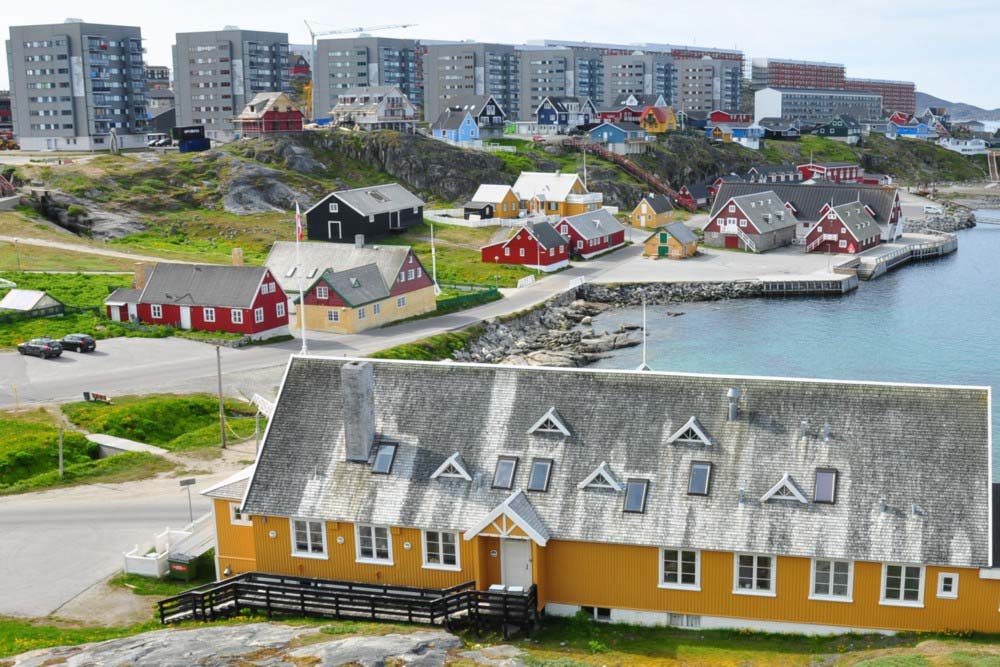
Nuuk, the capital of Greenland, has been growing since Danish colonial times

My friend and fellow children’s book author Caroline Hatton and her husband Bill visited Greenland in July 2019. She took all the photos in this post.

Flying from Narsarsuaq to Nuuk. Image courtesy of NASA, with red added.
After three days in Narsarsuaq enjoying a rich variety of experiences, we flew 1 hour 15 minutes up the west coast to Nuuk (pronounced nuke), the capital.

Can you find a heart-shaped lake?
Airplane seats are not assigned on domestic Air Greenland flights. We picked right-window seats, hoping to see the fringes of the Greenland Ice Sheet. Sights were awesome beyond words, with countless glaciers, snow caps, lakes, and braided rivers. Any lake size, shape, and shade of blue I can dream up, I could probably find somewhere in Greenland.

Founder’s statue (hilltop), Nuuk’s oldest Danish church, pale blue residence of the Danish government observer who monitors whether the government of Greenland (an autonomous country within the Kingdom of Denmark) operates within its rights and in accordance with international agreements signed by Denmark, and oldest house in Nuuk (yellow, at right)
The guide who drove us around Nuuk showed us a statue of the city’s founder, Hans Egede, a Danish-Norwegian Christian missionary who came in the late 1700s to convert the Vikings, but arrived a few centuries after they’d packed up and left. The original village, named Godthåb (Good Hope), thrived as a trading post during Danish colonial times.

Katuaq, the cultural house of Greenland, hosts events in Nuuk.
Now named Nuuk, the capital of Greenland is home to almost a third of the nearly 60,000-strong Greenland population. Most Greenlanders are indigenous Inuit, some ethnically Danish, and some of mixed Inuit and Danish ancestry. 

Our guide drove past the university, explaining how education is free for Greenlanders, including at universities in Denmark for disciplines not taught in Greenland. Health care is free for Greenlanders, including in Denmark for treatments not available in Greenland.

Ivory carvings at the Greenland National Museum
We visited the Greenland National Museum where info is available in  English that is not only perfect, but inspired and eloquent. The collections cover all 4,500 years of the history of Greenland. My favorites were the ivory carvings, wooden dolls, costumes, and antique examples of qajaq (kayak). Apparently, most visitors want to see the 15th-century mummies, which include a baby.
Statue of the Mother of the Sea, the goddess of the sea in Inuit mythology. In Nuuk’s colonial harbor, at high tide.
With more time, I would have liked to hike in the stunning, steep, sharp mountain ranges around Nuuk, and to visit the Nuuk Art Museum. Anyone interested in shopping for souvenirs, clothing, or art works would need an extra day.

Pages 10-11 of TULORIARUSEQ by HL Bastian & JN Præstegaard. The picture makes it easy to guess what the Greenlandic word “emalje” means. But what’s “mattusoorujorujussuuvoq?”
After one night in Nuuk and before flying north to Ilulissat, I explored the children’s play corner in the airport terminal. There were more books than toys! Some books were in Greenlandic, the official language, used in schools, and some in Danish, taught to older students.
Greenlandic was never written down until a Christian missionary, Samuel Kleinschmidt, invented a spelling system and translated parts of the Bible into Greenlandic. Because Greenlandic is written as it is pronounced, reading and writing are easier to master for those who speak the language. Yet with so many words a few kilometers long, I especially admire young Greenlanders for learning to read!

For more info