 |
| Pair of Grey Crowned Cranes, Rwanda |
My friend Karen Minkowski, a frequent contributor to The Intrepid Tourist and definitely an intrepid traveler, has just returned from Africa, where she spend two and a half months photographing birds in Umusambi Village, in Rwanda. I thank her for sharing her spectacular photos and insights into the birds' behavior with The Intrepid Tourist.
On the eastern edge of Kigali, Rwanda's capital, lies Umusambi Village, a beautiful wetland park that is a sanctuary for Gray Crowned Cranes rescued from the illegal pet trade. The park's 21 hectares (52 acres), once-degraded wetlands that were restored by the Rwanda Wildlife Conservation Association, provide a safe environment for these birds whose wings and flight feathers had been clipped in captivity. Now they live much like wild cranes--except they cannot fly.
 |
| Path in Umusambi Village |
I spent many happy hours walking Umusambi’s well-maintained pathways and boardwalks that give visitors access to marshes, grasslands, dense thickets and woodlands. The park attracts well over 100 native bird species (including wild Grey-crowned Cranes), as well as a few mammals, reptiles, amphibians, insects and other invertebrates. As I did with my account of Kigali’s other wetland park, Nyandungu, a few months ago on Intrepid Tourist, my photos are annotated with a few details about the birds’ behaviors that I found fascinating.
 |
| Grey crowned crane |
Courtship and bonding rituals seem to be part of daily life for grey crowned cranes, who mate for life. At the top of this post, a wild pair perched atop a tree appear to be “kissing” with the tips of their bills. Above, a rescued crane jumps as part of a typical display for his/her partner.
 |
| Black-headed Gonolek |
Black-headed Gonoleks occupy the narrow strips of woodland that border Umusambi’s wet grasslands. The Gonoleks are frequently heard duetting with their mate. The male’s clear-toned call is usually answered by a harsh, grating response from the female. Duetting may help in pair-bonding, maintaining contact in dense foliage and with territorial defense (two birds calling sound more formidable than one?)
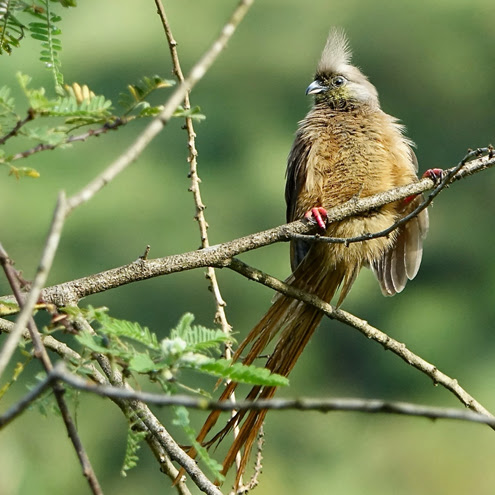 |
| Speckled Mousebird |
When nutrient-dense fruits are in low supply, the Speckled Mousebird turns to leaves, a rare food item among birds, but generally abundant in most areas. The species’ GI tract has evolved the ability to digest and extract sustenance from leaves. While they don’t provide the same amount of energy that fruits do, eating leaves allows the Speckled Mousebirds to maintain smaller territories. They have also evolved ways to conserve energy in their daily lives. Rather than flapping their wings in flight, they often glide. Huddling together at night and even during the day helps preserve body temperature. And by perching vertically, as the Mousebird in the photo is doing, they expose their bellies to sunlight, which aids in digestion.
 |
| View of acacia wetlands. |
A boardwalk and platform seen in the background allow access into the acacia wetlands.
 |
| Pied Kingfisher |
Pied Kingfishers engage in cooperative breeding, a system in which non-breeders, often juveniles, assist a breeding pair in rearing their chicks. It is often undertaken where breeding sites and potential mates are in short supply. With Pied Kingfishers, the helpers are males, usually a juvenile helping its parents, but some helpers are not related to the breeding pair. Like most social systems, this one involves both cooperation and conflict, primarily between the breeding male and unrelated helpers. (The breeding female is much more tolerant - she will accept fish from any male who offers it). Helpers related to the breeding pair have a genetic stake in the chicks’ survival and can also be aggressive towards an unrelated helper.
 |
| Red-backed Shrike |
The elegant Red-backed Shrike impales its captured prey on thorns, barbed wire or anything spiky. This behavior probably evolved to compensate for not having feet strong enough to hold captured lizards, frogs, and other birds in place while the shrike tries to tear off bite-sized pieces. Some Red-backed Shrikes store food items on spikes, creating “larders”, especially during the breeding season when there are more mouths to feed.
 |
| Army ants. |
Birding involves a lot of looking up, but I also watched my feet to avoid tripping on the uneven ground or stepping on Army ants. These little creatures sneak up one’s pant legs undetected until they reach soft flesh and suddenly start biting. The intense pain and itching can last a couple of days.
Army ants live in huge colonies of up to 50 million individuals! They form highly disciplined military-like columns that devour just about anything they encounter – mostly other insects – and do a good job of cleaning up the forest floor.
 |
| Black Goshawk |
The Black Goshawk (aka Great Sparrowhawk) is reportedly a skillful hunter of guinea fowl, hawks and owls. They also prey upon rodents and snakes. Females are significantly larger than males. These goshawks build their nests from large sticks and reuse the nests annually, repairing them as necessary.


