Showing posts with label shrike. Show all posts

Monday, February 12, 2024

BIRDS OF UMUSAMBI VILLAGE, KIGALI, RWANDA: Guest Post by Karen Minkowski

Pair of Grey Crowned Cranes, Rwanda

My friend Karen Minkowski, a frequent contributor to The Intrepid Tourist and definitely an intrepid traveler, has just returned from Africa, where she spend two and a half months photographing birds in Umusambi Village, in Rwanda. I thank her for sharing her spectacular photos and insights into the birds' behavior with The Intrepid Tourist.

On the eastern edge of Kigali, Rwanda's capital, lies Umusambi Village, a beautiful wetland park that is a sanctuary for Gray Crowned Cranes rescued from the illegal pet trade. The park's 21 hectares (52 acres), once-degraded wetlands that were restored by the Rwanda Wildlife Conservation Association, provide a safe environment for these birds whose wings and flight feathers had been clipped in captivity. Now they live much like wild cranes--except they cannot fly.

Path in Umusambi Village

I spent many happy hours walking Umusambi’s well-maintained pathways and boardwalks that give visitors access to marshes, grasslands, dense thickets and woodlands. The park attracts well over 100 native bird species (including wild Grey-crowned Cranes), as well as a few mammals, reptiles, amphibians, insects and other invertebrates. As I did with my account of Kigali’s other wetland park, Nyandungu, a few months ago on Intrepid Tourist, my photos are annotated with a few details about the birds’ behaviors that I found fascinating.

Grey crowned crane

Courtship and bonding rituals seem to be part of daily life for grey crowned cranes, who mate for life. At the top of this post, a wild pair perched atop a tree appear to be “kissing” with the tips of their bills. Above, a rescued crane jumps as part of a typical display for his/her partner.

Black-headed Gonolek

Black-headed Gonoleks occupy the narrow strips of woodland that border Umusambi’s wet grasslands. The Gonoleks are frequently heard duetting with their mate. The male’s clear-toned call is usually answered by a harsh, grating response from the female. Duetting may help in pair-bonding, maintaining contact in dense foliage and with territorial defense (two birds calling sound more formidable than one?)
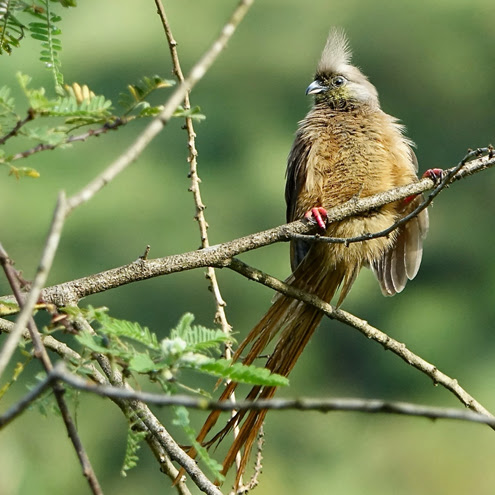
Speckled Mousebird

When nutrient-dense fruits are in low supply, the Speckled Mousebird turns to leaves, a rare food item among birds, but generally abundant in most areas. The species’ GI tract has evolved the ability to digest and extract sustenance from leaves. While they don’t provide the same amount of energy that fruits do, eating leaves allows the Speckled Mousebirds to maintain smaller territories. They have also evolved ways to conserve energy in their daily lives. Rather than flapping their wings in flight, they often glide. Huddling together at night and even during the day helps preserve body temperature. And by perching vertically, as the Mousebird in the photo is doing, they expose their bellies to sunlight, which aids in digestion.

View of acacia wetlands.

A boardwalk and platform seen in the background allow access into the acacia wetlands.

Pied Kingfisher

Pied Kingfishers engage in cooperative breeding, a system in which non-breeders, often juveniles, assist a breeding pair in rearing their chicks. It is often undertaken where breeding sites and potential mates are in short supply. With Pied Kingfishers, the helpers are males, usually a juvenile helping its parents, but some helpers are not related to the breeding pair. Like most social systems, this one involves both cooperation and conflict, primarily between the breeding male and unrelated helpers. (The breeding female is much more tolerant - she will accept fish from any male who offers it). Helpers related to the breeding pair have a genetic stake in the chicks’ survival and can also be aggressive towards an unrelated helper.

Red-backed Shrike

The elegant Red-backed Shrike impales its captured prey on thorns, barbed wire or anything spiky. This behavior probably evolved to compensate for not having feet strong enough to hold captured lizards, frogs, and other birds in place while the shrike tries to tear off bite-sized pieces. Some Red-backed Shrikes store food items on spikes, creating “larders”, especially during the breeding season when there are more mouths to feed.

Army ants.

Birding involves a lot of looking up, but I also watched my feet to avoid tripping on the uneven ground or stepping on Army ants. These little creatures sneak up one’s pant legs undetected until they reach soft flesh and suddenly start biting. The intense pain and itching can last a couple of days.

Army ants live in huge colonies of up to 50 million individuals! They form highly disciplined military-like columns that devour just about anything they encounter – mostly other insects – and do a good job of cleaning up the forest floor.

Black Goshawk

The Black Goshawk (aka Great Sparrowhawk) is reportedly a skillful hunter of guinea fowl, hawks and owls. They also prey upon rodents and snakes. Females are significantly larger than males. These goshawks build their nests from large sticks and reuse the nests annually, repairing them as necessary.


Monday, April 29, 2019

BIRDS OF ZIMBABWE, Part 2: Guest Post by Karen Minkowski

Red-headed Weaver, seen near Dete, Zimbabwe, Africa
My friend Karen Minkowski is spending several months in Africa and sent me some of her wonderful photos taken on her morning bird walks. Karen and I were on the same memorable trip to East Africa in 1971 that I wrote about in my post on May 16, 2011. Karen has been back to Africa many times since then, both for work and for pleasure. I thank her for sharing her terrific photos and observations of African wildlife with The Intrepid Tourist. Here is the second part of her post on the birds of Zimbabwe.

Early each morning I walked along the road observing and photographing birds. The abundance, diversity and beauty of Zimbabwe's birds were a continual source of enjoyment for me. The beautiful Red-headed Weaver, seen above, builds its nests in smaller colonies than does the Southern Masked Weaver I wrote about in last week's post.
Some of the most intriguing interactions I witnessed were between two different species. Here, a fledgling Jacobin Cuckoo begs for food from its host parent, a Dark Capped (Common) Bulbul.

Cuckoos are brood parasites that lay their eggs in the nests of other species who (for the most part) accept the egg and expend their time and energy rearing the parasites' young, often along with their own. The cuckoos' strategy demands close cooperation between male and female. Together they quietly approach a potential host nest. The male cuckoo starts calling to distract the host. Eventually he perches just above the nest, taunting the host. When the host leaves the nest to attack the intrusive male, the female cuckoo moves in and lays her egg. Then the cuckoo pair flies off, leaving their genetic legacy to the (hopefully) good parenting skills of the host.
Five days later I saw the young cuckoo again with its host parent. It looked to me like the cuckoo had grown and was now using its size and and perhaps aggressive nature to bully the bulbul. The cuckoo would relentlessly thrust its bill at the host parent, until it would finally fly off in search of another meal. At other times the host parent, probably by now exhausted, appeared to resist: a standoff.
Whenever the cuckoo finished eating what the bulbul had brought to it, the bullying began again.
Often I used my photos, like this one of the Red-backed Shrike, to identify a bird with my app once I was back home.
Striped Kingfisher with an insect in its bill. Many kingfishers feed on insects, reptiles, and frogs, even small mammals, either exclusively or more frequently than on fish and other aquatic creatures.
When I photographed this Yellow-billed Hornbill I thought it was eating a flower. Enlarging the image revealed that it was actually a moth. 
The Laughing Dove is distinguished by its blue wings.
The Tropical Boubou's call is lovely, haunting. I only saw it making that sound once, or I would have forever been mystified. When the bird was foraging low in the foliage or on the ground for insects, I could often see that it was uttering a completely different call, hoarser, and more coarse.

By eight a.m., the sun was burning away the cool, fresh morning air and I headed home, eager to rehydrate, look at my new photos, and identify new bird sightings.
 

Monday, March 4, 2019

ZIMBABWE, Birds of Hwange National Park, Guest Post by Karen Minkowski

Yellow-billed Hornbill in Hwange National Park, Zimbabwe
My friend Karen Minkowski is spending several months in Africa and sent me some of her wonderful photos taken on a trip to Hwange National Park in Zimbabwe. Karen and I were on the same memorable trip to East Africa in 1971 that I wrote about in my post on May 16, 2011. Karen has been back to Africa many times since then, both for work and for pleasure. I thank her for sharing her terrific photos and observations of African wildlife with The Intrepid Tourist.

Last week Karen reported on some of the many wild animals of Zimbabwe. Here is the second half of Karen's report about Hwange National Park and some of the many birds she saw and photographed there.

Birds were everywhere, calling and singing and displaying.

White-crested helmet-shrikes cock their heads as they search for invertebrates in the bark of a fallen tree.


The Kori bustard is Africa's largest flying bird, but at about 40 pounds it does not often leave the ground. It hunts invertebrates, lizards, snakes and carrion, but also eats vegetable matter.
The male Red-crested Korhan can often be heard calling in preparation for his “suicide” display, an impressive aerial feat performed in hopes of securing a mate. The male suddenly flies up about 15-20 meters high, then stops flapping his wings and falls straight down as though he's been shot dead.  A couple meters above the ground, he spreads his wings and lands gracefully. While falling he is at risk of being grabbed by a raptor. 
Our guide told us that the Korhan displays to show the female that he is willing to risk his life for his family and is thus worthy of fathering her chicks...An amazing performance (and too quick for me to photograph, but you can watch an 11 second video at https://www.youtube.com/watch?v=A2o_c_TClSI ) The red crest reportedly is erected only as part of attracting a female; displaying it at other times might attract a predator.
This little Rufous-naped Lark positions itself on a termite mound or thin dead stump, about 2 meters above ground, and belts out its beautiful call. We heard and saw them all along our game drives.


Maribou Storks, above, White-backed Vultures below...not the beauties of the bird world but they do a lot of the cleanup.


Here's a mother Magpie-shrike (aka long-tailed shrike) gazing lovingly at her offspring. Or perhaps it's the dad.

A few of the many raptors in Hwange National Park include the black-chested snake eagle, the dark chanting goshawk, and tawny eagle and more.
Here is a black-chested snake eagle perched on a branch. This bird feeds mostly on snakes, but will also prey on lizards, small mammals and frogs.
The Secretary bird is a ground raptor. When it raises the quill-like feathers at the back of the head it brings to mind an old-fashioned secretary with quills tucked behind his/her ear.

When I go to Hwange I am accustomed to joining a walking safari. I love this way of seeing wildlife, following the tracker as he picks up the spoor of a lion or rhino. There's nothing between me and the wildlife, and ... I get to walk. On this safari we viewed everything from a vehicle, but I did appreciate that we were able to approach birds and animals much closer without disturbing them, and we saw more wildlife.