Showing posts with label Kona. Show all posts

Monday, August 28, 2023

HULIHE’E PALACE, Kona, Hawaii, A Peek at Hawaii's Royal Past

Hulihe'e Palace, Kona, Hawaii, is a heritage site of Hawaii.

On Alii Drive in the center of Kona on the Big Island of Hawaii is Hulihe’e Palace, an elegant historic structure, one of  the few reminders of Hawaii’s past amongst the many tourist hotels and eateries around Kailua Bay.

Hulihe’e Palace was built using lava rock, coral lime mortar, koa and 'ohi'a wood. It was completed in 1838.

Examples of historic Hawaiian houses.

For centuries, the west part of the island of Hawaii has been associated with royal chiefs. The land on which Hulihe'e Palace sits was once part of a traditional homestead developed by King Kamekameha in the early 1800s. Grass houses (hale pili) once stood on the grounds along with a pavilion and a two story bungalow.

Statue of King Kamekameha in his royal finery.
Kamekameha's brother-in-law Kuakini built Hulihee Palace in 1838 as his royal residence. It is the oldest building on the island except for the Congregational Church on the opposite side of the road.

View of Mokuaikaua Church from front door of Hulihe'e Palace. It is the oldest Christian church in Hawaii. The congregation dates to 1820 and the building to 1837.

A number of the royal family inhabited Hulihe'e until 1914, when it was sold to a non-royal, Bathsheba Allen. She died a month later and the house was vacant for ten years. In 1925,  Hulihe’e was bought by the state of Hawaii with the purpose of preserving it as a museum. It is operated and maintained by the Daughters of Hawaii.

The Royal Lineages of Hawaii (Bishop Museum).

I visited the museum during my recent visit to Hawaii. I made a reservation online, but if the museum isn’t crowded, walk-in visitors are welcome. (Before going inside, you must leave your shoes on the porch--or wear booties over your shoes--to protect the beautifully polished dark wooden floors.)

From the ocean front lanai you can view directly across Kailua Bay to a site known as Kamakahomu. This is where Kamekameha I lived out the rest of his days after he consolidated the kingdom. The many ancient temples and royal residences have been replaced by hotels, restaurants and shops that line Kailua Bay. (The Kamekameha Hotel nearby was the site of my husband’s conference during our visit to Hawaii.)

Shark skin drum (paha). The paha is one of the most important instruments used to accompany the hula.

After confirming my reservation at Hulihe'e Palace, I received a brochure for a self-guided tour. On the main floor are the entry hall, parlor and dining room. The parlor, known as the Kuakini room, displays items such as bark cloth, wooden bowls, stone fishhooks, and other items used by traditional Hawaiians prior to modern times. 

Tapa (bark cloth) with bamboo block prints.

Feather cape.

The extinct O’o bird was prized for its few yellow feathers. Skilled bird catchers collected the feathers by listening and observing the birds and identifying the branches on which the birds would land. They spread sap on the branches to catch the birds. They then removed the yellow feathers, cleaned the sap off the bird’s feet and let it go. Feathers were used in helmets, capes, leis, or tall royal standards called kahili. The feathers are a symbol of Hawaiian royalty.

Princess Ruth Ke’elikolani in Western style clothes.
 
The upper floor of the Hulihe’e Palace consists of a sitting room and two bedrooms. In the sitting room are mounted portraits of the royal residents of Hulihe'e and a chart of the lineage of the royal family.
In 1887 Queen Kapi'olani traveled to England for Queen Victoria's Jubilee Celebration.  

This large wooden box made from the trunk of a coconut tree with a lid and legs of a koa tree was the hat box of Princess Ruth Ke’elikolani. She was the longest royal owner of Hulihe’e. 

Wooden hat box in the bedroom of Ruth Ke'elikolani.

The second bedroom is dedicated to Prince David and Priness Abigail Kawananakoa. As some of the last royal owners, Prince David and his wife visited Hulihe'e on their honeymoon in the early 20th century. This royal line thrives today and the family graciously loans many items to this room for display.

On my visit to Hulihe'e Palace I loved learning about the royal inhabitants of the palace and their history, and I especially enjoyed the Kuakini room with examples of crafts and everyday items from the time before Europeans came to Hawaii. If you are visiting Kona and have an afternoon free, a visit to Hulihe'e Palace is well worth the time. 

For more information go to the Hulihe'e Palace website.

One enters the palace grounds through an ornate iron gate.


Monday, June 5, 2023

FROM MAI TAIS TO MAHI MAHI: Eating Out on the Big Island of Hawaii

Mai Tai at Jackie Rey's, Kona, Hawaii

When you get a slice of pineapple in your drink, you know you are in Hawaii. For a long time Art and I have been making regular trips to the Big Island of Hawaii, where he attends a meeting every three years.
 (While he is at the meeting, I enjoy being a tourist.) In our search for good places to eat we have tried out various restaurants, returning to our favorites. 

Hilo

Sushi at the Hilo Bay Cafe

Our favorite restaurant on the whole island is the Hilo Bay Café, located in a former boat house on the bay in Hilo. We had dinner there on the first night of our recent trip to Hawaii. (We made a reservation a week ahead of time.)The food is fresh and the menu original, featuring, not surprisingly, seafood.

Our hotel that first night was The Inn at Kulaniapia Falls, about a fifteen minute drive outside of Hilo past fruit and nut orchards and fields of purple sweet potatoes. Breakfast, which was included, was served on a deck overlooking their own private waterfall. We chose our food from the menu the night before (eggs, bacon, toast, fresh pineapple.)

Breakfast patio with view of waterfall below.

The next day, after a morning at the Hawaii Tropical Botanical Garden, we headed for the food stand where we have eaten on previous trips called What's Shakin just a mile up the road, but when we discovered that it is closed on Sundays, we went back to Hilo and got tasty pork barbecue sandwiches from a shop across from the Hilo Farmer’s Market.  

Kona

Our hotel in Kona, the Royal Kona Resort

The rest of our trip was spent in Kona, where most of the restaurants, especially on Alii Drive, the main street along the waterfront, cater to tourists. Our first night, after enjoying complimentary mai tais at our hotel, the Royal Kona Resort, we ate at a nearby restaurant, Thai Rin, sitting on the outside patio watching the sun set. We ordered fresh spring rolls and pad thai and had more than enough food. 

Crab cakes at Jackie Rey's

Two of our dinners in Kona were at Jackie Rey's Ohana Grill Kona, a more upscale but casual restaurant located away from the tourist strip. (There is also a Jackie Rey's restaurant in Hilo.)

Linguini with clams, Jackie Rey's

Another night on this trip we met friends at Sushi Cocoro, a small hole in the wall café, just off Alii drive, chosen because it was near the conference hotel. The food wasn't that great, but at least the restaurant wasn't noisy, so it was fine for talking.

Ba-le Kona Restaurant was our discovery of this trip. Located in a strip mall just a few blocks from the beach, the atmosphere is like a diner. Both times we ate there all the other customers appeared to be locals. The main dishes they offer are Pho (large bowls of noodle soup) and delicious pork sandwiches Vietnamese style, made on freshly baked French rolls. 

Across the street from Ba-le in another strip mall are the Island Corner Café (75-5595 Palani Rd STE A-10, Kailua-Kona, HI 96740) and Land L Drive Inn--L and L Hawaiian Barbecue, where we went for breakfast. Both are open early, an advantage when coming from the U.S. and waking up early because of the three hour time difference--or more if you are not from the West Coast. 

Waiting for the sun to set at Lava Lava Beach Club.


On several of our previous trips we ate dinner at Lava Lava Beach Club, the perfect place to watch the sunset and listen to Hawaiian music while enjoying our drinks and meal. Some of the tables are literally on the sand. It is in Waikoloa Village, about a half hour drive from Kona.

You can't go to Hawaii without having poke (pronounced PO-kay), raw fish cut into small cubes and flavored with various spices, often served with rice and vegetables as a poke bowl. In Kona we have gotten poke at Umeke's, both to take out from their fish market, and to eat in.

For snacks to eat in our room, we went to one of the convenient ABC stores along Alii Drive. And at the Farmer's Market in Kona (Wed-Sun), we bought a supply of macadamia nuts to bring home as gifts and souvenirs. 

Hawaiian food is basically American food, with a tropical twist. There is no shortage of places to eat or buy food in Hawaii. You may have your favorites. These are some of ours.


Monday, May 8, 2023

IMAGES OF HAWAII'S PAST: PETROGLYPHS AT WAIKOLOA on the Big Island of Hawaii


On our recent visit to the Big Island of Hawaii, we stopped to view the Waikoloa Petroglyph Preserve, a historic site sandwiched between condominiums and golf course fairways,  a short walk from the Waikoloa shopping center. A sign with the following information greeted us at the beginning of the path through the petroglyph field:


This collection of images engraved in stone is one of the major concentrations of ancient rock carvings (petroglyphs) in the Hawaiian Islands. Boundaries were not crossed casually in old Hawaii, and the thousands of surface carvings, just north of the border between the ancient kingdoms of Kohala and Kona, suggest that many may have a religious or commemorative meaning to the event of crossing that border.


Groups waiting for permission to cross, or armies poised to defend the border or attack it, made simple encampments using cave shelters and rock wall windbreaks. Some of the “C”-shaped windbreaks may still be seen in an unrepaired state.


Most petroglyphs were made with a sharp stone held as a chisel and struck with a hammer stone; the lines being further incised with a sharp rock fragment. Others were made by rubbing a blunt stone against a lava surface, or by bruising the surface by pounding, breaking the natural glaze which forms on cooling lava to reveal the granular interior. Erosion of the edges has blurred the most ancient carvings, and some damage has been caused by persons making rubbings (a practice not permitted without special permission.)


We can only speculate about the meanings of the petroglyphs. Some of the information given to early western observers is contradictory, perhaps deliberately misleading to preserve the secrecy of meanings not intended to be shared. But these carvings were not idle “doodling.” In the Polynesian world, every expression had significance and purpose. The pictorial images may have commemorated events, or served as representations or guardian spirits carved as prayer objects, or they may have been heraldic devices of clans. 


Concentrations of dots, lines, and circles may have recorded the number of persons in a group, or days of travel, or prayers made, or the number of trips made past this place, as an indelible communication to posterity. Here, travelers might come upon the signature of an ancestor, and add their marks.

The presence of Hawaiian names in Roman letters, of dates, and of images of sailing ships and horses, poignantly marks a time of change. The most recent carving is more than a century old. Because the trail was primarily used by commoners, these carvings may not have profound relevance to the main events of ancient Hawaii. But all petroglyphs are treasured as enigmatic but tangible evidence of the old culture, irreplaceable and priceless.

Transcribed from information sign at Waikoloa.

The Waikoloa Petroglyph Field is located between two golf course fairways, a short walk from the parking area and gas station adjacent to the Waikoloa shopping center. Go to the link to see photos and detailed instructions on how to get to the site. Be sure to wear a hat and sun protection. There is no shade on the petroglyph field and the sun can be hot, especially at midday.


Monday, May 1, 2023

WHERE LAVA MEETS THE SEA, Exploring Hawaii’s Tide Pools


Tide pools, Kona, Hawaii

When visiting the Big Island of Hawaii, one is constantly reminded of both its volcanic past and present. In many places, vast fields of black rock—once molten lava—cover the landscape. Here and there small plants are taking a foothold. Along the coast, where lava once reached the ocean and hardened into rock, waves pound the shore, creating cavities for tiny animals and pools for fish and crabs.

Sea urchins.

On our recent trip to the Big Island, our hotel in Kona (The Royal Kona Resort) overlooked the sea. Along the edge of the sea was a rocky ledge. Wearing sturdy shoes and taking care where I stepped, I ventured out onto the rocks to get a closer look at the creatures that were making their homes in the tide pools. 

At the outer edge of the shore, a constant stream of water washes in and out of the pools as waves break. But at low tide, the water of the inner pools is still and clear. In some I saw tiny fish dart from crevice to crevice. In others, sea urchins clung to the rocks, their spiny exteriors making them look like living pin cushions.

Sea cucumber.

As I peered under an overhanging rock, I spotted several sea cucumbers, their tentacles spread at the end of their long bodies. Tiny crabs skittered across the rocks above, but as soon as they detected my shadow they disappeared into cracks. The crabs are preyed upon by birds, who leave their empty exoskeletons behind. 

Crab remains left on a rock.

I had hoped to see sea turtles swimming or resting near the shore, as I had on previous trips, but this time none appeared. However, the variety of creatures that I did discover were reward enough and yet another example of the myriad ways that life exists on our planet.

Bright yellow seaweed (Ahnfeltiopsis coccina) is called Limu Aki Aki in Hawaiian.  Common in Hawaii, it is edible.

Note
: Public access to Hawaii's shore is marked with signs at various places along the coast. I explored the tide pools near my hotel (The Royal Kona Resort) following the signed walkway to the beach at the point where Kahakai Road turns inland.  For a guide to the best tide pools near Kona, click HERE.

A colony of helmet urchins (Colobocentrotus atratus).
Chunks of coral, bleached and rounded by waves, stand out against the black lava.

View of the reef near the Kona airport, as seen from the plane window shortly before landing.


Monday, August 10, 2015

HAWAII: Kauai and Kona, Guest Post by Sara Kras

Island of Kauai, Hawaii
My friend and fellow children’s book writer Sara Kras recently returned from a trip to Hawaii with her husband Joe. She has graciously agreed to share her comments and a few of Joe’s fantastic photos. You can find out more about Sara’s books at http://www.saralouisekras.com/.
Waterfall, Kauai
KAUAI
Even though Joe and I have traveled all over the world, we've never been to Hawaii. If you can, go to Kauai someday. You won't regret it. It's one of the most beautiful places on Earth.
View from our hotel, Hanalei Bay, Kauai
The entire island of Kauai should be a World Heritage Site. The Napali Coast is like the Grand Canyon, but with greenery, waterfalls, and bordered by a beautiful blue ocean. There's lots of hiking trails for those who like a good hike. I was too lazy.
Hanalei Bay, Kauai
The views from our hotel room at the St Regis, Hanalei Bay, Kauai, were stunning and jaw dropping.

THE BIG ISLAND, HAWAII

View from our hotel room at Mauna Lani, Kona, Hawaii
I really liked Kona, but you definitely have to wear water shoes to swim because of the occasional lava rock in the sand. Ouch! Other than that, the beach at the hotel was a calm and blissful place to swim.
Black sand beach, the Big Island
Turtles, turtles were everywhere on the Black Sand Beach at the Big Island, Hawaii. You can't see them in the picture, but there were three large turtles swimming in the water in front of me. Plus there are three just sitting on the beach!

Then there's this somber, stately looking fellow in Kauai.
Green sea turtle, Kauai
We also swam with wild dolphins in the open sea on the Big Island. There were about 50 -60 of them. I could hear them talking to each other. I wonder what they were saying.

Manta rays are the graceful dancers of the dark, deep ocean. Lights (several LED flashlights) were mounted on a pre-made surfboard which had handles for the snorkelers to grab. Our "guide" dragged/swam us through a mass of about 100 other tourists to get the best show.

Swimming with the manta rays on the Big Island in Hawaii. Video link: https://fbstatic-a.akamaihd.net/rsrc.php/v2/y4/r/-PAXP-deijE.gif
Yes, they do really come that close. One almost touched my belly. Thanks for the show!

Note: Joe takes all the pictures. I believe he uses a little Canon Powershot in an underwater casing. Not professional grade like his above water pictures.
Kauai

Monday, May 13, 2013

HAWAII’S BIG ISLAND: The Kona Side

Kona, Hawaii, King Kamekameha Heiau
A little over a year ago, in April, I was in Hawaii with Art, who was attending a conference.  The conference was in Kona, on the Big Island (Hawaii), and while Art was at his meetings, I spent part of each day doing my own work, and part enjoying the local sights. This was our third visit to Kona and I was looking forward to its more relaxed pace of life.  Most people think of Kona as a jumping off place for trips to the volcanoes or the luxury resorts up the coast, but I find that the town has its own charm.

The main street of Kona, along the waterfront, is full of shops for tourists, but it also has several spots of historical interest including the first church in Hawaii, founded by Christian missionaries.  I love the museum across the street from the church where you can learn the history of the island both before and after Captain Cook.  On a previous visit I happened to be at the museum when a docent was giving a tour.  Afterward, when I went outside, a group of little girls were having a hula lesson on the front lawn.  This time there were no dancers, but I noticed that the palm trees had signs warning tourists to “Watch Out for Falling Coconuts”!

We were staying at the King Kamekameha Hotel and from the balcony of our room on the fifth floor I could see the ocean peeking though the palms of the courtyard below.  On a small island just beyond the hotel was a traditional Hawaiian structure, honoring King Kamekameha.. In front of the hotel, colorful canoes were stacked up by the beach and in the late afternoon each day I watched local rowing teams take the long canoes out into the bay to practice their racing skills.

We always wake up early when we go to Hawaii because of the time difference, so our routine was to get breakfast at our favorite eatery, Buns in the Sun (located in the nearby shopping mall and selling delicious sticky buns), and then take a walk in the old airport park.

Community Garden at Old Airport, Kona
Some years ago, the airport for Kona was enlarged and  relocated several miles to the north.  The old airport, along the beach just at the edge of town, has become a park with picnic tables on the beach side of the former runway (now a parking lot), and a walking/jogging trail on the other.  The land along the walking trail has become a community garden and half the fun is admiring all the different plots and the variety of plants. The other entertainment is watching the cats.  The park is filled with feral cats, all looking quite happy and healthy because of the “cat ladies” who bring food every day. 

Kona Farmer's Market
When I am in Kona I also enjoy walking along the waterfront, doing a little bird watching, and sometimes catching sight of dolphins in the bay.  The other wildlife seen all over the island are the mongooses.  Brought to Hawaii originally to prey on rats in the sugarcane fields, they have proliferated and become pests. On one of my afternoon walks I went the farmer’s market where people sell locally grown coffee, macadamia nuts, papayas and other tropical fruits, homegrown vegetables, exotic looking plants, and souvenirs.  That evening we at at Jackie Rey's, a local restaurant recommended by a Hawaiian friend, where we had a delicious meal.

On one of Art's free afternoons we treated ourselves to a game of golf--the challenge being to avoid hitting the ball into the ocean or piles of lava. When the conference was over we headed back to Los Angeles.  I had enjoyed my third visit to Kona.  To read about what we did in Hilo at the beginning of this trip, go to my April 30, 2012 post, Hawaii’s Big Island: The Hilo Side.

Monday, April 30, 2012

HAWAII'S BIG ISLAND: The Hilo Side

Hawaii Tropical Botanical Garden, Hilo
Last week, Art and I were on Hawaii’s Big Island.  Most of the week was in Kona, where Art was attending a conference, but before it started we wanted to spend a day on the Hilo side of the island.  The two sides of the Big Island, divided by mountains in the middle,  are like Dr. Jekyll and Mr. Hyde, completely different in almost every way. The Kona side is dry, gently sloping, and vast volcanic flows cover the ground with chunks of black lava. Most of the large resorts are on the Kona side along the coast. The Hilo side is your mental image of Hawaii, lush, wet, green, with steep coastal cliffs indented by narrow  gorges and spectacular waterfalls.
Waipio Valley, View from Overlook
On our way to Hilo from the Kona airport we passed the turnoff to the Waipio Valley and decided to make a slight detour.  It was a sunny day, which meant that we would get a good view of the valley from the overlook.  On a previous trip we had taken a hike to another supposed overlook but instead of a view of the 2000 foot drop to the valley floor, had seen nothing but clouds.  This time, we were rewarded with a sweeping view of the valley with its patchwork of taro fields, the black sand beach, and the cliffs beyond.  The road to the valley is so steep that only four wheel drive vehicles are allowed down.  We did not have a 4WD car, so we contented ourselves with walking a short distance down and then huffing and puffing our way back to the top.  On another trip in the future, we’d like to take a tour to the bottom. (You can arrange to go by car or by horseback.)

Hilo Bay, View from our Hotel Balcony
We then drove from Waipio to Hilo.  Hilo is built around a beautiful moon-shaped bay, famously susceptible to tsumanis.  (All around the island you see signs posted directing you to tsunami evacuation routes.)  After a powerful tsunami wiped out much of the bay front in 1946 and then again in 1960, it was decided to turn the low lying land around the bay into parks and hotels.  We were assured that our hotel (the Hilo Hawaiian Hotel), built at the edge of the water, was designed to withstand even a powerful  tsunami surge, with an open lower structure that would allow water to flow right through.  Our room, on the fifth floor, certainly had a spectacular view of the bay.


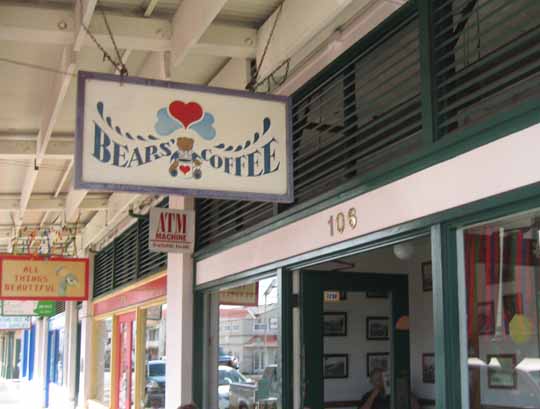
Bears' Coffee, Hilo
Most of Hilo’s large hotels, including ours, are located on Banyan Drive, a loop road lined  with huge banyan trees, each named after the famous person who planted it.  Planted in the 1940's, the trees now tower over 100 feet high and their hanging roots are like small fortresses.  That night we ate dinner at our favorite restaurant on the island, the Hilo Bay Café.  Located in a shopping mall, it doesn’t look fancy on the outside, but the food is fresh and creatively prepared. [Update in 2015: The Hilo Bay Cafe has relocated to a building right on the water with a spectacular view over the bay. The food is still delicious!]  In the morning, on the recommendation of our waitress at the Hilo Bay Cafe, we ate breakfast at Bear’s Coffee, a small café favored by locals where the food is fresh and inexpensive.

Hanging Lobster Claw, Hawaii Tropical Botanical Garden
Our main goal for our day in Hilo  was to revisit the amazing Hawaii Tropical Botanical Garden, which we had first seen on a previous trip.  The garden, nestled in a lush canyon just north of Hilo, features tropical plants from around the world, meticulously tended and clearly labeled. It is a photographer’s paradise.  We worked our way down the steep path from the garden entrance past tumbling streams and waterfalls, brilliant colored plants with names like hanging lobster claw, beehive ginger and cannonball tree, to a koi pond, a cage of noisy macaws, and finally to a rocky beach at the bottom of the canyon.  In an upcoming post, I will do a more detailed tour of the garden.

For a late lunch, we stopped a few miles up the road from the garden at What’s Shakin, where everything is made from locally grown produce.  We bought sandwiches, a smoothie, a pineapple muffin, and a deliciously sweet papaya.  We then headed for Kona, about a two and half hour drive to the other side of the island.

Note: Be sure you have a good guidebook and map for finding your way around the island.  There are almost NO signs to attractions to help you know where to turn.  Strict laws prohibit commercial signs except on your own property and then they can be no larger than 3 by 5 feet. Our favorite guidebook is Hawaii, The Big Island Revealed by Andrew Doughty.

For my report on the Kona side of Hawaii's Big Island go to my May 13, 2013 post.