Monday, February 27, 2023

POINT PINOS LIGHTHOUSE, PACIFIC GROVE, CA: Emily Fish, Socialite Keeper

Point Pinos Lighthouse, Pacific Grove, CA

The Point Pinos lighthouse in Pacific Grove, California, (near Monterey) opened for business on February 1, 1855 and has been a guiding light for ships along the Central Pacific coast ever since. It is the oldest continuously operating lighthouse in the Western United States. On a sunny Saturday in late August, Art and I made a day trip from Oakland to visit the lighthouse. (It had been closed to visitors during the pandemic and recently opened to the public.) Walking on the grounds is free. Tickets for inside tours of the lighthouse led by volunteer docents are available in the gift shop. .

Sometime after 1899, Light Keeper Emily Fish stands near the front entrance, and her servant is to the right in the kitchen garden. Photo courtesy of Pat Hathaway Collection.

I was particularly interested in visiting the Point Pinos Lighthouse because its most famous light keeper (from 1893 to 1914) was Emily Fish, the mother of Juliet Fish Nichols, the subject of my recent picture book biography for children, KEEPER OF THE LIGHT: Juliet Fish Nichols Fights the San Francisco Fog. Juliet was the light keeper at Angel Island in San Francisco Bay from 1902 to 1914. Emily and Juliet were an unusual mother/daughter light keeper duo, but with different personalities. Juliet led a quiet life at her lighthouse isolated at the bottom of a cliff on an island, whereas Emily was known as the “Socialite Keeper” due to her love of entertaining at her lighthouse.

Emily's bedroom on the second floor of the Point Pinos lighthouse.
Unlike the lighthouse at Point Knox on Angel Island, which was torn down, the Point Pinos lighthouse has been maintained both as a functioning lighthouse (now with a state-of-the-art beacon at the top) and as a historical monument. It is maintained by local volunteers. Most of the building is furnished in the style of the early 20th century, as it would have been when Emily Fish lived there. (Emily’s belongings were lost after she retired.)

An information panel in the parlor gives a brief description of Emily: "In 1893, Mrs. Malancthon W. Fish (Emily), recently widowed, arrived to take over the job of keeper at Point Pinos. She brought her Chinese servant and a taste for the finer things in life.…Lawns, flowers, hedges, trees and fountains appeared. Fashionable furniture filled the rooms and visitors from near and far would join her for tea. She was a tough boss, going through over thirty assistants in twenty years. Retiring at 71, she and her faithful servant moved to a house in Pacific Grove, where they lived until Emily’s death in 1931."

View across Monterey Bay toward Santa Cruz from the second floor of the lighthouse.

Like keepers at other light houses, Emily recorded the weather and activities at her lighthouse in her log. Sample pages from her log are on display by the second floor window of the lighthouse, which looks out toward the sea. The lighthouse sits on a knoll that provides a good view of the water but is safely away from dangerous waves during a storm.

Sample log entry: Five ladies and a boy were cut off by high tide on the Point. Two of the party called for aid. I sent a stout plank, a rope and the laborer to get them off safely at sunset. Otherwise they would have had to remain until midnight for the low tide. July 31, 1899, Emily Fish, Keeper


Rooms at the back of the lighthouse include the kitchen and bathroom, furnished in an early 20th century style. The only room in the house not in keeping with Emily's time is upstairs over the parlor. It is devoted to WW II mementos, including a newspaper report of the sighting of Japanese submarines off the coast.

Foghorn on display in the parlor.

We were lucky to have a sunny day and clear skies on the day of our visit to the lighthouse. On foggy nights an automated horn blew to warn ships away from the rocky coast. In addition, buoys anchored in the ocean had bells that also served as warnings. 

Ocean buoy.

The buoy on display outside the lighthouse is similar to the red one located in the ocean to the north of Point Pinos. It marks the southern entrance to Monterey Bay. Normally it would have a bell and a light. Buoys warn of danger and serve as navigational tools.

Stairway to light tower. View into room with WW II mementos.

The light on top of the Point Pinos lighthouse still sends its bright beams across the bay--now from a LED lamp. It is completely automated and there is no need for a lightkeeper. The light is maintained by the Coast Guard. Visitors can peek up the narrow stairway of the light tower, but the top is closed to visitors.

Blog post on TIT about Angel Island:

My book KEEPER OF THE LIGHT: Juliet Fish Nichols Fights the San Francisco Fog is available on Amazon.

For more about Emily Fish's daughter, Juliet Nichols, her log, Angel Island, the Point Knox Lighthouse, 1906 San Francisco earthquake, and more go to https://carolinearnoldart.blogspot.com/p/extra-material-for-keeper-of-light.html .


Monday, February 20, 2023

BALI, A TROPICAL PARADISE: Guest Post by Tom Scheaffer

Bali, Indonesia

My brother Tom spent three weeks in Bali in January and has generously shared some of his photos and impressions from his trip. A short video is at the end of this post. He writes:


The hotel we are staying at, Uma Dawa, used to be a museum where an artist lived. It’s peaceful and Bali style--and feels very tropical. 


The hotel has a nice pool and there are few people. We are just a five minute walk from the main hotel so it’s very convenient. It’s quite warm here, but if you stay in the shade it’s good.


I am sitting on my front porch looking out onto the jungle view. It has rained a little bit but otherwise the weather has been good. 


The Balinese culture has a real sense of beauty, and everything they make is artistically done.


We all move to the next location in two days, and that hotel will be by the ocean.


Tom made a short video of his three weeks in Bali. Enjoy!

This is Tom’s second trip to Bali. He was there in 2017. You can read about his previous trip at these two posts: SUDAJI FALLS and ULUWATU TEMPLE.

Monday, February 13, 2023

VICTORIA FALLS, ZIMBABWE: Guest Post by Karen Minkowski

Young male giraffes, Zambezi National Park, Zimbabwe.

My friend Karen Minkowski, a frequent contributor to 
The Intrepid Tourist and definitely an intrepid traveler, is currently in Africa, a place that she has visited often. She spent the month of December in and around Victoria Falls, Zimbabwe. She begins her report: 


Since late November I’ve been living in Victoria Falls, a small tourist city just across the Zambezi River from Zambia. Two national parks, Zambezi NP on the west, Victoria Falls NP to the east, surround most of the city. Fences only partially separate Park lands from commercial/residential areas, so walking on the edge requires alertness. Baboons and warthogs move through the commercial and residential areas, mostly unharassed, though people understandably chase baboons from their vegetable gardens. Baboons will go after women – not men - carrying shopping bags. A large male baboon followed me once, too close. I was trying to figure out where to take refuge until a human male noticed and offered to walk me to my gate. Elephants and buffalo often wander through town at night. Recently, lions were sighted in town, attracted by buffalo. Elephants and lions very occasionally kill humans, usually when someone is chasing an elephant raiding a garden or is trying to protect their livestock from a lion attack. Overall, Victoria Falls is quite wildlife tolerant – tourism is a huge source of foreign exchange and employment.

Giant kingfisher.

A full report of Karen's recent activities, including excursions into nearby Zambezi National Park, filled with a description of her activities and her wonderful photographs, is 
HEREas a PDF.  There are incredible close-ups of birds--Karen is a devoted bird-watcher with patience to catch the birds at their best--and other wildlife. Karen's text makes you feel as if you are a vicarious visitor too. Enjoy!


A white-backed vulture tries to grab some meat from a marabou stork.

White-backed vultures and a marabou stork.

Chameleon


Monday, February 6, 2023

ALICE IN WONDERLAND TOPIARY at the Hampshire Gardens in England, Guest Post by Anita Withrington


I thank my friend Anita Withrington for sharing her photos of the Alice In Wonderland tea party topiary at the Hampshire Gardens in what was once the ancient Beaulieu Abbey in England. 


Complete with the Queen, Mad Hatter, White Rabbit, March Hare, and a comfortable chair surrounding the tea table covered with herbs, it is a whimsical and charming feature of the Hampshire gardens.


Beaulieu Abbey is also home to the National Motor Museum, which Anita and her husband also visited. Anita writes, "I expected to be bored but found it really fascinating. The James bond car with video running in the background, and this charming little car with a round windscreen and an umbrella stand on the side--a definite must-see in England.


Monday, January 30, 2023

THE IDAHO POTATO MUSEUM: NO SMALL POTATOES, Guest Post by Caroline Hatton at The Intrepid Tourist

Idaho Potato Museum, Blackfoot, Idaho. Many visitors want their photo taken with the big baked potato.

My friend Caroline Hatton, a children’s writer and frequent contributor to this blog, immersed herself in the world of potatoes and took the photos in this post in October 2022.

If you happen to be driving around Idaho, consider visiting the Idaho Potato Museum in the town of Blackfoot, the Potato Capital of the World, on Interstate 15. I spent an hour there enjoying a wealth of information about the humble, yet glorious potato, and admiring the quality of the displays.

Left: 1930s McCormick potato cultivator; Middle: 1930s Oilver one-row pick planter to be pulled by two horses; Right: 1900s sulkey plow to be pulled by two horses.

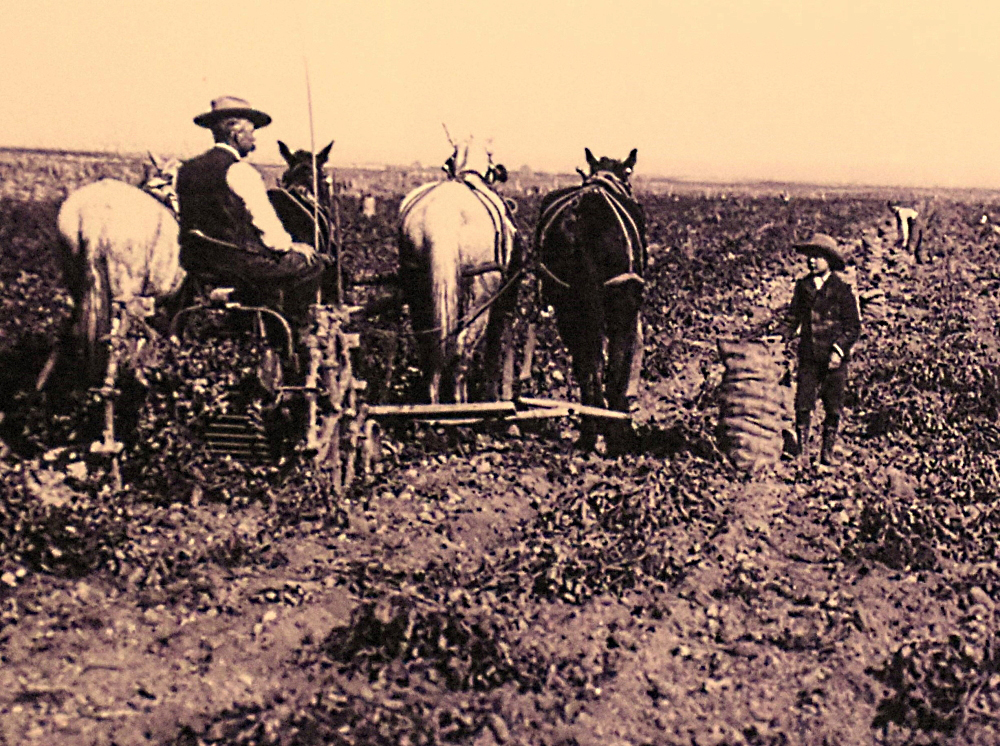
The museum is located in a former train depot, an old building next to railroad tracks. Even before entering, I got to see a number of antique agricultural implements displayed outdoor. Developed by potato growers, the earliest ones were pulled by up to four horses.

1930s Pugh one-row potato harvester to be pulled by two horses.

Besides the fact that I love rust for its look, hints of stories past, and photo opportunities, I had fun visualizing how the contraptions might work. The harvester in the above photo, when pulled forward, would drive the shovel-like front end into the soil, digging up potatoes. As they “climbed” onto the shovel, potatoes dug-up later would push potatoes dug-up earlier toward the back, off the shovel, up a conveyor belt of metal rungs gently sloping up. The bumping and bouncing would perhaps shake dirt off the potatoes. At the top of the conveyor belt, the potatoes would tumble into a larger receptacle.

The potato originated in the Andes in South America, where the Inca potato footplow or chakitailla, was used long before the 15th century and is still in use today.

The museum is small but stuffed with historical, scientific and commercial info. The potato originated in the Andes in South America where native peoples cultivated it around 200 BC. In the 1500s, Spanish conquistadors seeking gold reached Peru. They brought home a treasure: the potato. In the 1600s, it spread through Europe, Africa, China, India, and Russia, and from Ireland to Bermuda, then Virginia. The first recorded potato planting in North America was in Nova Scotia, on the Atlantic coast of Canada, in 1623.

Four horses pull a three-row potato planter designed and built by a grower, around 1935.

Today potatoes are grown in all 50 U.S. states. Idaho offers ideal potato growing conditions: a light volcanic ash soil, aquifer water for irrigation, hot days and cool nights in the summer, and a network of railroads to take potatoes to markets.

Left side: Colorado potato beetle stamps, postcards, and postmarks to educate the public about this pest. Right side:  Stamps featuring a potato merchant (top left) or potatoes.

Irish stamp commemorating the Irish Potato Famine of 1845-1850.

Of some 125 potato-growing countries around the world, the five top producers are China, India, Russia, Ukraine, and the United States. The potato changed the world and made it to Mars, at least in the movie, “The Martian.”

Half of the museum's collection of stove-top potato bakers.

One third of the museum's collection of sour cream dishes.

The museum exhibits include a collection of collections (potato peelers, stove-top bakers, sour cream ceramic dishes, what may well be the largest collection of potato mashers in the world, postage stamps, toys, vintage posters of science activities for children…) and record-setting potato items (such as the largest potato chip ever made, a Pringle listed in the Guinness Book of World Records, and a bronze sculpture replica of the largest potato ever grown in Idaho).

The gift shop sells lots of potato-themed T-shirts, souvenirs (potato peelers), and food items (potato soup or pancake mixes, seasonings). The café serves baked potatoes best ordered hours in advance so they’re ready when you are. It’s a few dollars more for access to the toppings bar, or for the topping of the day for fearless gourmets. For smaller appetites, the menu includes French fries, potato cupcakes and potato ice-cream.

I didn’t eat at the café, but visiting the Idaho Potato Museum inspired me to reminisce about yummy potato dishes I tasted in my travels (such as plokkfiskur in Iceland, a fish and potato casserole) and plan to make them at home (any day now).

All text and photos, copyright Caroline Arnold. www.theintrepidtourist.blogspot.com


Monday, January 23, 2023

FOR THE BIRDS: THREE WEEKS BIRDWATCHING IN EAST AFRICA, Guest Post by Owen Floody

Mariqua Sunbird, Kenya

With many thanks to our friend Owen Floody, who was my husband's field partner on our trip to East Africa in 1971. Art and I have not been back to Africa since then, but Owen has made numerous trips in recent years and written about several of them for The Intrepid Tourist. His latest report chronicles a trip focused on birds--and much more.

I like birds. I like Africa. So, why not embark on a three-week birding tour of Kenya, especially when fond memories of a past trip strongly endorse the itinerary?  Following this reasoning, I found myself spending most of November 2022, on a birding safari organized by Wings Birdwatching Tours and implemented by Ben’s Ecological Safaris, of Nairobi.

Long-crested Eagle in the Kakamega Forest, Kenya

Critical to the success of this safari were superb efforts by our guide, Brian Finch, and driver/guide, Ben Mugambi. Both were extremely adept at spotting and hearing birds.  And there is not a bird in East Africa that they could see or hear but not identify.

The fact that these efforts were so highly valued reflects, in part, the size, enthusiasm and competence of the audience.  At the outset, it surprised me that our group consisted of me and just three others.  However, it quickly became apparent that this intimacy was more than a luxury: What would be the value of expert guides if you were stuck in a different vehicle and could not hear them?

Access to the guides might be especially important to participants who already are expert birders and anxious to improve their skills by helping to spot and identify as many birds as possible.  With one exception, this perfectly describes the members of this group.  As I said, I like birds.  But I am not a birder.  In contrast, my three companions were dedicated and expert birders with previous birding tours behind them: They knew the drill and were prepared to work hard to expand their life lists.

Malachite Kingfisher, seen near Lake Victoria

And this tour did require effort.  We typically met for breakfast at 6 am, began birding (on foot or from the vehicle) at 6:30, took a brief lunch break at about 2:30 pm, then resumed birding until returning to our lodge at about 6:30.  We then met at 7:30 to review the day’s sightings before moving on to dinner at about 8:30.  This routine was taxing but effective, yielding a total of 578 sightings (of different bird species) over the 3 weeks.  Many of these were lovely.  To illustrate, a few of my favorites are shown in the first three of the associated images, of a Mariqua sunbird, long-crested eagle, and Malachite kingfisher.  However, we were not such purists as to ignore animals other than birds.   

Lion

To the contrary, we reacted as enthusiastically as any visitor to Africa to sightings of lions and were captivated by insects and colorful reptiles such as the Mwanza flat-headed agama shown below.

Mwanza flat-headed agama lizard

Though these sightings helped to keep us going, a tiring trip also is eased by scenery that is varied and attractive.  In this connection, our itinerary did exactly what I expected of it.  We visited many areas in central and western Kenya.  These varied on many dimensions and so exposed us to a wide range of habitats and wildlife.  We began by flying to the Samburu/Buffalo Springs National Reserve looking for birds of a savannah made more arid than usual by recent droughts.  Next, we paid a brief visit to a montane forest on the slopes of Mount Kenya, looking for birds of the forest and clearings.  Once back on the road, we headed into and along the Great Rift Valley.  Here, we visited two of the famous Rift Valley lakes, Nakuru and Baringo, focusing on birds of the lakes and lakeshores.   

Kakamega Forest

Next, we spent two days in the Kakamega Forest, an extension into Kenya of the great Congo basin rainforest and one of the few places in East Africa at which rainforest can be found and explored.  This made the forest itself a focal point.  Nevertheless, we worked hard to see as many forest birds as possible.  From Kakamega, we traveled to two areas near Lake Victoria, which forms part of Kenya’s western border.  Birds of the lake and adjacent grasslands were the attractions here (including that in 3rd image).  Finally, we capped our tour with several days in the Masai Mara National Park, one of the world’s most attractive and productive areas for birds and other animals.

Zebra in Masai Mara National Park

Visiting a variety of natural areas in 2022, one could not expect to escape exposure to the consequences of climate change.  We did see evidence of such effects, but they were not always as I expected.  For example, I visited Samburu in 1991, at which time it stood out as relatively lush.  Now, however, it is extremely arid, reflecting the severe droughts that have parched much of Kenya in recent years.  

Flooding in the Rift Valley

In contrast, the problem facing the Rift Valley lakes is excessive water, which has very significantly increased the levels and areas of these lakes since about 2010.  The impacts of these increases are obvious, as drowned stands of trees highlight the increases in lake areas and drowned buildings do the same for the impacts on human life and infrastructure.  The causes of these increases are unknown but could include tectonic activity and local agricultural practices as well as climate change.

Finally, a word on birders and birding tours.  They go together.  In general, I thought that this tour was great: The company was congenial, the itinerary was perfect, and the quality of the guiding was amazing.  Still, I think that this trip clearly is aimed at experienced birders (people who self-identify as birders and have been on at least 1 previous birding tour).  Non-birders certainly can do it (I did) but should only do so with caution and some prior study of what high-level birding is like.