Showing posts with label penguins. Show all posts

Monday, June 20, 2022

CHINESE LANTERN FESTIVAL: Franklin Square, Philadelphia, PA

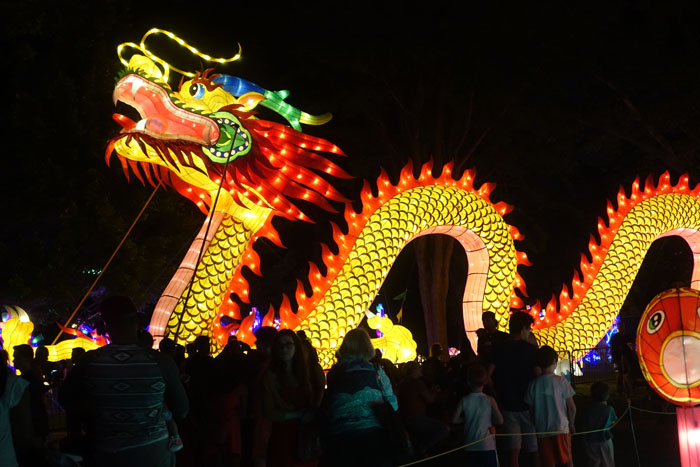
Dragon, Chinese Lantern Festival, Franklin Square, Philadelphia, PA

The Chinese Lantern Festival in Philadelphia is back! It returns to Franklin Square June 21, 2022 and will be there through August 7th.

New this year, Franklin Square Fountain Show will debut a new spectacular performance of choreographed water and lights!

A portion of the proceeds from the Lantern Festival benefits Historic Philadelphia, Inc. for the programming and care of Franklin Square. For more information and tickets click HERE.

Here is my report from my visit to the Lantern Festival in the summer of 2016:

Franklin Square, one of five public squares laid out by William Penn in his original plan for Philadelphia, offers a refreshing, urban green space with a variety of activities including a miniature golf course, classic carousel, burger stand, storytelling bench, picnic area, and more.

During our recent visit to Philadelphia, Franklin Square was lit up every night with 25 amazing illuminated Chinese lanterns–including a 200-foot long dragon. Around the park various booths offered Chinese crafts and foods and on the open-air stage performers juggled, did balancing acts, and demonstrated the art of “face-changing”–in which the actor changed masks so fast it seemed almost magic.
Juggler
The nighttime visit required a ticket. We purchased our tickets ahead of time online, and made our way from our hotel to Philadelphia’s Chinatown, which is adjacent to the park.
Entrance to the festival
It was still light when we arrived, and although the lanterns were colorful and impressive, we knew they would be even more dramatic in the dark. So, after enjoying a drink in the beer garden under the watchful eye of the dragon, we went to a nearby restaurant for dinner and returned as the sun was setting, entering through a tunnel of lighted arches.
Tulips and Roses
We then wandered through the park past displays of glowing flowers, stars, fish, penguins, flamingos and more, but the star of the show was the giant dragon. This was our last night in Philadelphia after a week of meetings for Art, and it was a fitting finale to the trip.
Penguins
The Chinese Lantern Festival, which ran from April 22, 2016 to June 12, 1016 was a celebration of the tenth anniversary of the rebirth of the once-derelict city park.
Lilies

Monday, August 22, 2016

CHINESE LANTERN FESTIVAL: Franklin Square, Philadelphia, PA

Dragon, Chinese Lantern Festival, Franklin Square, Philadelphia, PA
Franklin Square, one of five public squares laid out by William Penn in his original plan for Philadelphia, offers a refreshing, urban green space with a variety of activities including a miniature golf course, classic carousel, burger stand, storytelling bench, picnic area and more.
Overlooking the beer garden
During our recent visit to Philadelphia, Franklin Square was lit up every night with 25 amazing illuminated Chinese lanterns–including a 200-foot long dragon. Around the park various booths offered Chinese crafts and foods and on the open-air stage performers juggled, did balancing acts, and demonstrated the art of “face-changing”–in which the actor changed masks so fast it seemed almost magic.
Juggler
The nighttime visit required a ticket. We purchased our tickets ahead of time online, and made our way from our hotel to Philadelphia’s Chinatown, which is adjacent to the park.
Entrance to the festival
It was still light when we arrived, and although the lanterns were colorful and impressive, we knew they would be even more dramatic in the dark. So, after enjoying a drink in the beer garden under the watchful eye of the dragon, we went to a nearby restaurant for dinner and returned as the sun was setting, entering through a tunnel of lighted arches.
Tulips and Roses
We then wandered through the park past displays of glowing flowers, stars, fish, penguins, flamingos and more, but the star of the show was the giant dragon. This was our last night in Philadelphia after a week of meetings for Art, and it was a fitting finale to the trip.
Penguins
The Chinese Lantern Festival, which ran from April 22, 2016 to June 12, 1016 was a celebration of the tenth anniversary of the rebirth of the once-derelict city park.
Lilies

Monday, May 18, 2015

ANTARCTIC CRUISE, Part 2: Falklands to South Georgia, Guest Post by Owen Floody


King Penguin Colony

In January 2015, our friend Owen Floody went on a cruise to Antarctica, which also included stops at the Falklands and South Georgia Island.  Owen recently retired from a career of teaching and research at Bucknell University in Pennsylvania. He has always been an avid photographer and in his retirement has taken several trips that allow him to pursue his passion. Here is part 2 of a short reflection on his Antarctic trip and a few of his excellent photographs. 
Wandering Albatross on Nest
After devoting part of our trip's fourth day to a brief tour of Stanley, the capital of the Falkland Islands, we plunged back into the heavy seas for the long cruise to South Georgia Island.  We arrived there midway through the seventh day and then spent nearly four days enjoying a great number and variety of activities including landings, zodiac cruises and ship cruises.  In part, this wealth of activities reflected the much better weather that marked most of our time at South Georgia.  In addition, it reflected the constant efforts of the expedition crew to compensate for time and activities previously lost to the weather.
Fur Seals: mother and pup
To a large extent, it was my desire to see South Georgia that motivated this trip and I am happy to say that South Georgia did not disappoint.  Among the things that it combines are impressive mountains and glaciers and a special place in the history of Antarctic exploration, revolving around the fact that it was at the Stromness Harbour whaling station that Ernest Shackleton and two of his crew appeared in May, 1916, after sailing a stormy 810 miles from Elephant Island and then hiking for 36 hours over glaciers and 6,000 foot mountains from the other side of South Georgia, all as just a first step in the eventual rescue of the majority of his crew, still marooned on Elephant Island.  
Macaroni penguin
As interesting as were the perspectives it provided on the histories of whaling and Antarctic exploration, it was the wildlife on South Georgia that stole the show, not just here but for the cruise as a whole.  Our initial activities, on and near Prion Island, brought us up-close-and-personal to nesting Wandering albatrosses and sometimes-belligerent mother fur seals. 

Elephant seals
Later landings or zodiac cruises at Gold Harbour and Cooper Bay exposed us to lovely Macaroni penguins  and the spectacle of immature (but still enormous) male elephant seals facing off on the beach.

King penguins
Still, the stars of the show unquestionably were the King penguins that we encountered at Saint Andrews Bay and Gold Harbour.  These were notable for their bright colors and impressive numbers: For example, the colony at Saint Andrews alone is reported to contain more than 300,000 pairs (see very small fraction in the photo above).  But like other penguins, I found the kings most endearing for their sometimes comical patterns of movement and their elegance, perhaps especially when interacting or preening. 

Details: The ship was the m/v Plancius (capacity = 112), which is owned and operated by Oceanwide Expeditions (http://www.oceanwide-expeditions.com/).  This is a Dutch outfit with an office in Houston.  We booked our cabins directly, though it is possible to book through other travel agencies or tour operators, as is standard for such cruises.

We flew on Aerolineas Argentinas between JFK and Ushuaia, with stops of 3 (on the way down) or 1 (return) day(s) in Buenos Aires.

King penguins
Next week, Part 3: South Georgia to the Weddell Sea.


Monday, May 11, 2015

ANTARCTIC CRUISE, Part 1: Ushuaia to the Falklands, Guest Post by Owen Floody


Beagle Channel

In January 2015, our friend Owen Floody went on a cruise to Antarctica, which also included stops at the Falklands and South Georgia Island.  Owen recently retired from a career of teaching and research at Bucknell University in Pennsylvania. He has always been an avid photographer and in his retirement has taken several trips that allow him to pursue his passion. Here is part 1 of a short reflection on his Antarctic trip and a few of his excellent photographs.
Black-browed albatross
In December of 2005 I went on an 11 day Antarctic cruise from Ushuaia, Argentina, to  the Antarctic Peninsula, returning to Ushuaia by way of the South Shetland Islands.  This trip was blessed by calm seas, beautiful scenery and great wildlife, including a multitude of penguins, many with small chicks. I enjoyed this trip so much that I resolved to return to Antarctica, but this time following the longer route (approximately 18 days) that visits the Falkland Islands and South Georgia Island on its way to the Antarctic Peninsula.  It is this trip that occupied me for the second half of January, 2015. 

Mixed colony of seabirds--Black-browed albatrosses and Rockhopper penguins
On any trip of this type, you ultimately are at the mercy of the weather and bad weather can affect you in a variety of ways.  First, it can slow the ship, thereby limiting the time that you can spend at some destinations.  Second, it can increase the difficulty of leaving or returning to the ship, sometimes preventing these altogether.  Together, these can limit the land-oriented activities (landings and zodiac cruises) that are the primary goals on such cruises.  Third, heavy seas and high winds can "shrink" the ship (by making the outside decks impassable) and make it more difficult to move about the parts of the ship that remain open.

Rockhopper Penguin
As you may have guessed, the conditions of my recent trip were generally bad.  This became apparent immediately, as high winds pinned our ship to its pier for 12 hours beyond the scheduled time of departure which delayed our arrival in the Falkland Islands to the extent of excluding one of the two planned wildlife-oriented landings there. 


Blue-eyed Shags
The one completed landing, on Saunders Island, was great, bringing us to a mixed colony of seabirds, most notably including Rockhopper penguins, Black-browed albatrosses and Blue-eyed shags.  Of course, we're all greedy on trips of this sort so that this success did not completely suppress thoughts of what we might have seen on the intended second such landing.

Details: The ship was the m/v Plancius (capacity = 112), which is owned and operated by Oceanwide Expeditions (http://www.oceanwide-expeditions.com/).  This is a Dutch outfit with an office in Houston.  We booked our cabins directly, though it is possible to book through other travel agencies or tour operators, as is standard for such cruises.

We flew on Aerolineas Argentinas between JFK and Ushuaia, with stops of 3 (on the way down) or 1 (return) day(s) in Buenos Aires.

Next week, Part 2: Falklands to South Georgia

Monday, June 3, 2013

PATAGONIA: Spectacular Scenery and Abundant Wildlife

View from Hosteria Pehoe in Torres del Paine National Park, Chile
The trip to Patagonia in 1995 is among our top family vacations ever. At the extreme southern tip of South America,  Patagonia is a land of rugged seashores, jagged mountains, enormous glaciers, and vast, windy grasslands. It is half the size of Alaska with just 1.5 million inhabitants. As the climber Yvon Chouinard, founder of the Patagonia outdoor clothing line, says, “It is a mystical, almost imaginary place.” 
Rounding up the cattle

Some people in Patagonia live on remote estancias, or ranches, but the majority reside in Punta Arenas, a city that had its heyday in the era of clipper ships.  In those days, before the Panama Canal was built, ships traveling from Europe and the east coasts of the Americas had to go around the southern tip of South America to reach San Francisco and other west coast ports.  Victorian style architecture still dominates Punta Arenas.

Magellanic Penguin
Punta Arenas (which means Sandy Point in Spanish) sits on the edge of the Straits of Magellan, the connector of the Atlantic and Pacific Oceans. We flew into the Punta Arenas airport and then rented a car and drove north to the spectacular national park, Torres del Paine, passing few cars or signs of habitation on the way.  We did stop at a penguin colony and walked the paths between the nesting burrows of Magellanic penguins, who go there each Austral summer to raise their chicks. (See my post for June 20, 2011.)

Mustering the sheep on the Patagonian plain.
The broad plains bordering the Straits of Magellan provide rich grazing for huge herds of sheep and cattle and nesting grounds for millions of birds.  As we drove north we were awed by the giant flocks of flamingos, endless nesting geese, and vast array of small birds, all in the midst of laying eggs and rearing their young.

Torres del Paine is truly one of the last Edens on Earth.  Towering granite peaks rise above ice cold lakes, and flocks of giant Andean condors soar on the updrafts created by the ever present winds that collide with the mountains.  On the grassy slopes below the peaks, herds of guanacos, once in danger of becoming extinct, are now multiplying. Patagonia is a wildlife photographer’s paradise. I used a few of the photos we took of guanacos, foxes, penguins, and rheas (South American relatives of ostriches) to illustrate my book South American Animals (Morrow, 1999.)
Guanaco, Torres del Paine
In Torres del Paine we stayed at Hosteria Pehoe, a comfortable and somewhat rustic hotel with a spectacular view of the “torres”, or towers, of rock that are the iconic image of the park.  The hotel where we stayed when we went to Chile’s Atacama desert four years ago, the Tierra Atacama, has recently opened a sister hotel in Torres del Paine called the Tierra Patagonia.  Here’s a short (one minute) video from Tierra Patagonia that gives an overview of what you can expect when you visit the park.  It brought back many memories for us.  We’d love to go back someday.  Perhaps we will!
Update:  Here's another absolutely amazing video from Tierra Patagonia.  Enjoy!

Monday, March 5, 2012

Phillip Island, Australia: Koalas, Kangaroos and a Penguin Parade

Woolamai Peninsula, Phillip Island
Excerpt from my diary of our three month trip to Australia in 1999.  Our trip to Phillip Island was in late February.
On Sunday we took a day trip to Phillip Island, which is about two hours south of Melbourne.  It is mostly agricultural, but people have summer cottages there and it is also a good place to see wildlife.  By the time we arrived it was lunchtime, so we bought some food and took it to the beach on the Woolamai Peninsula for a picnic.  The long sandy beach faces the Bass Strait (the body of water that separates Tasmania from Australia) and we watched the huge waves come crashing in and the surfers trying to catch them. 
Mother and baby koala take a nap
In the afternoon we visited a Koala sanctuary, where you can see koalas both in their natural state (where they look like furry lumps high in the treetops) and up close in a special enclosure.  We also went to a wildlife park where you can walk among the kangaroos, emus, deer, and other animals.  When you buy your ticket they give you a bag of food for the animals, so if you hold your hand out, the animals will come and eat.  Some of them are more aggressive than others, and one emu actually pulled the bag of food out of my pocket when I didn’t offer it anything to eat.
A young grey kangaroo waits for a snack
We had an early supper at a supposed Tex-Mex restaurant (it lost something in the translation) and then made our way to the Penguin Parade, Phillip Island’s most famous wildlife feature.  Every evening at dusk, hundreds of fairy penguins come in from a day at sea, waddle up the beach and into their burrows in the sand dunes.  During nesting season, which is just ending now, the plump chicks wait at the entrance of the burrow for their parents to come back with dinner.
Waiting for the penguins to come ashore
Fairy penguins are the smallest of all penguins and stand about a foot high and are quite charming, especially the superfat ones which have put on extra weight to give them energy while they stay ashore for several weeks and molt.  The unfortunate thing about the Penguin Parade is that it has been over commercialized and they let too many people in to watch.  More than two thousand tourists sit on bleachers and wait for the penguins and then rush around trying to see them next the boardwalk when they come in.  Rather amazingly, and luckily, the penguins don’t seem fazed by all the human activity.  We had a nice, relatively warm evening, perfect for penguin watching and sunset at the beach, but I suspect that when the weather is less hospitable, far fewer people are willing to sit out in the cold and the birds are less bothered.
Fairy penguins return to their nests after a day at sea.

Monday, June 20, 2011

Patagonian Penguins

Visiting a Penguin Colony in Southern Chile (December 1996)


The Otway Sound in southern Chile is the summer home of thousands of Magellanic penguins. These "warm weather" penguins are recognized by white rings around the face and chest.
    Penguins were everywhere.  Some rested on the beach, cleaning themselves after a day at sea.  Others marched like teams of tuxedoed soldiers across the short grass.  Parent penguins and their chicks peeked out of their underground burrows. We were in southern Chile visiting a nesting colony of Magellanic penguins at the edge of the Otway Sound (Seno Otway) on the Magellan Strait.  Each spring more than 1000 of these plump seabirds come ashore to this windswept plain to mate, lay eggs, and bring up their young.  Although we were bundled in warm coats to protect us from the chilly wind, the penguins seemed to be enjoying the long hours of summer sunshine.

On the Beach

     As we watched the penguins waddle across the grass they reminded us of comical waiters. Unruffled by the constant winds that sweep across the southern tip of South America, penguins are well equipped to withstand the harsh weather of this region. Luckily for us, the weather on the day we visited was mild and sunny.  Because we were so far south and it was near the summer solstice, the sun remained high into the sky until well into the evening.


 Don't Touch the Penguins!
Magellanic penguins stand about two feet tall and weigh about seven pounds. They live along the coasts of Chile, Argentina and the Falkland Islands.  They are named after the explorer, Ferdinand Magellan, who saw them on his historic trip around the world between 1519 and 1522.
Obeying the sign that warned us not to touch the penguins, we followed the winding path through the colony. A fence separated us from the nesting area.  The birds paid little attention to us and went about their business cleaning their nests, tending their chicks, or making their way to and from the water.

The Southern Hemisphere spring begins in September and that is when the penguins begin to arrive at their nesting colonies.  Waddling up the shore on sturdy webbed feet the penguins search for good nest sites.  Digging in the soft ground, they make a nesting burrow. Once a penguin pair has mated they stay together for their whole lives.   Older pairs usually return to the same nest hole that they used the year before. 

Penguin Chicks

Penguins preen their feathers to keep them clean and waterproof.  The fluffy chick on the right will get its adult feathers in a few weeks.
Six weeks after eggs have been laid, they are ready to hatch.  The newly hatched chicks weigh about three ounces and look something like furry gray tennis balls.  Like all baby birds, penguin chicks are always hungry.  For the rest of the summer, their parents take turns going to sea to catch fish to feed them.  When the adult bird returns to the burrow, it coughs up partly digested food and feeds the chicks.

Young penguins come out of the burrow for the first time when they are about six weeks old.  As we walked through the colony we could see some of the young birds peering cautiously out of their nest holes.  Others stood by the entrance with their parents.  By the time young penguins are eight weeks old they are completely covered with smooth, oily feathers.  Then they are ready to join their parents in the water.

Penguin parents watch over their chicks closely.  They have to protect them from foxes, large seabirds and other animals that might harm them.  We saw a Patagonian fox, or zorro, bound across the shore with a conger eel in its mouth.

A Memorable Visit
We visited the penguin colony in December when it was bustling with activity.  But by March all the penguins would go back to sea for the winter.  Then all would be quiet on the shores of  Otway Sound until the next nesting season.  We were lucky to visit during the few months that the penguins spend on land. 

Getting there: We flew from Santiago, Chile, to Punta Arenas, Chile’s most southern port city.  We were on our way to Torres del Paine National Park.  After renting a car (actually a small Toyota truck) at the airport, we stopped at the penguin colony on our way from the airport to Punta Arenas where we spent our first night before heading north.  A sign on the highway marked the dirt road that led to the penguin colony.

Penguins at the Zoo: You don’t have to travel to South America to see a breeding colony of Magellanic penguins.  Instead, go to the San Francisco Zoo.  Every spring, you can see penguin parents and their fluffy chicks standing outside their nest holes.  I wrote about these penguins in my book Penguin (Morrow Junior Books, 1988), illustrated with photos by Richard Hewett.  It is out of print but you may be able to find it in the library.  It inspired my visit to the colony at Seno Otway when I went to Patagonia with my family several years later.