 |
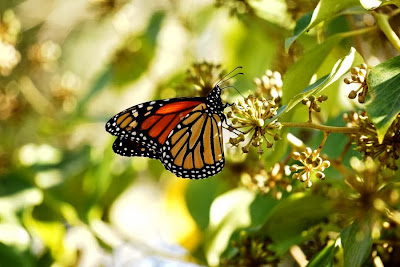
| Monarch butterfly, Ellwood Butterfly Grove, Goleta, California |
Among nature’s most incredible journeys is the annual migration of monarch butterflies. After spending the summer fluttering and feeding in woods and fields in the United States and Canada, the butterflies travel south for the winter, flying up to 80 miles in a single day. Monarchs east of the Rockies fly to the mountains of central Mexico. (See update below.) Monarchs west of the Rockies make their way to California where they gather in eucalyptus groves along the coast.
On a recent sunny afternoon in early October, Art and I visited one of these butterfly groves near Santa Barbara, California--the Ellwood Grove and neighboring Coronado Grove in Goleta, not far from the University of California Santa Barbara campus. Tucked between a residential neighborhood and an open coastal mesa, giant eucalyptus trees grow along a seasonal creek. At the peak of the season, in December and January, more than 50,000 monarchs cluster in the trees in this grove.

We knew it was a bit early to see the giant clumps of butterflies hanging like bunches of orange and black living leaves, but already some of the monarchs had arrived for the winter. As we walked the shady paths through the grove (which is protected as a nature preserve) a parade of butterflies flitted over our heads, their colorful wings catching the sunlight. And then we came upon a bush where we found hundreds of butterflies perched like jewels as they fed on the flowers. As we watched them up close, we could see their tiny legs and antennae and their coiled proboscises sucking up nectar.

Monarchs have an amazing life cycle. An adult monarch lays its eggs on milkweed leaves. When the eggs hatch, the caterpillars eat the leaves. After a few weeks, when the caterpillars are about two inches long, they stop eating, attach themselves to a leaf, and form a beautiful light green chrysalis. Inside the chrysalis, the caterpillar grows wings and metamorphosizes into a butterfly. After about two weeks, the butterfly emerges, gradually unfolding its wings. When they dry, the butterfly is ready to fly. It will look for food, lay eggs, and the cycle of life will begin again.
When monarchs eat milkweed sap, a little bit of the poison in the sap becomes part of their bodies. It helps protect them from birds and other predators. (Predators do not eat monarchs because they taste bad.)
 |
| Information sign at Coronado entrance to grove |
Monarch butterflies have a life span of about a year. Each butterfly makes the migration trip only once. The amazing thing is that they know where to go even though they have never been there before. If we return again next year to see the butterflies, we will see the descendants of those that fluttered over our heads on this trip.
Coronado Butterfly Preserve: Located adjacent to the Ellwood Grove. Click
HERE for more information:
Video: For a great video of the butterfly migration and information about other monarch groves in California click
HERE.
Directions to the Ellwood Butterfly Grove and Coronado Butterfly Preserve: Click
HERE for directions to the Coronado entrance to the Elwood Butterfly Grove and links to other hikes in the Santa Barbara area.
UPDATE February 23, 2014:
Monarchs, milkweed and the spirit of Rachel Carson. See this article in the Los Angeles Times about how pesticides are endangering the monarch butterflies. Fewer butterflies have migrated to Mexico this year than ever before.
http://www.latimes.com/opinion/commentary/la-oe-nabhan-monarch-butterfly-extinction-20140223,0,7973387.story#axzz2uBU4ETM3
 |
Marker showing paths from the grove across the mesa to the beach in Santa Barbara
|


