Showing posts with label flamingos. Show all posts

Monday, March 31, 2025

BOLIVIA: Unfinished Business--Return Trip by Guest Poster Owen Floody

Flamingos, Laguna Colorada, Bolivia

With many thanks to our friend Owen Floody for another exceptional contribution to The Intrepid Tourist. He writes:

Regular readers of this blog may recall my description of a June 2024 trip that surveyed the Bolivian highlands. That was a great trip. One reflection of this was that it left me wanting more, of exhibits that deserved more time than available in June and of locations or populations that deserve to be seen in more than one season.

My follow-up trip was relatively brief, running from 2/21/25 to 3/3/25.  All arrangements were made through Lucia Berrios, of Sendas Altas in La Paz. She was terrific. My major stops included La Paz, the Salar de Uyuni, the Desierto de Siloli, and Laguna Colorada.  Anyone interested in duplicating any part of this trip should be aware that the altitudes of these sites range between 12,000 and 14,600 feet.  some shortness of breath and some colder weather than the month of the year might predict.

Mask at the Museo Nacional de Etnografia y Folkore, La Paz, Bolivia.

My major goal in revisiting La Paz was to spend more time in the excellent Museo Nacional de Etnografia y Folklore (Musef).  

Mask.

This museum has outstanding displays of fabrics characteristic of Bolivia’s different regions and of a great variety of ritualistic masks such as appear in carnivals, festivals and other religious ceremonies.  I had great fun photographing many more of the latter than I can share here.

Sunset, Salar de Uyuni.

The Salar de Uyuni is a huge (4,100 sq mi) salt flat. It is mesmerizing at any time, but its character changes entirely across the seasons.  In the dry season (as I saw it in June), it is a seemingly endless flat expanse of brilliantly white salt. How such a uniform and seemingly impoverished landscape can be so attractive I don’t know, but you will have to consult the photos from my earlier column if you’re in doubt.

Salar de Uyuni.

In any case, I think that it may be in the wet season that the Salar shines most brightly.  Now, much or all of it is transformed into a huge shallow lake.  This has the potential to perfectly reflect the sky during sunrises, blue-sky afternoons, sunsets, and, perhaps especially, at night.  My efforts to capture the Milky Way were limited by rookie mistakes plus higher winds and more low clouds than expected.  Even so, this left so many wonderful scenes that I enjoyed myself far too much for complaint.
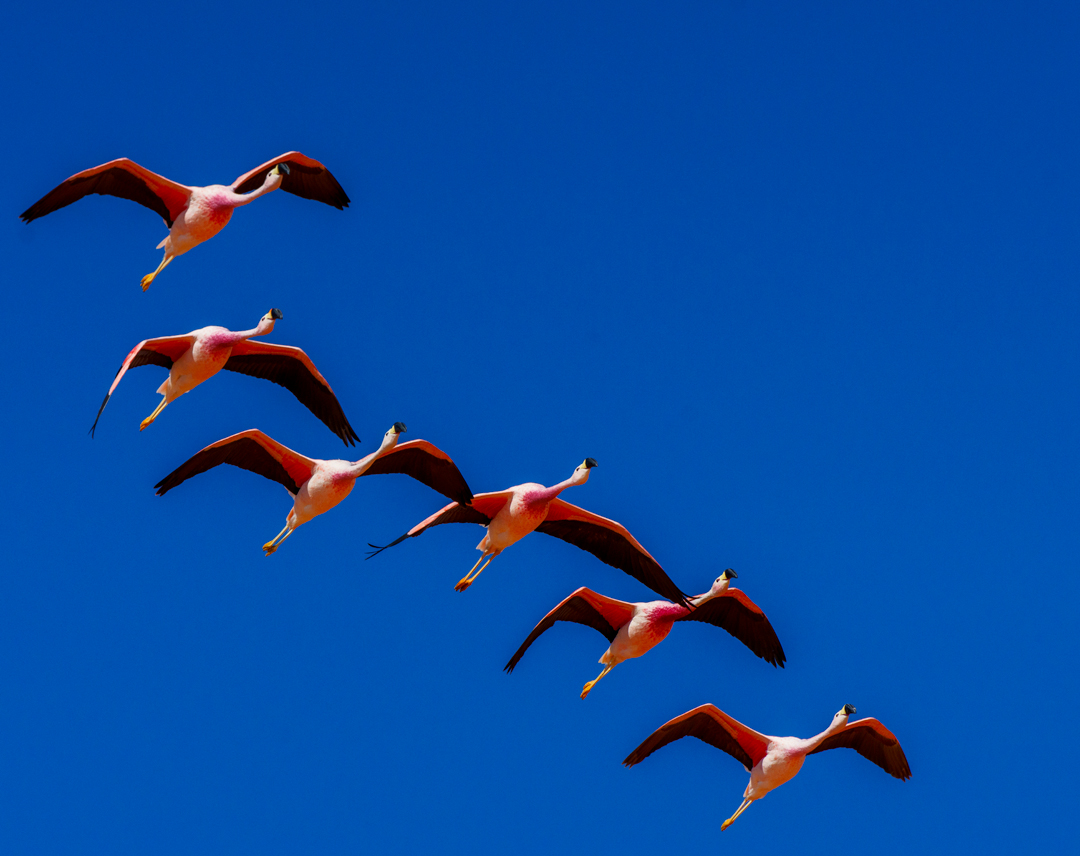
Flamingos.

My third major goal for this trip was to observe and photograph the flamingos at Laguna Colorada as they gathered in huge numbers for breeding.  There should be three species present (Andean, Chilean, James) but the second of these was hiding from me.  

Flamingos.

Nevertheless, it was great fun trying to capture these striking birds as they interacted in dense groups or celebrated their grace in flight, especially low over the striking waters of the Laguna.

Desert landscape, Bolivia.

Finally, effort of the sort that I expended (it’s just so hard taking all these photos!) deserves some reward and my unexpected bonus took the form of the succession of jaw-dropping desert landscapes that we passed through on our return from the Laguna Colorada to Uyuni.  I’m sure that my guide and driver were grateful that I let them make any progress at all between desperate pleas for “just one more shot.”  Is that what they meant as they cried “No mas. No mas."?

Monday, November 3, 2014

FLAMINGOS, GIRAFFES, CONDORS AND MORE: Santa Barbara Zoo, Santa Barbara, CA

Chilean Flamingo, Santa Barbara, Zoo
Recently, on a trip to Santa Barbara, California, I decided to go to the zoo where I had not been for a long time. I stopped first at the large sundial on a plaza near the zoo entrance and stood on the marker for the month.  My shadow told me that it was 4:00–exactly the time on my watch! It was a great time to visit–the zoo was not crowded and the animals were up and about.

Sundial Shadow, 4:00
I then proceeded to the flamingo display, always a favorite, and watched these elegant and beautifully feathered birds. (They were Chilean flamingos, a species I had seen in the wild with my family on our trip to Patagonia in 1995.) After I left the flamingos and was walking down the trail to the next exhibit, I suddenly realized I was being followed.  I turned around and saw a group of flamingos (and their keepers) coming down the path!  I asked, and learned that the flamingos go out for a walk every day to get their exercise.

Flamingos Out for a Stroll
I took a circular path around the zoo past capybaras, some lively tamarin monkeys, and other animals, until I came to a sign that said “Giraffe Deck”. There I saw a group of children, under the supervision of a keeper, feeding treats to a very friendly giraffe.  As the giraffe stuck out its long blue tongue to grab the treats, the kids squealed with delight. (The cost for giraffe feeding is $6 or $5 for zoo members.) I learned from the sign that the blue color of the tongue is an adaptation that helps keep the tongue from becoming sunburned as giraffes feed in the wild.
Masai Giraffe
I then walked along the California Trails, which includes exhibits of a Channel Island fox, desert tortoises, and other animals native to the state.  I looked up and saw three condors sitting on their perches in their huge flight cage enjoying the afternoon sun. The Santa Barbara Zoo is one of only four zoos in the world to display California condors, along with Condor Ridge at the San Diego Wild Animal Park, Elephant Odyssey at the San Diego Zoo, and the Chapultepec Zoo in Mexico City. I have seen wild condors in the California mountains and along the Big Sur coast, but never this close up.  A distinguishing feature both in the wild and at the zoo are the large numbered tags on the birds’ wings. There are so few of these birds left, that each one has an identifying number. I learned about condors and their extreme plight when I researched and wrote my book On The Brink of Extinction: The California Condor.  No other bird in North America has a wingspan as wide as a condor’s–a spread of more than nine feet from tip to tip.
California Condors
The Santa Barbara Zoo is a relatively small zoo, but well worth a visit.  Its impeccably landscaped trails and large, well designed exhibits make it a perfect place for an afternoon walk or for a longer visit, with or without children.  As the attendant at the ticket booth says when you come to the zoo: “Have a Zooper Day!”

Santa Barbara Zoo
500 NiƱos Drive
Santa Barbara, CA 93103
Main Phone: (805) 962-5339
Info Line: (805) 962-6310

Open every day 10:00 a.m. - 5:00 p.m.,  10:00 a.m. - 3:30 p.m. on Thanksgiving, Christmas Eve, and Christmas.
Crocodile

Monday, May 23, 2011

Chile: Atacama Desert, Part I

Flamingos, Oases, and Volcanoes (December 2009)

Flamingos in the Salar de Atacama
Like a bevy of pink ballerinas, the flamingos tip-toed across the salty lagoon, sweeping their wide bills through the shallow water in search of food. Then, with a burst of wide wings they launched themselves into the sky, and became silhouetted against the sunset and the towering mountains of northern Chile. We were in the Atacama desert, a land of stark beauty and surprising wildlife. With less than an inch of rainfall each year, the Atacama is the driest desert in the world. And yet, it has been home to people and wildlife for thousands of years.

At the Foot of the Andes
To get to the Atacama, we had flown north from Santiago to the mining town of Calama. As the plane descended into the airport we circled over a giant hole in the earth, the largest open pit copper mine in the world. Trucks loaded with copper ore looked like toys as they wound their way up its steep sides. At the airport we were met by Juan, our driver from the Tierra Atacama, our hotel in San Pedro de Atacama, the oasis town 75 miles away that would be our base. It was December, early summer in the southern hemisphere. Technically we were in the tropics, but the altitude, about 8,500 feet, meant that the temperatures were comfortable.

View of the volcano Licancabur from our room at the Tierra Atacama

At the hotel we were escorted through a garden of newly planted flowers and fig trees to our spacious room. We had a direct view of the volcano Licancabur, which at 19,400 feet high dominates the skyline and has been imbued with religious significance since ancient times.
Our all inclusive plan meant that everything for our stay was taken care of–meals, transportation, guides, entertainment. So, before relaxing with our pisco sours (the classic Chilean cocktail), we met with the trip planner who wanted to make sure that our three days would be filled with the activities we desired.

San Pedro and Toconao, Oases in the Desert
For day one, we chose a morning trip to the Valley of the Moon, spectacular rock formations just to the north of San Pedro.
View of the Valley of the Moon
After lunch, on bicycles provided by the hotel, we rode over the bumpy dirt road about a mile into the center of town. Fed by water flowing down from the mountains, San Pedro de Atacama has long been an agricultural center and was a stopping place for Pedro de Valdivia, one of the founders of Chile, as he made his way south from Peru in 1540. Near the main plaza there is a church and small museum containing ancient artifacts. A covered arcade nearby has souvenir stalls with blankets, pottery, jewelry, and other crafts, mostly from Peru (to the north) or Bolivia (a few miles to the east, on the back side of Licancabur.)

At 5:00 we met our guide and fellow travelers for a trip to the National Flamingo Reserve. En route we stopped at the small oasis town of Toconao where we toured terraced gardens filled with apricot, quince, fig, and other fruit trees. We also went into the historic church to see an elaborate Christmas manger scene, complete with llamas, a volcano, and tiny glass flamingos.

Flamingos and Giant Salt Flats
We then climbed back into the van and drove along a road of finely crushed salt through the sea of jagged crystals that form the giant salt flat of the Salar de Atacama, once an ancient inland sea. Before following the walkway to the lagoons, we toured the small visitor center to see exhibits of the flamingo life cycle. Three species of flamingos can be seen feeding in the lagoons, the Chilean, Andean and James flamingos. Periodically the birds launch themselves into the air, flapping their wide wings and honking like geese as they rearrange themselves for the night. As we watched the birds, the sun slowly sank in the west, turning the hills first orange, then pink, and finally the sky grew dark, revealing the unfamiliar southern constellations, sparkling in the clear, dry air. It was a spectacular end to our first day.
Sunset and Flamingos

Part II will cover our visits to ancient petroglyphs and the Tatio Geysers.

Getting there: After flying from the U.S. to Santiago, the capitol of Chile, we took a local flight on Sky Airlines to Calama. Lan Chile also flies there. (Calama is 1225 kilometers from Santiago.) Our ground transportation to and around San Pedro was provided by our hotel, the Tierra Atacama, but it is possible to rent a car and drive yourself. (The main road is paved but most other roads are dirt.) Click here for a MAP of Chile. (Calama and San Pedro de Atacama are east of Antofagasta near the Bolivia border.)
Did we need to speak Spanish? Although we can get along in basic Spanish, almost everyone at the hotel spoke English. English was the international language for us and the other international tourists, many from Brazil and Europe. Except for one person, there were no other Americans at our hotel.
When did we go to Chile? Art and I made this trip to the Atacama in December 2009. We also spent time in Santiago, Rancagua, and the beach town of Iloca (later greatly damaged by the earthquake and tsunami.)