 |
| Namib Desert, view from the air. |
With many thanks to our friend Owen Floody, who was my husband's field partner on our trip to East Africa in 1971. Art and I have not been back to Africa since then, but Owen has made numerous trips in recent years and written about several of them for The Intrepid Tourist. His latest report chronicles a trip to Namibia—his third—and is accompanied by his excellent photographs.
I recently returned from a 17-day photo-tour of Namibia, in southern Africa. This was run by Joseph van Os Photo Tours and led by Mike Byrne. Mike was a great organizer, leader and photographic mentor, whose efforts were enhanced by our expert Driver/Guides Jakes De Jager and Charl Schoombee, of the Swakopmund-based SafariWise. This was my third visit to Namibia. I have enjoyed them all, but this was the best, primarily because its itinerary was loaded with photographic must-sees.
Namibia is a moderately large country, about twice the size of California. It gained its independence just in 1990. It is the most arid country in sub-Saharan Africa and, not surprisingly, is very sparsely populated: Only Mongolia has a lower population density. Nevertheless, it is blessed by striking landscapes and abundant wildlife. It was the goal of this tour to present both of these, with landscapes dominating the first half and wildlife the second. My report will reflect this division, with the first installment focusing on landscapes followed by a second emphasizing wildlife.
 |
| Quiver trees. |
The trip began with a long drive from Namibia’s capital, Windhoek, to a farm near Keetmanshoop. This farm and area are notable for a concentration of grotesquely beautiful Quiver Trees. It was our hope to photograph these in the late afternoon, at sunset, against the Milky Way, and at sunrise. However, a nearly full moon forced us to give up on the Milky Way and focus instead on the other conditions and a different expanse of the night sky. As expected, the quiver trees were lovely, especially in the golden light of sunset and sunrise.
 |
| Abandoned house in Kolmanskop. |
Next, we spent two days poking through and around Kolmanskop, a town that rose with the discovery of diamonds and crashed with their exhaustion. It has been abandoned and besieged by the sands since the 1950s. Though not familiar generally, it is well-known among photographers for the striking images it offers suggesting decay and the power of natural forces. However, I found it to present two faces. The predominant one is of rooms and buildings being gradually reclaimed by sand.
 |
| Building in Kolmanskop, an abandoned diamond mining town. |
Contrasting with these are a few other buildings and rooms that look as though you could move in tomorrow: Even though decay may be the dominant theme, some scenes speak more of resistance and resilience.
 |
| Dead Vlei salt pan. |
Our next stop was Sossusvlei, the expanse of orange and red sand dunes that is Namibia’s greatest claim to fame. We had a wonderful morning wandering around Dead Vlei, a salt and clay pan packed with dead trees, some of which are thought to have died more than 500 years ago. For me, the comparison to a modern dance troupe was irresistible.
 |
| Sossusvlei. |
In addition, we gaped at the surrounding fantastically shaped dunes. One of these is Big Daddy, a particularly tall (roughly 900 ft) dune with a commanding view. Big Daddy often is recognizable from the groups of people laboriously climbing its spine.
 |
| "Big Daddy" sand dune. |
In these explorations, we benefited from our tour’s ability to book us into the Dead Valley Lodge, one of a very few lodges located within the national park’s boundaries. Whereas most visitors were held at the park gates until sunrise, we were able to get a valuable earlier start.
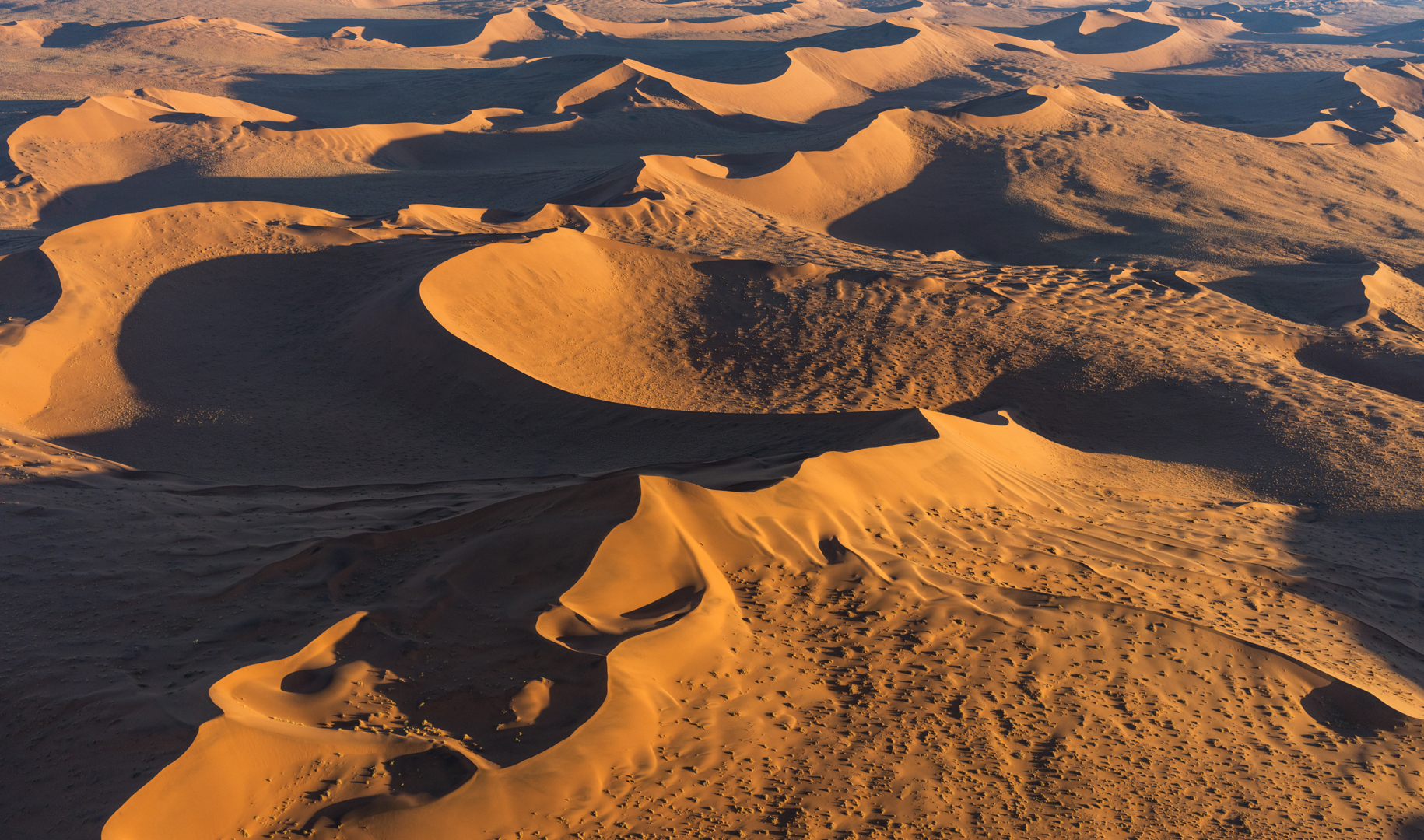 |
| View from the air. |
Some aspects of the Sossusvlei dunes are best appreciated from the ground. However, such views cannot convey a sense of the extent of the dune field. The Namib Desert is large, extending 30-100 mi inland from the Atlantic Ocean and over 1000 mi along the coasts of Namibia and neighboring countries. We were extremely fortunate to have two opportunities to see this desert from the air. First, most of us took optional helicopter rides over the dune field. Second, when it became time to leave Sossusvlei, we flew by small plane from there to Swakopmund, our next stop.
These views were wonderful and well worth the added expense. They reinforced our earlier impressions of the dunes’ remarkable shapes and textures. Both flights extended these impressions by revealing much more of the field’s huge size, with dunes marching off as far as the eye can see.


