Showing posts with label Namibia. Show all posts

Monday, July 10, 2023

NAMIBIA: Spectacular Dunes and Abundant Wildlife, Part II, Guest Post by Owen Floody.

Zebra at Etosha National Park, Namibia.

With many thanks to our friend Owen Floody, who was my husband's field partner on our trip to East Africa in 1971. Art and I have not been back to Africa since then, but Owen has made numerous trips in recent years and written about several of them for The Intrepid Tourist. His latest report chronicles a trip to Namibia—his third—and is accompanied by his excellent photographs.

Where the Namib desert meets the sea.

My previous post began with my description of a recent photo-tour of Namibia and 
ended as we flew by small plane from the red sand dunes of Sossusvlei to coastal Swakopmund, marking the tour’s transition from an emphasis on landscapes to one on wildlife. The flight itself provided a second look at the shapes and distributions of the Sossusvlei dunes. Particularly impressive was how abruptly the dunes end and the ocean begins. In addition, the flight permitted us to look down on one of the shipwrecks that give the Skeleton Coast its name. Finally, we viewed an impressive bank of mist extending inland from the ocean, as is very typical of this area.

These mists limited our activities in the Swakopmund area. One victim was a planned excursion to Walvis Bay in search of flamingos and other water birds. But we did see quite a few flamingos from the plane.  And the mists could not completely derail a Living Desert tour that exposed us to a few of the small creatures (chameleons, geckos, skinks, and spiders) able to make the dunes their home.

Gecko.

From Swakopmund, we continued on to our last two stops, Etosha National Park (in northern Namibia) and the Erindi Private Game Reserve (about midway between Etosha and Windhoek, our endpoint).
  Even though we saw wildlife earlier in the tour, these were the areas that we expected to be the most wildlife rich.

The Etosha Salt Pan.

Etosha is the third largest of African national parks at 8600 sq mi, closely approaching the size of New Hampshire. Contained almost entirely within it is the Etosha Pan, a salt pan of about 1840 square miles. Etosha is dry, though average rainfall levels vary seasonally and regionally.
  Due to its aridity, much of the wildlife viewing in Etosha occurs at waterholes, some natural, others man-made.  A few of these (including one a few feet from my room) are lit at night, permitting interesting views of a great variety of animals as they (very cautiously) visit to drink.

Giraffes and rhinos at the water hole.

Of the waterhole visitors, zebra are so photogenic as to be hard to beat.
 Nevertheless, the most prized nighttime visitors were the black rhinoceros and giraffes: I did not expect to see this many rhinos and was very pleased by the turnout.  And nothing could have beat the show put on for us by a large herd of elephants during a daytime waterhole visit. All of them, but especially one expressive and irresistible baby, had a grand time frolicking in the dust, water and mud.

Mother elephant and her calf having a mud bath.

Even though these sightings were great and made our visit to Etosha memorable, sightings of some other animals, especially big cats, were scarce. It was suggested that this reflected eastward movements of some animals in response to conditions that were unusually arid even by Etosha's standards.

Mother cheetah and her cubs.

We hoped that these gaps would be filled at Erindi.  And, to some extent, they were, as we were able to get good views of cheetah (6th image) and lions there. Unfortunately, at least some of these sightings came at what I considered unacceptable costs.  One of the benefits of private reserves is the ability to drive off road and at night.  And done judiciously, I think that these can be valuable.  However, our efforts to track a hunting mother cheetah suggested to me that the drivers at Erindi (which were not those attached to our tour) were prone to engage in two unethical practices.  First, they frequently plowed right through any shrub or small tree that might otherwise have required a detour. Secondly, several vehicles maintained positions close to and on at least three sides of the hunting cat. It is hard for me to believe that these intrusions didn’t compromise the hunt (which did end unsuccessfully). One of the drivers claimed that he knows the animals individually and well and would have broken off the pursuit if the animal was distressed. Perhaps this is true, but I am unconvinced. Since many of the cats are radio-collared, it should be possible to collect data on the outcome of hunts accompanied and unaccompanied by safari vehicles. If the success rates are similar, I will praise the sensitivity and skill of the drivers. Otherwise, I will give Erindi a pass, as I did on our remaining game drive.

Please bear in mind that this incident occupied no more than two hours of a 17-day trip.  Therefore, anyone attracted to Namibia but concerned about the incident should recall the saying about throwing out the baby along with the bathwater. Taken together, the sights and experiences of this trip for me elevate further a destination that already was one of my favorites. In my opinion, tweaking the itinerary would be an appropriate response, staying away would be overkill and unnecessary.      

Part I of Owen’s report appeared on July 3, 2023.

Monday, July 3, 2023

NAMIBIA: Spectacular Dunes and Abundant Wildlife, Part I, Guest Post by Owen Floody.

Namib Desert, view from the air.

With many thanks to our friend Owen Floody, who was my husband's field partner on our trip to East Africa in 1971. Art and I have not been back to Africa since then, but Owen has made numerous trips in recent years and written about several of them for The Intrepid Tourist. His latest report chronicles a trip to Namibia—his third—and is accompanied by his excellent photographs.

I recently returned from a 17-day photo-tour of Namibia, in southern Africa.  This was run by Joseph van Os Photo Tours and led by Mike Byrne.  Mike was a great organizer, leader and photographic mentor, whose efforts were enhanced by our expert Driver/Guides Jakes De Jager and Charl Schoombee, of the Swakopmund-based SafariWise. This was my third visit to Namibia. I have enjoyed them all, but this was the best, primarily because its itinerary was loaded with photographic must-sees.

Namibia is a moderately large country, about twice the size of California. It gained its independence just in 1990. It is the most arid country in sub-Saharan Africa and, not surprisingly, is very sparsely populated: Only Mongolia has a lower population density.  Nevertheless, it is blessed by striking landscapes and abundant wildlife. It was the goal of this tour to present both of these, with landscapes dominating the first half and wildlife the second.  My report will reflect this division, with the first installment focusing on landscapes followed by a second emphasizing wildlife.

Quiver trees.

The trip began with a long drive from Namibia’s capital, Windhoek, to a farm near Keetmanshoop.
  This farm and area are notable for a concentration of grotesquely beautiful Quiver Trees.  It was our hope to photograph these in the late afternoon, at sunset, against the Milky Way, and at sunrise.  However, a nearly full moon forced us to give up on the Milky Way and focus instead on the other conditions and a different expanse of the night sky. As expected, the quiver trees were lovely, especially in the golden light of sunset and sunrise.

Abandoned house in Kolmanskop.

Next, we spent two days poking through and around Kolmanskop, a town that rose with the discovery of diamonds and crashed with their exhaustion.  It has been abandoned and besieged by the sands since the 1950s. Though not familiar generally, it is well-known among photographers for the striking images it offers suggesting decay and the power of natural forces.  However, I found it to present two faces. The predominant one is of rooms and buildings being gradually reclaimed by sand.  

Building in Kolmanskop, an abandoned diamond mining town.

Contrasting with these are a few other buildings and rooms that look as though you could move in tomorrow: Even though decay may be the dominant theme, some scenes speak more of resistance and resilience.

Dead Vlei salt pan.

Our next stop was Sossusvlei, the expanse of orange and red sand dunes that is Namibia’s greatest claim to fame. We had a wonderful morning wandering around Dead Vlei, a salt and clay pan packed with dead trees, some of which are thought to have died more than 500 years ago.
  For me, the comparison to a modern dance troupe was irresistible.  

Sossusvlei.

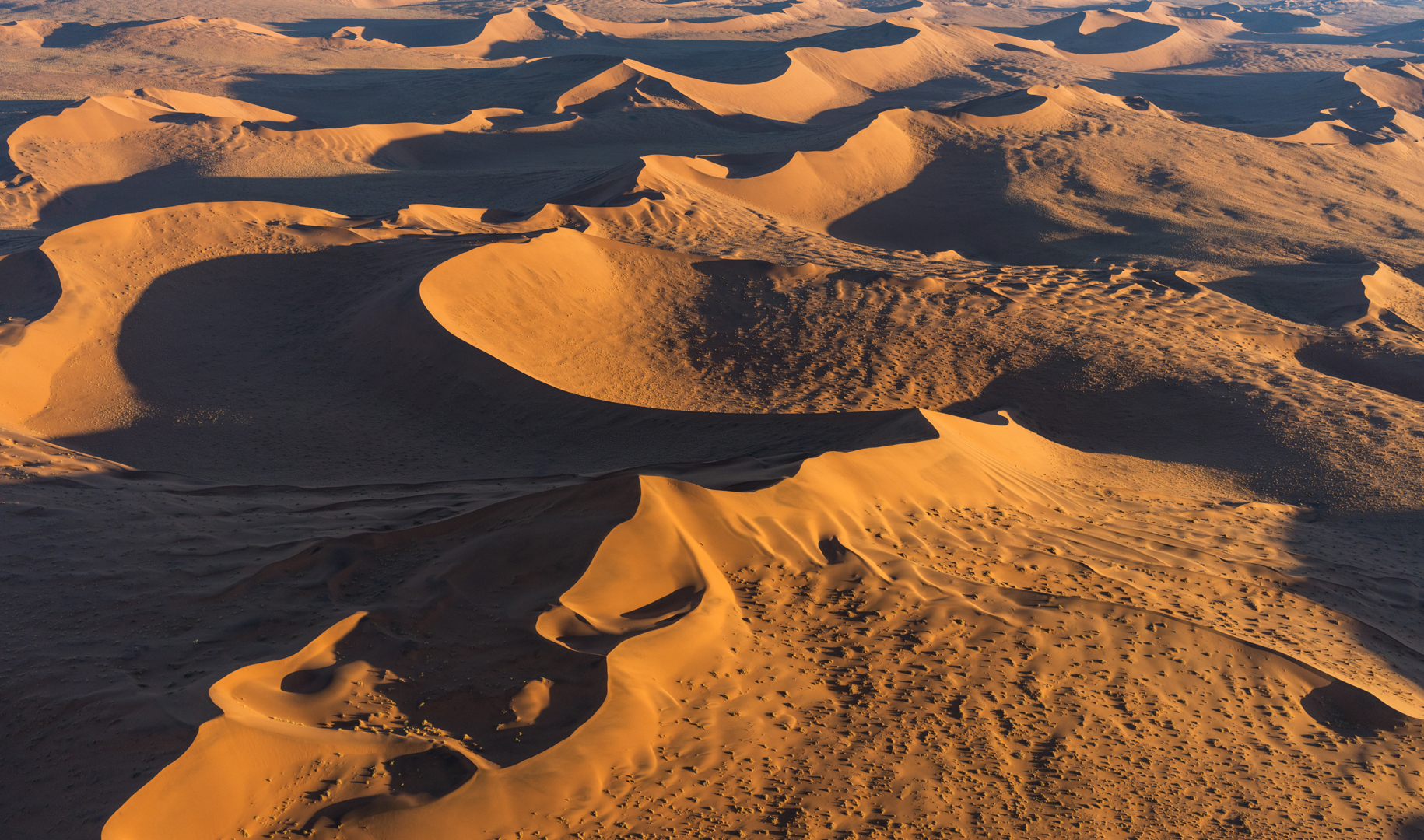
In addition, we gaped at the surrounding fantastically shaped dunes.
 One of these is Big Daddy, a particularly tall (roughly 900 ft) dune with a commanding view. Big Daddy often is recognizable from the groups of people laboriously climbing its spine. 

"Big Daddy" sand dune.

In these explorations, we benefited from our tour’s ability to book us into the Dead Valley Lodge, one of a very few lodges located within the national park’s boundaries.
  Whereas most visitors were held at the park gates until sunrise, we were able to get a valuable earlier start.

View from the air.

Some aspects of the Sossusvlei dunes are best appreciated from the ground.
  However, such views cannot convey a sense of the extent of the dune field. The Namib Desert is large, extending 30-100 mi inland from the Atlantic Ocean and over 1000 mi along the coasts of Namibia and neighboring countries.  We were extremely fortunate to have two opportunities to see this desert from the air. First, most of us took optional helicopter rides over the dune field. Second, when it became time to leave Sossusvlei, we flew by small plane from there to Swakopmund, our next stop.

These views were wonderful and well worth the added expense. They reinforced our earlier impressions of the dunes’ remarkable shapes and textures. Both flights extended these impressions by revealing much more of the field’s huge size, with dunes marching off as far as the eye can see.

To be continued next week.


Monday, January 3, 2022

ETOSHA NATIONAL PARK, NAMIBIA: Okaukuejo Waterhole, Guest Post by Sara Kras

Okaukuejo Waterhole, Etosha National Park, Namibia

My friend and fellow children’s book writer Sara Kras spent much of the past year living in Namibia. Here she shares a recent visit to Etosha National Park. Sara loves to travel and has contributed numerous articles to The Intrepid Tourist. Sara's most recent book, Baby Boomer Reboot, is a fascinating account of the challenges she faced going back to college in her fifties.  

 
Etosha National Park lies in northern Namibia. This large park is 8600 square miles and is surrounded by a fence.  To ensure the animals within its borders have water, many manmade waterholes have been constructed throughout the park. The most famous one is Okaukuejo. One of the park entrances is there, along with a large camp comprised of villas and cottages. There is even a large dirt parking lot where visitors can pitch their own tents and camp.

Entrance to Okaukuejo waterhole, with its characteristic stone tower.

High-end international travelers rarely stay on site at Okaukuejo because of the condition of the buildings. The main advantage of staying on site is to be at the waterhole after sunset, when there can be lots of activity.  If you stay outside the park, you must leave by sunset. We stayed in one of the most expensive rooms (about $180 including dinner and breakfast) called a Premier Waterhole Villa.  Our room #33 had a direct view of the waterhole. We could sit on the balcony or even in our bed and watch the animals come and go any time of day or night.  But, for this wonderful feature we had to put up with very noisy and leaky air conditioners, stained curtains, and an upstairs toilet with no toilet seat.  This was definitely not a luxury situation and most western travelers would find it intolerable. But it did have strong hot water pressure in the shower and the bed was comfortable--two of my main criteria since I am not a camper.

What did I get for putting up with this discomfort?  If you’re into African animals as I am, you get a lot.

After sunset, floodlights illuminate the waterhole. This is the best time and place to see the endangered black rhino.

On Day 1, we saw a large herd of zebra, many giraffe, springbok and gemsbok.  After the sun went down, a male lion began roaring and huffing. This continued most the night, though he never made an appearance at the waterhole. However, twenty black rhinos showed up, staggering their appearance to keep us all entertained, and two lionesses trotted down to the waterhole for their nightly drink.

During the night there was an intense thunder and lightning storm. Buckets of rain poured from the sky, much to our dismay, as rain disperses the animals because they can find abundant water elsewhere.

The waterhole was pretty quiet on Day 2. I felt sorry for the visitors that came to Okaukuejo for just one night (never a good idea). There were lots of long, sad faces sitting around the waterhole willing animals to appear. They never did except for three giraffes and three black rhinos.

Elephant herd

Because of the heat, a lot of water evaporated from the rain, so animals began making their trek back to the waterhole on Day 3 in the afternoon. There was a group of about one hundred wildebeest, along with zebra, gemsbok, and springbok. Several herds of elephants showed up, totaling about thirty. Many babies were part of the group. Later in the evening, five different black rhino made their lumbering appearance.

A visit to Okaukuejo is one of the most unusual safaris my husband and I have experienced. The reason is that the animals come to you. There’s no need to drive anywhere to search for them. In addition, there’s lots of opportunity to see the critically endangered black rhino. The best months to go to Okaukuejo are June through October when the park is the driest.