Showing posts with label video. Show all posts

Monday, October 14, 2024

NEW MEETS OLD: Contemporary African Art by Leilah Babirye at the de Young Museum, San Francisco, CA

Masks by Leilah Babirye at the de Young Museum in San Francisco.

A new exhibit at the de Young Art Museum in San Francisco, called We Have a History, features the art of Leilah Babirye. At first, Leilah Babirye’s sculptures look like traditional African forms, but on closer look, the complex decorations turn out to be a colorful mixture of found objects—can tops, electrical wire, extension cords, PVC pipe, and whatever else she has happened to find. 
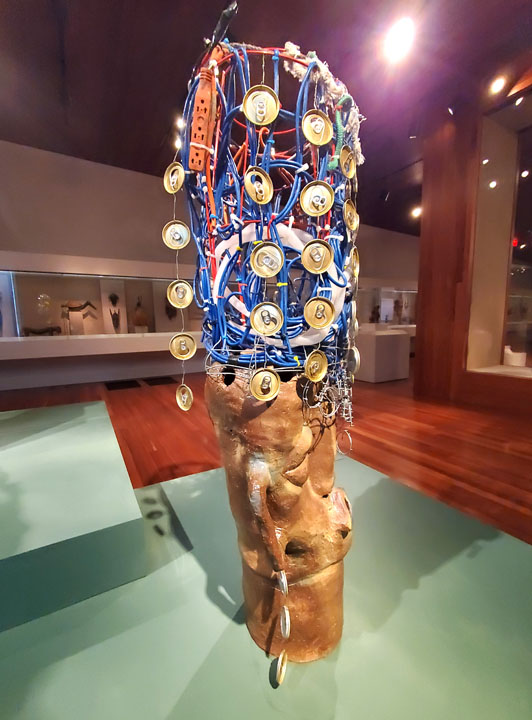
Auntie Muzumganda by Leilah Babirye, Ceramic, wire, and found objects.

Detail.

Leilah Babirye, born in Uganda, works in New York, creating busts, masks, and figures from ceramic and wood. This is her first solo museum show in the United States. Her work highlights the connection between the past and present in African art.

R. Peaceful Bride of Mwanga II, Leilah Babirye, Wood, wax, nails, wire, glue and found objects.

I saw Leilah Babirye’s exhibit when I was at the de Young Museum in July. Her art is displayed in the Art of Africa gallery, alongside the permanent exhibits of masks, paintings and other objects, thus tying Babirye’s work to the larger African tradition. 

Dance mask, Bogadjin people; Headrests, Tami people.

I was intrigued by her use of ordinary household objects and the way they become transformed into vibrant art when incorporated in the sculptures.

Carved wooden figure, Leilah Babirye.

Included in the exhibit is a video installation where we see Leilah Babirye at work in her studio. We see the intense and energetic way she attacks materials, turning them into the forms she intends. As she works we hear her talk about them.  Leilah Babirye’s sculptures, busts and masks are portraits of her LGBTQ+ community. Each one speaks for itself, inviting the viewer to take a closer look.

The exhibit, on the second floor of the museum, runs through October 26, 2025. 

For more information about visiting the de Young Museum of Art, click HERE.


Monday, February 20, 2023

BALI, A TROPICAL PARADISE: Guest Post by Tom Scheaffer

Bali, Indonesia

My brother Tom spent three weeks in Bali in January and has generously shared some of his photos and impressions from his trip. A short video is at the end of this post. He writes:


The hotel we are staying at, Uma Dawa, used to be a museum where an artist lived. It’s peaceful and Bali style--and feels very tropical. 


The hotel has a nice pool and there are few people. We are just a five minute walk from the main hotel so it’s very convenient. It’s quite warm here, but if you stay in the shade it’s good.


I am sitting on my front porch looking out onto the jungle view. It has rained a little bit but otherwise the weather has been good. 


The Balinese culture has a real sense of beauty, and everything they make is artistically done.


We all move to the next location in two days, and that hotel will be by the ocean.


Tom made a short video of his three weeks in Bali. Enjoy!

This is Tom’s second trip to Bali. He was there in 2017. You can read about his previous trip at these two posts: SUDAJI FALLS and ULUWATU TEMPLE.

Monday, October 18, 2021

IMMERSIVE VAN GOGH: LOS ANGELES

52 Places to Go: Week 42


Last week, Art and I went to the Los Angeles installation of the Immersive Van Gogh show--a distinctly Hollywood experience, dazzling, fascinating, and nothing like viewing Van Gogh’s art in a museum, where the art stays firmly in place on the walls. At the theater/gallery for the Immersive Van Gogh exhibit on Sunset Boulevard, light projections of Van Gogh’s art swirled around us–on the four walls of the room, reflected in mirrors, on the floor, and on us, all to the beat of surround sound music–while we sat inside our designated socially distanced circles, masks on. It was like being inside a giant kaleidoscope.

The show, which repeats about every 45 minutes, roughly follows the course of Van Gogh’s life, from his early paintings like The Potato Eaters, to his final super productive phase, including Starry Night. We sat through the show twice–the first time just in awe and absorbing the experience, the second time admiring again, taking more pictures, and changing our position in the room to see the art from a different angle.

The show invites viewers to step into Van Gogh’s paintings and become part of the scene–to sit at the table with the potato eaters, to join a street scene in Arles, to look the artist in the eye in his self-portraits, to fly with crows over a wheat field in Southern France.
In one sequence, we join the artist’s process as the pieces of furniture in his bedroom are drawn, colored, and placed in the room. And because the paintings are magnified on such a huge scale, one can see and appreciate every brush stroke.


Everyone who is familiar with Van Gogh’s art will recognize the images on the walls–irises, sunflowers, windmills, an absinthe drinker, stars in the sky–as they morph seamlessly from one scene to the next. It was hard to stop taking photos. And yet, the photos capture mere transient moments in the exhibit because the images are constantly moving. (We also took some short videos, but even those are only an approximation of the actual experience.)

Immersive Van Gogh is an elaborate production. It was designed and conceived by Massimiliano Siccardi, with soundtrack by Luca Longobardi, who both pioneered immersive digital art experiences in France. The show has been seen in Paris, Toronto, and has been or will be shown in twenty American cities. (Click on the Choose Your City button on the website to find out when it will be near you.)


In the room just outside the exhibit, a short summary of Van Gogh’s life is presented–The Seasons of Vincent Van Gogh: Winter, Spring, Summer, Fall–with critical facts and dates (born 1853, died 1890.) There is also a sculpture created from the hundreds of letters that Van Gogh wrote. When you leave the show, you exit through the gift shop, where you can purchase all sorts of Van Gogh themed items including books about his life. But the main draw is the exhibit itself, unlike any other art show I’ve ever attended.


Immersive Van Gogh is a good Covid outing--everyone wears masks and keeps their social distance. Tickets are for timed entry, limiting the number of people inside at one time. Our tickets were for 10:00 on a Sunday morning. We did not have to stand in line to get in, but when we came out, there was a long line of people waiting. There are different levels of tickets. Ours included seat cushions (especially useful for sitting on the floor) and when we exited, we exchanged our cushions for a free poster of Van Gogh to take home. 

Before you enter the exhibit, you can take a selfie in front of this enlarged portrait of Vincent Van Gogh.


Monday, March 1, 2021

AKUMAL, MEXICO, Place of the Sea Turtles by Caroline Arnold at The Intrepid Tourist

52 Places to Go: Week 9
Green Sea Turtle, Chelonia mydas.  On the beach at Aventuras Akumal, Mexico.

Turtles have been swimming in the oceans of the world since dinosaur times. Only during nesting season do they come on shore, and then just for a few hours in the middle of the night. We were lucky to see this yearly ritual on a vacation in the summer of 2013 in the Yucatan Peninsula, whose beaches along the Caribbean coast (known as the Maya Riviera) are historic nesting sites for sea turtles. For six days, we rented a beach house near the tiny town of Akumal, a Mayan word meaning “place of the turtles”. 

All along the beach near our house, just above the tide line, were hundreds of stakes with signs in Spanish and English saying Por Favor, No Tocar Nido Natural de Tortuga Marina–Please Don’t Touch, Natural Nest of Sea Turtle.On the first morning when we woke up, we saw the characteristic “tire tracks” showing that a sea turtle had visited during the night.


In this case, she hadn’t stayed to build a nest.  But on the next night, we got up twice to find turtles laying eggs right in front of our house and a team of volunteers monitoring the process. We were instructed to be quiet and not to use bright lights.  The monitors used small red flashlights, which allowed them to see but not disturb the turtles as they checked their health and took measurements.
 
Volunteers from Program de Proteccion y Conservacion de Tortuga Marina marking a new nest
One of the amazing things about sea turtles is that when they are ready to mate and lay eggs, they return to the beach where they were hatched.  Apparently sea turtles can recognize their natal beach by its smell.  Mating is done in the ocean.  Only the females come on shore.  When a female turtle is ready to lay eggs, she swims to shore, sniffs the sand, and, if it smells right, pulls herself up the beach with her large front flippers.  Once above the tide line, she uses her front flippers to dig a shallow pit for her body.  Then, using her back feet, she digs a hole about 18 inches deep.  Then, lowering her tail, she begins to drop her leathery, ping pong sized eggs.  As we watched, we could hear the plop, plop, plop, as each egg fell into the hole.  (In that nest, the monitors counted 130 eggs!  A female turtle may nest several times a season, laying about 100 eggs each time.)  After the eggs were laid, the turtle filled the nest with sand, returned to the sea and we went back to bed.
When we came out to see the second turtle of the night, the sky was getting light.  The turtle was already filling her hole and the sand was flying.  The whole process takes several hours and we had missed the first part.
Finally, just after sunrise, the turtle seemed satisfied that the hole was covered.  She turned and heaved her huge body out of the pit. One doesn’t think of turtles being fast on land, but once out of the hole she moved with surprising speed across the sand and in less than a minute had disappeared into the surf.
About two months after eggs are laid, the baby turtles, which are the size of a silver dollar, hatch and scramble to the sea. The nesting season for sea turtles in Mexico is May to October. We were there in the middle of July, at the end of the nesting time and the beginning of hatching time.  When we stopped at the Ecology Center in Akumal (next to the Dive Shop) to learn about turtles we were told that the eggs in one of the May nests were about to hatch that night. We could have signed up to go along with the monitors to watch. It would have been exciting to see that, but after staying up much of one night already, we passed on that opportunity.  If you visit Akumal when it isn’t nesting or hatching season, you can watch a turtle video at the Ecology center and see other informational displays.

At some beaches where sea turtles used to nest, they no longer come. Sea turtles are endangered because of predation by both humans and animals, from housing developments along the beaches where they nest, from pollution, and from global warming. We were lucky to see sea turtles close-up in nature.  You can find out more about the sea turtles along the Caribbean Coast of Quintana Roo on the Yucatan peninsula here.

Note:  Green sea turtles live and nest all over the world including on the beaches of Viet Nam. To see a short video of the egg laying process and some amazing shots of the newly hatched turtles scuttling to the sea, click here. 

 All text and photos copyright Caroline Arnold
www.theintrepidtourist.blogspot.com


Monday, September 10, 2018

CANADA’S BAY OF FUNDY: Where Whitewater Rapids Rush UP a River, Guest Post by Caroline Hatton


Rapids rushing up the Saint John River, New Brunswick, Canada

My friend and fellow children’s book author Caroline Hatton visited the Bay of Fundy in New Brunswick, Canada, in October 2014. She took the photos and the video in this post.

Whitewater rapids caused by rising tides reversing the flow of a river? I had to see this. I had long known, from nature documentaries, about the world’s highest tides in the Bay of Fundy. But all I had seen was time-lapse videos of the corresponding, extreme ebbing tides lowering fishing boats the height of a five-story building, so that the boats had to be on extra long tethers to avoid dangling vertically like dead fish on a hook.

Weeks before traveling to the Bay of Fundy, I listed the “Reversing Rapids”  (in Saint John, New Brunswick) on my itinerary and googled Saint John Tide Times. Once in Saint John, I arrived at Fallsview Park on Fallsview Avenue in time for the high tide.
Red dot: location of Saint John in the Bay of Fundy
Tourists weren’t the only ones lining up to attend nature’s show. Cormorants also gathered on a small, rocky island in the river.
Here's my video of rapids rushing up the Saint John River:


The video shows the Saint John River, a church steeple on the opposite river bank, and the tips of two small islands. Left is down the river toward the Bay of Fundy. Right is up the river. In the few hours before I recorded the video, the tide had risen higher than the river level, gradually reversing the direction in which the water flowed. The narrow rocky gorge at this spot on the river squeezed this enormous volume of sea water, the same way a nozzle would. This created whitewater rapids, which peaked at high tide, the time of the video. Twice a day, the effects of the high tide can be felt more than 80 miles (~ 127 km) inland!
The cormorants, uninhibited by the violent whirlpools and churning foam, repeatedly flew up the water flow, plopped down, and dove out of sight to catch what must have been fish swept inland by the high tide. The birds resurfaced too far for me to tell whether they were visibly fatter.

After I left, the reverse flow would have slowed down as the sea water level began to go down. The sea and river water levels would have become equal, making the river look like a motionless pool for about 20 minutes between the high and low tide (slack tide). As the sea level dropped below the river level, the flow down the river would have grown stronger, until rapids rushed down the river at low tide. The flow down the river would have slowed until the next slack tide half-way to the next high tide. And this cycle of “Reversing Rapids” repeats itself twice a day.
Fern Fossil, New Brunswick Museum, Saint John
Instead of watching the complete cycle, I enjoyed learning more at the Saint John InformationVisitor Centre, seeing fossils and art at the New Brunswick Museum, and shopping indoor at St John’s City Market.
Saint John’s City Market
For more info:


Caroline Hatton's post about the tidal bore at Truro near the Bay of Fundy. https://theintrepidtourist.blogspot.com/2017/11/canadas-bay-of-fundy-watch-tidal-bore.html

Caroline Hatton's post about the collapse of The Hole on Long Island in the Bay of Fundy. https://theintrepidtourist.blogspot.com/2017/11/canadas-bay-of-fundy-about-hole-that.html

Caroline Hatton's post about the Bay of Fundy’s Joggins Fossil Cliffs. https://theintrepidtourist.blogspot.com/2015/11/canadas-joggins-fossil-cliffs-guest.html

Monday, August 5, 2013

AKUMAL, MEXICO, Place of the Sea Turtles

Green Sea Turtle, Chelonia mydas.  On the beach at Aventuras Akumal, Mexico.
Turtles have been swimming in the oceans of the world since dinosaur times.  Only during nesting season do they come on shore, and then just for a few hours in the middle of the night.  We were lucky to see this yearly ritual on a recent vacation in the Yucatan Peninsula, whose beaches along the Caribbean coast (known as the Maya Riviera) are historic nesting sites for sea turtles. For six days, we rented a beach house near the tiny town of Akumal, a Mayan word meaning “place of the turtles”. 

All along the beach near our house, just above the tide line, were hundreds of stakes with signs in Spanish and English saying Por Favor, No Tocar Nido Natural de Tortuga Marina–Please Don’t Touch, Natural Nest of Sea Turtle.On the first morning when we woke up, we saw the characteristic “tire tracks” showing that a sea turtle had visited during the night.


In this case, she hadn’t stayed to build a nest.  But on the next night, we got up twice to find turtles laying eggs right in front of our house and a team of volunteers monitoring the process. We were instructed to be quiet and not to use bright lights.  The monitors used small red flashlights, which allowed them to see but not disturb the turtles as they checked their health and took measurements.
 
Volunteers from Program de Proteccion y Conservacion de Tortuga Marina marking a new nest
One of the amazing things about sea turtles is that when they are ready to mate and lay eggs, they return to the beach where they were hatched.  Apparently sea turtles can recognize their natal beach by its smell.  Mating is done in the ocean.  Only the females come on shore.  When a female turtle is ready to lay eggs, she swims to shore, sniffs the sand, and, if it smells right, pulls herself up the beach with her large front flippers.  Once above the tide line, she uses her front flippers to dig a shallow pit for her body.  Then, using her back feet, she digs a hole about 18 inches deep.  Then, lowering her tail, she begins to drop her leathery, ping pong sized eggs.  As we watched, we could hear the plop, plop, plop, as each egg fell into the hole.  (In that nest, the monitors counted 130 eggs!  A female turtle may nest several times a season, laying about 100 eggs each time.)  After the eggs were laid, the turtle filled the nest with sand, returned to the sea and we went back to bed.
When we came out to see the second turtle of the night, the sky was getting light.  The turtle was already filling her hole and the sand was flying.  The whole process takes several hours and we had missed the first part.
Finally, just after sunrise, the turtle seemed satisfied that the hole was covered.  She turned and heaved her huge body out of the pit. One doesn’t think of turtles being fast on land, but once out of the hole she moved with surprising speed across the sand and in less than a minute had disappeared into the surf.
About two months after eggs are laid, the baby turtles, which are the size of a silver dollar, hatch and scramble to the sea. The nesting season for sea turtles in Mexico is May to October. We were there in the middle of July, at the end of the nesting time and the beginning of hatching time.  When we stopped at the Ecology Center in Akumal (next to the Dive Shop) to learn about turtles we were told that the eggs in one of the May nests were about to hatch that night. We could have signed up to go along with the monitors to watch. It would have been exciting to see that, but after staying up much of one night already, we passed on that opportunity.  If you visit Akumal when it isn’t nesting or hatching season, you can watch a turtle video at the Ecology center and see other informational displays.
At some beaches where sea turtles used to nest, they no longer come. Sea turtles are endangered because of predation by both humans and animals, from housing developments along the beaches where they nest, from pollution, and from global warming. We were lucky to see sea turtles close-up in nature.  You can find out more about the sea turtles along the Caribbean Coast of Quintana Roo on the Yucatan peninsula here.

Note:  Green sea turtles live and nest all over the world including on the beaches of Viet Nam. To see a short video of the egg laying process and some amazing shots of the newly hatched turtles scuttling to the sea, click here.