Showing posts with label de Young Museum. Show all posts

Monday, October 14, 2024

NEW MEETS OLD: Contemporary African Art by Leilah Babirye at the de Young Museum, San Francisco, CA

Masks by Leilah Babirye at the de Young Museum in San Francisco.

A new exhibit at the de Young Art Museum in San Francisco, called We Have a History, features the art of Leilah Babirye. At first, Leilah Babirye’s sculptures look like traditional African forms, but on closer look, the complex decorations turn out to be a colorful mixture of found objects—can tops, electrical wire, extension cords, PVC pipe, and whatever else she has happened to find. 
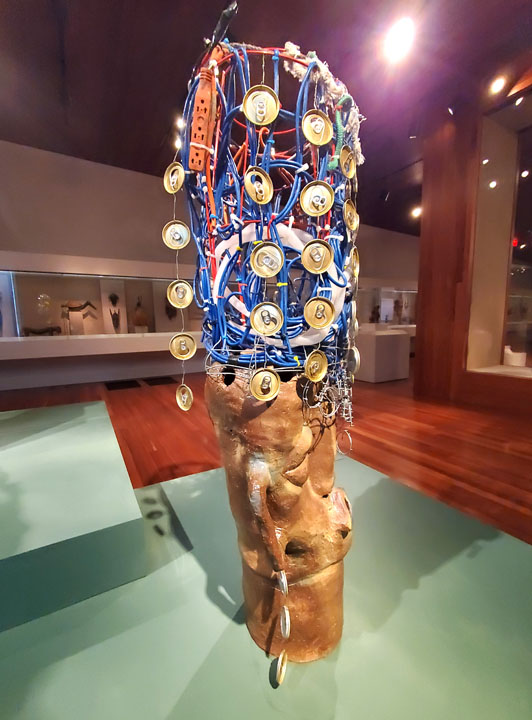
Auntie Muzumganda by Leilah Babirye, Ceramic, wire, and found objects.

Detail.

Leilah Babirye, born in Uganda, works in New York, creating busts, masks, and figures from ceramic and wood. This is her first solo museum show in the United States. Her work highlights the connection between the past and present in African art.

R. Peaceful Bride of Mwanga II, Leilah Babirye, Wood, wax, nails, wire, glue and found objects.

I saw Leilah Babirye’s exhibit when I was at the de Young Museum in July. Her art is displayed in the Art of Africa gallery, alongside the permanent exhibits of masks, paintings and other objects, thus tying Babirye’s work to the larger African tradition. 

Dance mask, Bogadjin people; Headrests, Tami people.

I was intrigued by her use of ordinary household objects and the way they become transformed into vibrant art when incorporated in the sculptures.

Carved wooden figure, Leilah Babirye.

Included in the exhibit is a video installation where we see Leilah Babirye at work in her studio. We see the intense and energetic way she attacks materials, turning them into the forms she intends. As she works we hear her talk about them.  Leilah Babirye’s sculptures, busts and masks are portraits of her LGBTQ+ community. Each one speaks for itself, inviting the viewer to take a closer look.

The exhibit, on the second floor of the museum, runs through October 26, 2025. 

For more information about visiting the de Young Museum of Art, click HERE.


Monday, July 17, 2023

ANSEL ADAMS PHOTOS AT THE DE YOUNG MUSEUM, San Francisco, CA

Photo by Ansel Adams, Marin Hills from Lincoln Park, 1952

It is hard to picture the American West without thinking of Ansel Adams and his iconic black and white photos—of New Mexico, Yosemite, the San Francisco Bay area, and other places in the western US. A spectacular exhibit of 100 of Ansel Adam’s photos is currently on display at the De Young Museum in Golden Gate Park in San Francisco, California, along with the work of other photographers and artists who have been inspired by the same landscapes but interpreted them in their own way. 

At the de Young Museum, San Francisco, CA

The exhibit, called Ansel Adams In Our Time, reveals his continued relevance   “Adams’s legacy continues to inspire and provoke, influencing how we envision the landscape and serving as an urgent call to preserve our environment.”

We visited the museum with our granddaughter on a recent Sunday afternoon, reserving our timed entry tickets ahead of time. The rooms were crowded but people patiently waited their turn to get close to the photos. Only at close view can one appreciate the richness of the tones and sharpness of the images—from the range of grays in billowing clouds to the tiny cross on the top of the church in New Mexico.

The Golden Gate Before the Bridge, 1932. Photograph, gelatin silver print. Museum of Fine Arts, Boston.

Ansel Adams’ (1902-1984) grew up in San Francisco. His family home was not far from the cliffs above Seal Rocks. One of my favorite photos in the exhibit is the one he made one clear morning as storm clouds rolled in toward the Golden Gate. This was in 1932, shortly before the Golden Gate Bridge began construction. (The bridge was completed in 1937.)  He later recalled: “One beautiful storm-chasing morning I looked out the window of our San Francisco home and saw magnificent clouds rolling from the north over the Golden Gate. I grabbed the 8-by-10 equipment and drove to the end of 32nd Avenue, at the edge of Sea Cliff. I dashed along the old Cliff House railroad bed for a short distance, then down to the crest of the promontory. From there a grand view of the Golden Gate commanded me to set up the heavy tripod, attach the camera and lens, and focus on the wonderful evolving landscape of clouds.”

The photo memorializes the vastness of the landscape as it was before its intrusion by human-made objects.

The Golden Gate from Telegraph Hill, photo by Carleton E. Watkins, 1868

The exhibit also includes historical photos, including one by Carleton E. Watkins, The Golden Gate  from Telegraph Hill, 1868. In contrast to Adams’ photo, the city dominates in this view of the Golden Gate entrance to San Francisco Bay while the natural landscape fades into the mist.

Canyon de Chelly National Monument Arizona, printed 1967.

Photos like Canyon de Chelly bring the grandeur of nature to the American public,

Ferns near Kiluea Crater National Park, Hawaii, ca 1948.
while  pictures like these ferns, seen close-up, celebrate the patterns and intricacies of the natural world.

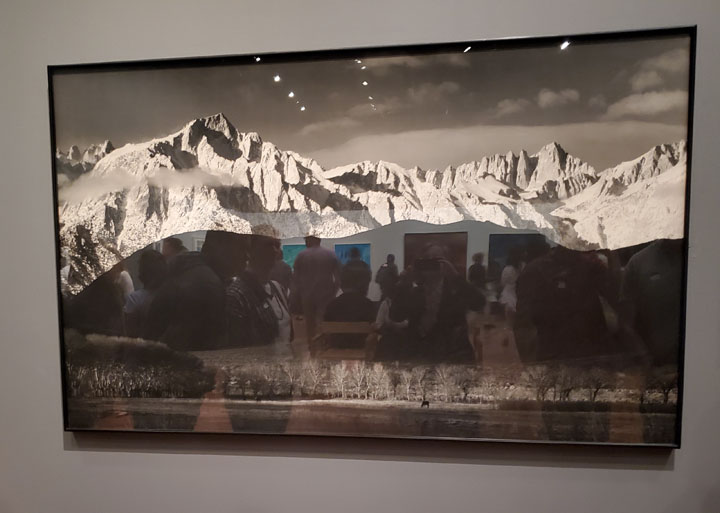
Winter Sunrise, View from Lone Pine.

Most of the photos in the exhibit are relatively small prints requiring close inspection. But in Winter Sunrise, View from Lone Pine, California, printed large and framed in glass, the reflection of the museum gallery on the dark lower slopes creates a collage uniting viewers with the art. It is why people go to museums—to enjoy a personal relationship with the art. At the top of the photo, the snowcapped peaks of the Sierras rise to the skies above the dark hills below ,and at the bottom, frost rimed trees sparkle in the morning light. If you stand to the side to eliminate the reflection, you can see the photo as Ansel Adams intended. It is a brilliant picture.

This is only a small sample of the Ansel Adams photos in the exhibit. The accompanying art work by other artists is also worth a look. The tent camera photos by Abelardo Morell, in which the ground becomes integrated with the view, are unique. I wondered how the images were merged with the photo until I read the description of the method. (See below.)

Tent-Camera photos by Abelardo Morell.

A digital camera captures the reflection of the landscape on the ground in a tent made into a pin-hole camera.

But it is the Ansel Adams photos that are the star of the show. The exhibit will be up at the De Young Museum until August 6, 2023. If you don’t get to see it in person, you can buy the book in the museum shop (which we did) and enjoy it again and again at home.

Monday, September 14, 2015

PAINTING SET FREE: J.M.W. Turner Exhibit at the de Young Museum, San Francisco, CA

Snow Storm–Steam-Boat off a Harbor’s Mouth by J.M.W. Turner
Several weeks ago, when we were in the Bay Area, we made a special trip into San Francisco  to see the spectacular exhibit of Turner paintings at the de Young Museum in Golden Gate Park, J.M.W. Turner: Painting Set Free.
Joseph Mallord William Turner (1775–1851) is one of England's most renowned and prolific painters. This show features works from the last fifteen years of Turner’s life, from 1835 to 1850, a period when some of his most famous paintings, such as Snow Storm–Steam-Boat off a Harbor’s Mouth and The Burning of the Houses of Lords and Commons were created. In these, and other paintings in the exhibit, the canvases swirl with color and light and sky and water seem to merge. In many, the actual subjects become almost secondary to the texture and physical qualities of the paint. Although Turner’s painted more than a century ago, his art feels supremely modern.
These three paintings, illustrating scenes from Virgil's Aeneid, were the last works Turner exhibited at the Royal Academy in London.
Turner loved to travel, which I learned both from the exhibit and from the movie Mr. Turner (Sony Classics, 2014), which I saw earlier this year. In summer, Turner journeyed all over Europe, filling notebooks and sketch pads with scenes of his travels. One room of the exhibit features Turner's “sample studies” which are rough watercolors of various scenic views. When he returned home to London, patrons could choose from these samples and he would create a finished painting for them.

Blue Rigi, sample painting; the Rigi is a large mountain in Switzerland near Lake Lucerne
The Blue Rigi, Sunrise, finished painting
In the movie it is clear that Turner was a man who marched to his own drummer and that he liked to experience life intensely. He claimed that his painting of the Snow Storm was painted after he had sailors lash him to the mast of the boat so that he could feel and experience the wind and power of the storm first hand. Although this claim has never been substantiated, the painting certainly evokes the crashing waves and violent swirl of the elements.
Norham Castle, Sunrise (1845)
The final room of the exhibit displays some of Turner’s most luminescent works. These include Norham Castle, Sunrise (1845) in which the objects seem to float in space and the painting seems to glow from within. Turner's greatness is that he was able to convey the emotional truth of his subjects.

J. M. W. Turner: Painting Set Free was organized by Tate Britain in association with the Fine Arts Museums of San Francisco and the J. Paul Getty Museum in Los Angeles. It is on exhibit at the de Young from June 20 to September 20, 2015.