Showing posts with label bee. Show all posts

Monday, September 23, 2024

AROUND THE WORLD WITH PLANTS at the UC Botanical Garden, Berkeley, CA

View of San Francisco Bay from the UC Botanical Garden, Berkeley, CA.

Fifty years ago, my daughter Jennifer and I posed in front of the sunflowers I was growing along our garden fence in Millbrook, New York. Several weeks ago, on our visit to the University of California Botanical Garden in Berkeley, Jennifer posed in front of a sunflower again, planted in the Crops of the World section.

With Sunflower, 1974.

With Sunflower 2024.

When Jennifer was young and we lived in a house in the country, we planted a huge garden, growing flowers and most of our own vegetables. Today, I still enjoy growing flowers in pots on my patio, but I buy my vegetables from our local Farmer’s Market.


A trip to the Botanical Garden in Berkeley is always a favorite outing with family and friends when we are at our house in Oakland. The 34-acre UC Botanical Garden is the third largest in the United States, featuring more than 10,000 kinds of plants from around the world. It specializes in plants that thrive in a Mediterranean climate similar to that of the San Francisco Bay Area.

Cactus bloom.

After buying our tickets at the front gate, we began our walk, first visiting the exhibits of orchids, cycads and carnivorous plants in the glass houses located just beyond the entrance. 

Gunnera tinctoria, also known as Chilean rhubarb.

From there we followed the paved and gravel paths through the deserts of the Americas, then upward through the Africa, Asian, Australasian, Mediterranean and South American sections, ultimately reaching the garden of old roses with its magnificent view of the garden and San Francisco Bay beyond. It was a warm, but overcast day, perfect for photography. 

Here are a few of our favorite photos from our expedition.

Cactus fruits.


Cactus viewed from above.

The garden was abuzz with bees collecting nectar.

Eryngium Paniculatum, from Argentina.

Sundial in the Garden of Old Roses.


The UC Botanical Garden has a lovely gift shop as well as a garden shop with plants. It puts on many programs for the public, including a monthly Butterfly Walk in summer, which we enjoyed a year ago. (Click on link for my blogpost about the butterfly walk.)


For directions and more information about the UC Botanical Garden, go to their website.


Monday, July 18, 2022

SARAH P. DUKE GARDENS, Durham, NC: The Tranquility of Nature on a Summer's Day

Terraced gardens. Sarah P. Duke Gardens, Durham, NC

From traditional garden flowers to native trees and plants, the Sarah P. Duke Gardens in Durham, North Carolina, offers a plethora of opportunities to appreciate the beauty of nature. Paths meander down shaded paths, around a small lake, through formal planted garden beds, and across grassy lawns. 
Guide to the Sarah P. Duke Gardens.

I recently toured the garden when I was visiting family in nearby Chapel Hill, NC. It was a warm summer day—quite hot in the full sun, but pleasant as long as we stayed in the shade.

Shaded walkway at the garden entrance makes one feel immersed in an Impressionist painting.

After parking and purchasing our tickets, we entered at the gate and proceeded to the rose garden, and from there to the terraced gardens that are part of the Historic Gardens where the Duke Gardens began in 1934. From there we followed trails to the Asiatic Arboretum, which features plants from Southeast Asia. Then, finally, we toured the Garden of Native Plants with its wildlife garden, carnivorous plant collection, and bird viewing shelter.

Purple cone flowers (Echinacea).

It was hard to resist taking photos. Here are a few favorites:

Lily pond at Azalea Court.

Close-up of sacred lotus reveals its bizarre cone shaped center.


Shrine with view of lake and Meyer Bridge

Meyer Bridge in the W.L. Culberson Asiatic Arboretum

A shaded bench in the native plant garden invites visitors to rest and enjoy the view.

A carnivorous plant opens its "jaws", waiting for its next victim.

A bee gathers nectar from an appropriately named beebalm (Lamiacea) blossom. Also called bergamot.

Snowballs the size of melons were in their full glory.

Every day is different at the garden, depending on the weather and time of year. On our visit we enjoyed the height of the summer bloom. The garden is open year round.

Sundial: "Nothing is worth more than this day."

For information about visiting the Duke Gardens, click here: https://gardens.duke.edu/visit


Monday, March 29, 2021

BACK YARD WILDLIFE, Guest Post by Karen Minkowski at The Intrepid Tourist

52 Places to Go: Week 13

Hooded oriole (male)

My friend Karen Minkowski, a dedicated wildlife watcher and keen photographer, has made the most of her Covid confinement by discovering the wealth of wildlife in her Southern California back yard. I thank her for sharing her observations and wonderful photographs with The Intrepid Tourist.

2020 was the year my hiking shoes didn’t get much use…

I stopped walking in LA’s Santa Monica Mountains shortly before the March lockdown was imposed and after that didn’t leave my rented home much at all. Soon, I turned my attention to our suburban backyard, a patch of boring grass partly surrounded by tall mature trees with dense foliage and low maintenance non-native plants. Like millions of other people in their homes, I discovered that my backyard was a safe place to try to connect with a tiny bit of the natural world. And over the next year I saw more wildlife in the yard than I ever expected.

Black phoebe

The diversity of bird species that pass
through the yard is impressive. Some, like this Black Phoebe, visit almost daily. They perch out in the open to ensure a straight flight path to air-borne insects or those hiding in the lawn. Many birds forage in the trees, obscured by the foliage and moving too rapidly for me to capture a clear image, either in my mind or with the camera.

Crows

Crows are common, noisy and highly visible. Here’s one about to feed a begging
youngster.

Eastern fox Squirrel

The ubiquitous Eastern Fox Squirrels are
an introduced (non-native) species in southern California. Their ability to thrive in fragmented habitat has led to the displacement of the Western Gray squirrel, which requires mostly undisturbed wooded or forested areas and now occupies the foothills and mountainous areas. Nonetheless, Fox Squirrels are fun to watch as they dig up edibles buried who knows when from caches they’ve dug in the ground; tumble as they chase each other across the lawn; gnaw on a fallen clothespin; or stretch along a tree limb to soak up the morning sun.

Opossum

Early in the pandemic’s
first spring we spotted an opossum. As I photographed it over the next half hour, it seemed more curious than wary as it watched me. I never saw it again.

Hooded oriole (female)

In April the very vocal Hooded Orioles were likely breeding in the neighbors’ palm
trees. I would see them mostly when they were foraging. They remained in the area for several weeks before migrating south.

A Jacaranda tree dominates the backyard. 

Allen's hummingbird and jacaranda blossoms

Bee feeding on jacaranda blossom

Squirrel eating jacaranda flower

It bloomed in early spring, and by May its purple
blossoms were falling, providing food for at least three different families of animals: Allen’s hummingbird and honeybees drink the nectar, while squirrels ingest the whole flower.

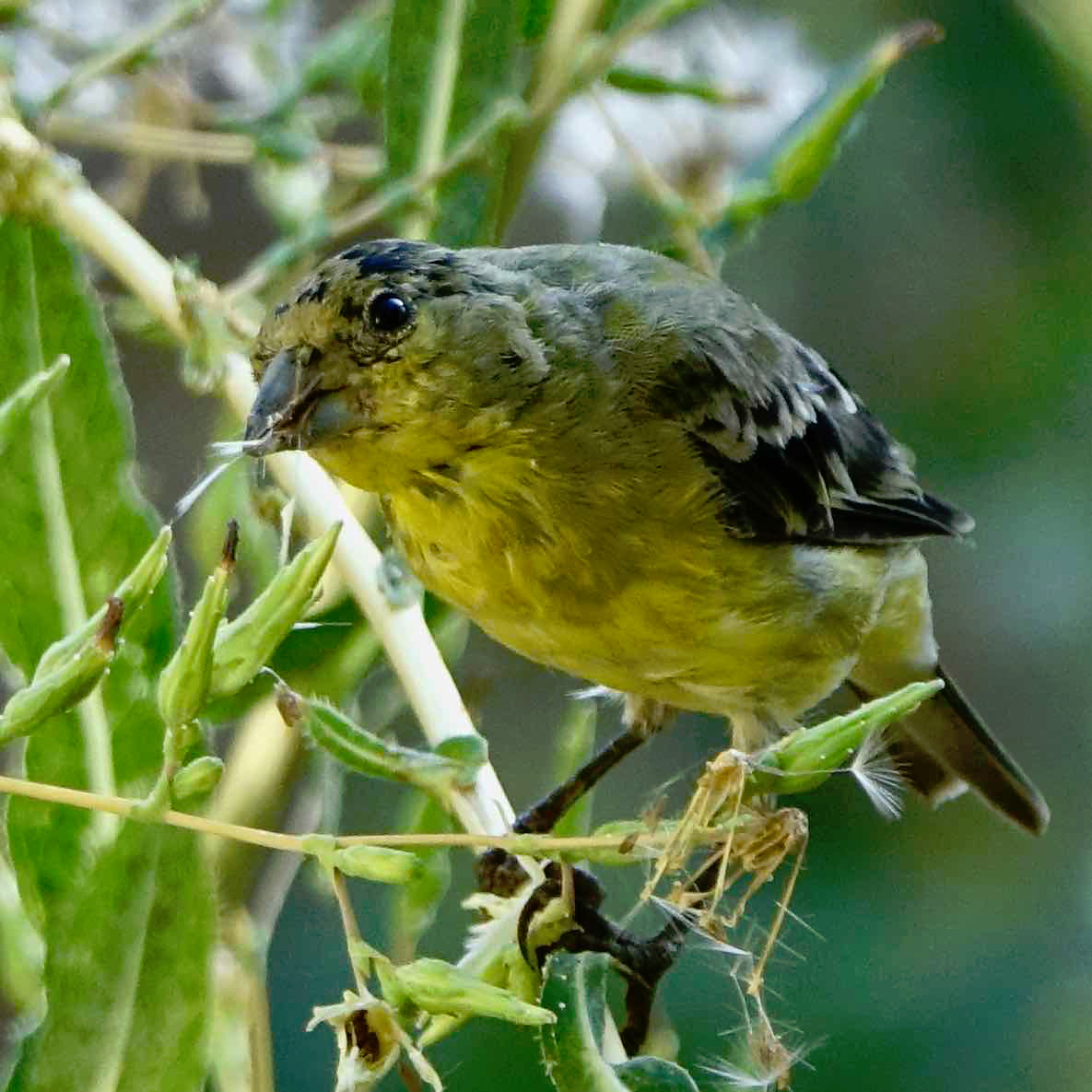
Lesser goldfinch

During late spring and summer I often stood on
a ladder to watch birds in the neglected backyard of the house next door. Filled with flowering weeds, it attracted seed-eaters like this young Lesser Goldfinch (above) and the House Finch (below). 

House finch

One summer morning a bulldozer destroyed this productive patch of
suburbia gone wild, which is now almost completely covered by a construction project to extend and enlarge the existing house.

Cooper’s hawk. This common raptor in the San Fernando Valley nests here beginning in late-March.

For a few days in July a beautiful juvenile
Cooper’s hawk hung out in the backyard.

Allen's hummingbird.

In July I hung a hummingbird feeder and have enjoyed seeing Allen’s hummingbirds many times a day since then.


One early morning in autumn the crows were cawing relentlessly. I went outside to see what was disturbing them and glimpsed the silhouette of what resembled a large house cat high up in a tree. 


Great-horned owl

But something about the shape didn’t seem quite cat-like, and soon the increasing light revealed that we had a spectacular Great-horned Owl in our backyard. The owl rested here for a good twelve hours, rarely moving from its perch and seemingly unperturbed by the incessant vocal harassment of the crows, perched as close as six feet away. Next morning the owl was gone. Months later I still check the tree, awaiting its return.

Yellow-rumped warbler

Winter arrived… Occasionally I spot “new” bird species, like this lovely Yellow-rumped warbler.
It paused just long enough for me to snap its portrait as it darted quickly in search of insects, the winter diet for many omnivorous birds.

Bushtit, another insect eater.

Cedar waxwing

As winter began to wane and vaccines arrived my feet were
itching to walk through forests and woods. 


One day I put on my hiking shoes and drove to Franklin Canyon. Below are a few images of my first 2021 forays.

Red-shouldered hawk

Ruby-crowned kinglet. (The crown is seen only when a male becomes excited during the breeding season.)


California thrasher, singing his lovely song after the rain had stopped.

I still check my backyard, but
enjoying much more my return to LA’s more natural environments.