Showing posts with label NC. Show all posts

Monday, January 2, 2023

WALK IN THE WOODS: Bromley Family Nature Reserve, Chapel Hill, NC

Bromley Family Nature Reserve, Chapel Hill, NC

We were in North Carolina for Thanksgiving and it was a beautiful fall day, so we decided to take a walk in the Bromley Family Nature Reserve, one of many local preserves with trails for hiking and biking.

Wood Duck Way is for both bikers and hikers. A number of bikes passed us on the path. Some trails are for hikers only.

After parking our car, we set off on Wood Duck Way, a circular path about 1.2 long, mostly through forest. While we saw no wood ducks, or much other wildlife, we spotted several nest boxes high in the trees where the wood ducks would lay their eggs in the spring. 

The wood duck nest box is mounted about 6 feet from the ground.
In late November, a few golden leaves still clung to the branches, but most had fallen to the forest floor. Next spring, the leafy carpet will make a soft landing place for the wood ducklings as they leave the nest and plummet to the ground. They will follow their mother's calls to the pond nearby and she will look after them. (The baby ducks can’t fly, but are able swimmers.)

Black vultures.

As we continued down the path we spotted a pair of black vultures circling overhead, the white tips of their wide wings catching the sunlight. They disappeared and a few minutes later we noticed them again, perched on a branch just above the path. What puzzled us was a third vulture, dead on the ground below them, showing no sign of what had caused its demise, and we wondered if it was being mourned by its companions.

A guide to common birds helps to identify species that make their home in the nature preserve.

Midway around the circular path we took a branch that led across a creek and to a small lake and a picnic area.

Beaver dam and lodge with "beaver deceiver" drainage pipe.

On the way to the lake, we passed a beaver dam that had a large drainage pipe going through it. A sign explained that this was a “beaver deceiver” designed to keep a steady flow of water in the creek. Beavers are important to the ecosystem but their dams sometimes cause the paths to flood during rainy periods. By draining excess water behind the dam, but leaving enough to protect the beaver lodge, the paths stay dry for hikers and bikers and the beavers are safe and happy.

Walkway to dock.

Arriving at the lake, we walked out to the dock and peered over the edge, where we spotted numerous turtles paddling about in the shallow water. They too seemed to be enjoying the mild November day. As I looked back toward the shore I could see the reflection of the trees on the shore, their shapes and colors modulated by the ripples in the water, making them seem like a Monet painting. 

Reflections.

It was time to head back to the car and the perfect end to a walk in the woods on a beautiful fall day.


Monday, July 18, 2022

SARAH P. DUKE GARDENS, Durham, NC: The Tranquility of Nature on a Summer's Day

Terraced gardens. Sarah P. Duke Gardens, Durham, NC

From traditional garden flowers to native trees and plants, the Sarah P. Duke Gardens in Durham, North Carolina, offers a plethora of opportunities to appreciate the beauty of nature. Paths meander down shaded paths, around a small lake, through formal planted garden beds, and across grassy lawns. 

Guide to the Sarah P. Duke Gardens.

I recently toured the garden when I was visiting family in nearby Chapel Hill, NC. It was a warm summer day—quite hot in the full sun, but pleasant as long as we stayed in the shade.

Shaded walkway at the garden entrance makes one feel immersed in an Impressionist painting.

After parking and purchasing our tickets, we entered at the gate and proceeded to the rose garden, and from there to the terraced gardens that are part of the Historic Gardens where the Duke Gardens began in 1934. From there we followed trails to the Asiatic Arboretum, which features plants from Southeast Asia. Then, finally, we toured the Garden of Native Plants with its wildlife garden, carnivorous plant collection, and bird viewing shelter.

Purple cone flowers (Echinacea).

It was hard to resist taking photos. Here are a few favorites:

Lily pond at Azalea Court.

Close-up of sacred lotus reveals its bizarre cone shaped center.


Shrine with view of lake and Meyer Bridge

Meyer Bridge in the W.L. Culberson Asiatic Arboretum

A shaded bench in the native plant garden invites visitors to rest and enjoy the view.

A carnivorous plant opens its "jaws", waiting for its next victim.

A bee gathers nectar from an appropriately named beebalm (Lamiacea) blossom. Also called bergamot.

Snowballs the size of melons were in their full glory.

Every day is different at the garden, depending on the weather and time of year. On our visit we enjoyed the height of the summer bloom. The garden is open year round.

Sundial: "Nothing is worth more than this day."

For information about visiting the Duke Gardens, click here: https://gardens.duke.edu/visit


Monday, September 20, 2021

CHIMNEY ROCK STATE PARK, NORTH CAROLINA: Hiking, Nature, and Spectacular Views

52 Places to Go: Week 38

Chimney Rock, North Carolina

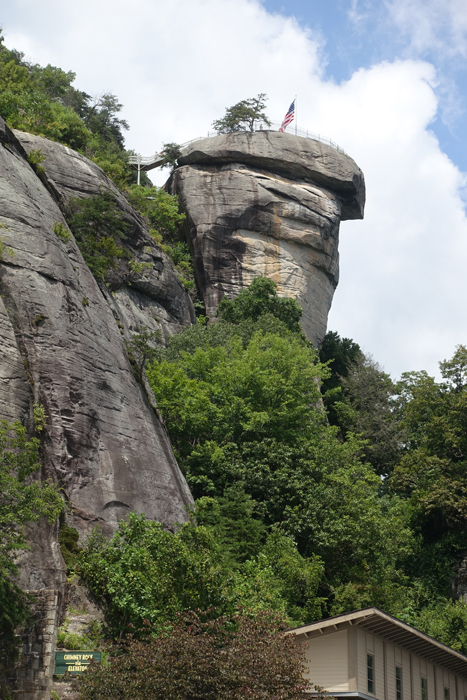
We stood at the railing and gazed almost one thousand feet below to Hickory Nut Gorge and the hills beyond. Like a silver ribbon, the Rocky Broad River threaded its way down the valley into Lake Lure. Above us, steep granite cliffs rose another 400 feet and the towering monolith of Chimney Rock was just a few steps away. We were with our family in Western North Carolina at Chimney Rock State Park for a day of hiking and sightseeing. 

View of Hickory Nut Gorge from the patio outside the Sky Lounge at Chimney Rock

Chimney Rock has a long history. After nearly a century of private ownership, when Chimney Rock was operated as a popular tourist attraction and nature preserve, it became a North Carolina State Park in 2007. During our family vacation at Lake Lure in August, it was on the top of our list of things to do. At Chimney Rock Village, a small community with hotels and tourist shops along the river, about a half hour from our rented house, we followed the sign into the park. 

After crossing the river we wound our way up to the entrance and bought our tickets for the day. By the time we arrived (about 11:00 am) the upper parking lot was full. We were directed to the lower parking area, the Meadows, and caught a shuttle bus to the parking area at the base of Chimney Rock. But we weren’t there yet! 

Stairway from the upper parking lot to Chimney Rock.

The energetic members of our family climbed a series of stairs from there to the top. Art and I took the elevator–blasted into the rock in the past by the original owners--and shot up nine stories to the top in less than a minute, and with much less effort than it would have been to walk.
Chimney Rock, Elevation 2280 feet (315 meters)

From the patio outside the Sky Lounge a short stairway led to the top of Chimney Rock–but even from the railing of the patio the view was spectacular. After appreciating the view, we bought sandwiches at  the café inside the Sky Lounge and ate them at a picnic table outside.
Beginning of Hickory Nut Falls Trail.

There are numerous opportunities for hiking in the park. After lunch, we took the Hickory Nut Falls trail, which begins at the end of the upper parking lot, going down stairs to join the trail.

Trail to Hickory Nut Falls is 1.4 miles round trip.

Following a wide, shaded path we walked gradually uphill through thick woodland. Scenes from several movies have been shot in Chimney Rock park, including Last of the Mohicans, and as we walked through the forest it was easy to imagine that the scenery must have been much the same long ago when the area was inhabited by Native Americans.
Hickory Nut Falls is formed by Falls Creek, which starts from natural springs on the top of Chimney Rock Mountain. 

At the end of the trail, Hickory Nut Falls cascade down the granite face of the mountain. At a height of 404 feet, it is one of the highest waterfalls east of the Mississippi. 

View from the bottom of Hickory Nut Falls toward Hickory Nut Gorge. The stream continues down a rocky ravine into the Rocky Broad River.

While resting on the rocks at the base of the falls, we caught our breath and watched dozens of fish swimming in the shallow pool. While our family was not alone admiring the falls, it wasn’t crowded, and it was easy to keep our social distance from other people.
Hickory Nut Falls.

We visited Chimney Rock on a sunny August day, midweek. The temperature was warm, but comfortable for hiking. The park is open year-round with activities to fit the season. For more information about visiting Chimney Rock, click HERE.

The round trip to Hickory Nut Falls (1.4 miles) takes 45 minutes--1 hour.


All text and photos copyright Caroline Arnold at The Intrepid Tourist.


Monday, September 6, 2021

FLOWERING BRIDGE, Lake Lure, North Carolina: A Real and Miniature World

52 Places to Go: Week 36

Lake Lure Flowering Bridge, Lake Lure, NC

From roses to succulents, pollinator gardens to art installations, the Flowering Bridge at Lake Lure, in the mountains of western North Carolina, is a wonder of nature and testament to the volunteers who turned an abandoned bridge into a beautiful floral walkway. 

View toward Chimney Rock from the Flowering Bridge

The project began in 2012, when gardens were first planted at either end of the bridge and then in following years on the bridge itself. I visited the Flowering Bridge in August 2021, on a trip with my family. As we wandered the 550 foot path across the bridge, each turn gave us a new view--of the plants and flowers themselves, art objects, mirrors, and ornaments decorating the garden, the Broad River that flows under the bridge, and the wooded mountains that rise above the valley.

Rabbit and tiny fairy angel along the path.

And tucked among the plants was a host of delightful surprises–tiny scenes with miniature figures in a fairy-tale like world. 

Tiny log home with wishing well and fairy perched in a knothole window.

In some, wooden stumps and clumps of moss were turned into tiny forest homes. Other scenes were nestled into open spaces among the plants. Occupants varied from tiny gnomes and fairy figures, to little people and animals.

Mr. McGregor's Garden and Peter Rabbit's family.

Peter Rabbit and his little blue coat.

Each of the thirty garden areas has a theme. Peter Rabbit Children’s Garden features a scene from Mr. MacGregor’s garden, which, if you remember, Peter Rabbit visited when he should have been picking blackberries with his brothers and sisters, Flopsy, Mopsy and Cottontail. If you look carefully, you can find Peter--and his blue coat that he left behind as he escaped from Mr. McGregor who was said to have turned Peter's unfortunate father into a pie.

Bringing home a plant for the garden.

Getting ready for a mini-barbeque.

Among my favorites of the various tiny scenes were two gnomes with a miniature grill outside their tree stump home. Another favorite was a small pickup truck pulling a tiny teardrop camper.The fairy scenes are on display between June 1 and September 7. They change from year to year.

Guides and maps to the garden are available at the entrance.

At the beginning of the walk, informational panels tell the history of the garden walk project and provide guides to some of the wildlife–birds, bees, butterflies–one might encounter in the garden. The Lake Lure Flowering Bridge is a stop along the Rosalynn Carter Butterfly Trail, which begins in Plains, Georgia, at the home of President and Mrs. Jimmy Carter. The mission of the trail is to promote the full life cycle of butterflies common in this area with a special emphasis on the monarch.
Mirror, mirror on the Wall! Throughout the garden, various mirrors reflect both the plants and visitors!

My visit to the Lake Lure Flowering Bridge was at the beginning of August, when summer flowers were in full bloom. The garden is free and open to the public year round.  For more information go to www.lakelureflowergingbridge.org .

A day the beach for tiny garden gnomes.
All text and photos copyright Caroline Arnold at The Intrepid Tourist.

Monday, September 9, 2019

BEYOND CURIE: Celebrating Women in Science at the Museum of Natural Sciences, Raleigh, NC

Beyond Curie: A Celebration of Women in Science, Exhibit at the North Carolina Museum of Natural Sciences; photo of Marie Curie, Polish/French Scientist, 1903
Chances are that you know about Marie Curie, the scientist who did pioneering work on radioactivity, and Rachel Carson, whose book Silent Spring alerted the world to the dangers of DDT, but what about Mae Jemison, the first black woman to travel in space or Grace Hopper, the computer scientist whose many accomplishments include coining the word “computer bug” after finding a moth in an early computer machine.
Mae Jemison. On September 12, 1992 she flew into space on the Shuttle Endeavour
These women and 36 more are featured in the exhibit, Beyond Curie at the Museum of Natural Sciences in Raleigh, North Carolina, a celebration of women scientists, all of whom surmounted incredible odds in the pursuit of knowledge, understanding, and impact.
Rachel Carson's book Silent Spring was published in 1962
On a recent trip to North Carolina, I spent a day at the Museum of Natural Sciences and had a chance to visit the Beyond Curie exhibit. Each of the women scientists is profiled on a large poster, which includes her photograph and highlights of her achievements. If you download an app to your phone, you can also discover 3-D images associated with the displays.
Here is a selection of a few of the remarkable women you featured in the exhibit.
Rose Frisch's research led to the discovery of the hormone that regulates hunger, fat and puberty.

Kalpana Chawla, an American astronaut, was the first woman of Indian origin to fly in space

Diane Figueroa, a noted marine biologist, is also an ambassador for science education.
Grace Hopper, a computer scientist, was also a Rear Admiral in the US Navy.
Lisa Ng and her team helped contain and treat the epidemic infections from the SARS and avian "bird" flu viruses.
Mildred Dresselhaus, an outstanding carbon physicist, was the first female president of the American Association of the Advancement of Science
Margaret Ann Bulkley had a brilliant career, posing as a man named James Barry. It was not discovered that she was female until after her death.