 |
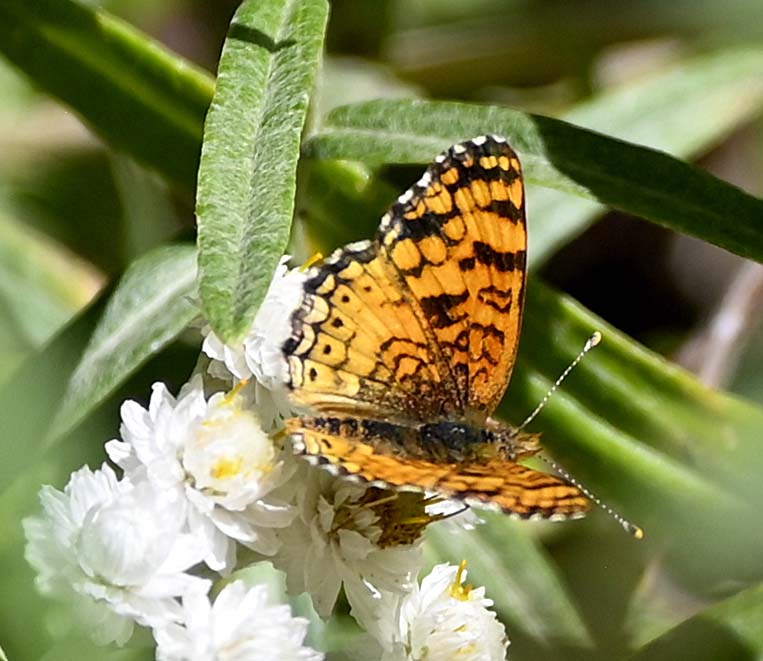
| Mylitta Crescent butterfly at the UC Botanical Garden, Berkeley, CA |
It is said that only mad dogs and Englishmen go out in the midday sun. Add to that list: butterfly enthusiasts. Butterflies like the sun—using it to heat their bodies—and the best time to see them is on a warm, sunny day. So, on a warm, August afternoon we joined a group at the UCBotanical Garden in Berkeley, California, for a one hour guided butterfly walk through the garden.
 |
| Viewing photos and caterpillars at the entrance to the garden. |
 |
| Looking for butterflies in the desert section of the garden. |
When I was growing up in the Midwest, my brothers and I collected butterflies--catching them in a net, killing them, and mounting them in glass-fronted boxes for our home “museum.” We learned to be careful as we handled them, not to touch their delicate wings and rub off the tiny colored scales. We also learned how to distinguish a butterfly from a moth by looking at the antennae—club shaped for butterflies and feather-like for moths. Now I prefer to appreciate butterflies free in the wild—although it is much harder to get a close-up look at them.
Before we set out on our walk, we each got a checklist
for the species we hoped to see. It was divided into three sections: Likely
sightings (5), Less Likely (5), and Even less likely (4). At the end of the
walk we had spotted all five likely species (Acmon blue, Cabbage white, Field Crescent, Gray Buckeye, Mylitta Crescent), two of the less likely (Common checkered skipper, Monarch), and one
that was not even on the list—a fritillary!
 |
| Mylitta Crescent on an aster |
Of all the butterflies we saw, the only one that stayed still long enough for a good photograph (taken by Art) was a Mylittta Crescent. And I got reasonably close to an Acmon Blue for a photo. But the other butterflies were too far away, even with a telephoto lens.
 |
| Acmon Blue butterfly |
The butterflies that I am familiar with—monarchs, swallowtails, cabbage whites—are easy to spot in the wild. But many of the butterflies on the list were small—some less than an inch across—as well as speedy fliers. Once spotted, we hoped they would land so we could at least see their markings through binoculars. We were impressed by Sarab Seth’s ability to identify them in flight, even from a distance. Along the way, Sarab Seth pointed out which plants were preferred by each species—which helped in knowing where to look for the butterflies.
 |
| Anise swallowtail caterpillar. |
Our first stop was at an angelica plant, a favorite of the anise butterfly. Sarab pointed out a caterpillar, still eating but which would soon be ready to form a chrysalis.
 |
| Anise swallowtail butterfly egg on an angelica leaf. (Look for the tiny white spot.) |
Sarab also showed us a single anise butterfly egg (which he had discovered earlier on the same plant), tucked carefully under a leaf. In a few days it would hatch into a tiny caterpillar, which would then grow rapidly over the next few weeks, continuing the cycle.
 |
| Monarch butterfly, photographed in our Oakland neighborhood |
The largest butterfly we spotted during our walk was a monarch—hard to miss with its handsome orange and black coloring. We see them often on walks in our Oakland neighborhood. When asked about the annual monarch migration, Sarab said that the monarch butterflies tend to stick around all year in the garden (unlike in the past when they gathered in clusters in trees along the California coast) because so many people plant milkweed in their gardens.
At the end of our walk we returned to the shade—leaving
the bright sunny spots to the butterflies. I was glad I learned about these California
butterflies that make the UC Botanical Garden their home. At the bottom of our
checklist Sarab gave us the link to his Facebook page with photographs he has
taken of 44 butterfly species in the garden. They are gorgeous! Click to enjoy—without having to go out
in the midsummer sun!
 |
| Wildflower in the UC Botanical Garden. |


