Showing posts with label pisco. Show all posts

Monday, November 15, 2021

From EMPANADAS to PISCO SOURS: Enjoying Chile’s Favorite Foods

 52 Places to Go: Week 46

Individual bowls of Pastel de Choclo, a favorite Chilean dish, ready to bake in the clay oven.
On our recent trip to Chile it seemed that every meal was a feast–ranging from sumptuous hotel buffets to large family holiday parties to picnics in the country to meals in local restaurants–each time giving us tastes of delicious Chilean foods.
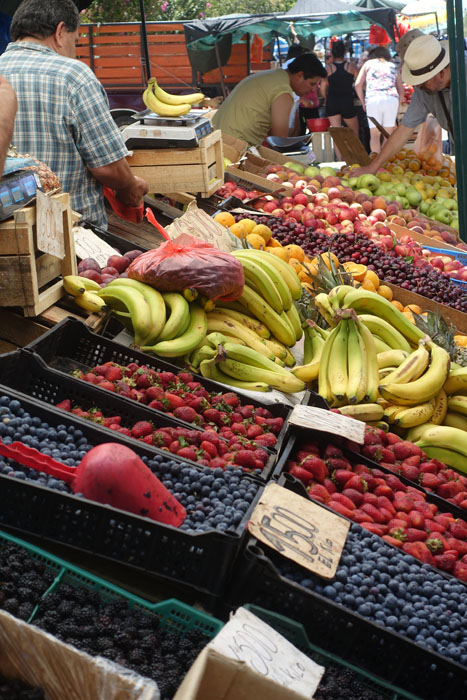
Blackberries, blueberries, strawberries and more fill the summertime farmer's markets.
It was December, the beginning of the southern summer, and the markets, or ferias, were full of juicy, locally grown, ripe fruits and vegetables. Many meals were eaten outdoors, often cooked on a barbecue or in a woodburning clay oven (horno.) And every meal included side dishes of tomatoes (tomates, always peeled), lettuce (lechuga), sliced cucumbers (pepinos) and avocados (palta.)
Typical side dishes. String beans, julienned and served as a cold salad, are a traditional Christmas dish.
A classic dish of Chile is pastel de choclo, a kind of casserole made of beef, chicken, onions, olives, raisins, and a wedge of hard boiled egg, which is then covered in a corn pudding topping and baked in a clay oven. We had pastel de choclo at a family party where guests formed an assembly line to prepare the ingredients. Each serving was cooked in the outdoor clay oven in its own ceramic bowl and then served steaming hot at a long picnic table.
Humitas. They can be made savory, sweet, or sweet and sour, served with added sugar, chile pepper, salt and paprika
The same corn mixture was used to make humitas, similar to tamales, but cooked in fresh rather than dried corn husks. I helped to make the humitas–my job was to secure the husks with a string made from a thin strip of a long leaf, making them look like fat bowties. The humitas were then steamed in a large pot on top of the stove.
Empanadas ready to bake.
Another classic dish of Chile, and elsewhere in South America, is the empanada, a kind of individual meat pie. They are fried or baked (empadanas del horno.)  Empanadas can be filled with meat, cheese, vegetables or other ingredients, but the typical filling in Chile is pino, a meat mixture made of beef, onions and herbs.
Clay oven with  empanadas inside.
During our trip, we spent three days in the country where our son-in-law’s father lives, enjoying fresh milk and vegetables every day from his neighbor’s farm and eating homemade empanadas.
Roadside stand for "The place where you can buy houseplants, beans, tomatoes, and lettuce."
The project of the visit was not only to make the empanadas (I helped roll the dough) but to build the clay oven!
At another family party during our trip, the main dish was cocimiento, a rich stew of vegetables, beef, chicken, fish and seafood (clams and mussels), flavored with wine and cooked slowly in a large pot over a barbecue. It is a bit like paella without the rice. Fish is delicious in Chile and we enjoyed it at several meals during our stay. With a coastline 2,653 miles long, a wide assortment of fish and seafood is always fresh and available.
"The King of Mote con Huesillo" offers drinks at his stand in the main plaza in Temuco. In the background are Chilean palm trees, whose flowers are used by bees to make honey.
Mote con Huesillo. The barley and peach sink to the bottom.
A typical summer drink in Chile is called mote con huesillo, made from dried peaches soaked in water to make a kind of tea, to which sugar and cooked barley is added. On a warm day it is very refreshing!
Enjoying a cafe helado.

On one of our restaurant visits my grandchildren ordered café helados another favorite Chilean treat. It sounds like it should be iced coffee, but café helado is actually an ice cream soda made with coffee, ice cream, and topped with whipped cream and wafer cookies–more like a dessert than a drink!
And, of course, on New Year’s Eve we drank the classic pisco sours, a lemon flavored drink similar to a whiskey sour, but flavored instead with pisco, a distilled alcohol made from grapes that is unique to Peru and Chile. (My only photos are of empty glasses so you'll have to imagine what our pisco sours looked like!)
And these are just a sample of Chile's delicious foods!  

This article first appeared 2/4/19

All text and photos copyright by Caroline Arnold.


Monday, February 4, 2019

From EMPANADAS to PISCO SOURS: Enjoying Chile’s Favorite Foods

Individual bowls of Pastel de Choclo, a favorite Chilean dish, ready to bake in the clay oven.
On our recent trip to Chile it seemed that every meal was a feast–ranging from sumptuous hotel buffets to large family holiday parties to picnics in the country to meals in local restaurants–each time giving us tastes of delicious Chilean foods.
Blackberries, blueberries, strawberries and more fill the summertime farmer's markets.
It was December, the beginning of the southern summer, and the markets, or ferias, were full of juicy, locally grown, ripe fruits and vegetables. Many meals were eaten outdoors, often cooked on a barbecue or in a woodburning clay oven (horno.) And every meal included side dishes of tomatoes (tomates, always peeled), lettuce (lechuga), sliced cucumbers (pepinos) and avocados (palta.)
Typical side dishes. String beans, julienned and served as a cold salad, are a traditional Christmas dish.
A classic dish of Chile is pastel de choclo, a kind of casserole made of beef, chicken, onions, olives, raisins, and a wedge of hard boiled egg, which is then covered in a corn pudding topping and baked in a clay oven. We had pastel de choclo at a family party where guests formed an assembly line to prepare the ingredients. Each serving was cooked in the outdoor clay oven in its own ceramic bowl and then served steaming hot at a long picnic table.
Humitas. They can be made savory, sweet, or sweet and sour, served with added sugar, chile pepper, salt and paprika
The same corn mixture was used to make humitas, similar to tamales, but cooked in fresh rather than dried corn husks. I helped to make the humitas–my job was to secure the husks with a string made from a thin strip of a long leaf, making them look like fat bowties. The humitas were then steamed in a large pot on top of the stove.
Empanadas ready to bake.
Another classic dish of Chile, and elsewhere in South America, is the empanada, a kind of individual meat pie. They are fried or baked (empadanas del horno.)  Empanadas can be filled with meat, cheese, vegetables or other ingredients, but the typical filling in Chile is pino, a meat mixture made of beef, onions and herbs.
Clay oven with  empanadas inside.
During our trip, we spent three days in the country where our son-in-law’s father lives, enjoying fresh milk and vegetables every day from his neighbor’s farm and eating homemade empanadas.
Roadside stand for "The place where you can buy houseplants, beans, tomatoes, and lettuce."
The project of the visit was not only to make the empanadas (I helped roll the dough) but to build the clay oven!
At another family party during our trip, the main dish was cocimiento, a rich stew of vegetables, beef, chicken, fish and seafood (clams and mussels), flavored with wine and cooked slowly in a large pot over a barbecue. It is a bit like paella without the rice. Fish is delicious in Chile and we enjoyed it at several meals during our stay. With a coastline 2,653 miles long, a wide assortment of fish and seafood is always fresh and available.
"The King of Mote con Huesillo" offers drinks at his stand in the main plaza in Temuco. In the background are Chilean palm trees, whose flowers are used by bees to make honey.
Mote con Huesillo. The barley and peach sink to the bottom.
A typical summer drink in Chile is called mote con huesillo, made from dried peaches soaked in water to make a kind of tea, to which sugar and cooked barley is added. On a warm day it is very refreshing!
Enjoying a cafe helado.
On one of our restaurant visits my grandchildren ordered café helados another favorite Chilean treat. It sounds like it should be iced coffee, but café helado is actually an ice cream soda made with coffee, ice cream, and topped with whipped cream and wafer cookies–more like a dessert than a drink!
And, of course, on New Year’s Eve we drank the classic pisco sours, a lemon flavored drink similar to a whiskey sour, but flavored instead with pisco, a distilled alcohol made from grapes that is unique to Peru and Chile. (My only photos are of empty glasses so you'll have to imagine what our pisco sours looked like!)
And these are just a sample of Chile's delicious foods! 

Monday, May 23, 2011

Chile: Atacama Desert, Part I

Flamingos, Oases, and Volcanoes (December 2009)

Flamingos in the Salar de Atacama
Like a bevy of pink ballerinas, the flamingos tip-toed across the salty lagoon, sweeping their wide bills through the shallow water in search of food. Then, with a burst of wide wings they launched themselves into the sky, and became silhouetted against the sunset and the towering mountains of northern Chile. We were in the Atacama desert, a land of stark beauty and surprising wildlife. With less than an inch of rainfall each year, the Atacama is the driest desert in the world. And yet, it has been home to people and wildlife for thousands of years.

At the Foot of the Andes
To get to the Atacama, we had flown north from Santiago to the mining town of Calama. As the plane descended into the airport we circled over a giant hole in the earth, the largest open pit copper mine in the world. Trucks loaded with copper ore looked like toys as they wound their way up its steep sides. At the airport we were met by Juan, our driver from the Tierra Atacama, our hotel in San Pedro de Atacama, the oasis town 75 miles away that would be our base. It was December, early summer in the southern hemisphere. Technically we were in the tropics, but the altitude, about 8,500 feet, meant that the temperatures were comfortable.

View of the volcano Licancabur from our room at the Tierra Atacama

At the hotel we were escorted through a garden of newly planted flowers and fig trees to our spacious room. We had a direct view of the volcano Licancabur, which at 19,400 feet high dominates the skyline and has been imbued with religious significance since ancient times.
Our all inclusive plan meant that everything for our stay was taken care of–meals, transportation, guides, entertainment. So, before relaxing with our pisco sours (the classic Chilean cocktail), we met with the trip planner who wanted to make sure that our three days would be filled with the activities we desired.

San Pedro and Toconao, Oases in the Desert
For day one, we chose a morning trip to the Valley of the Moon, spectacular rock formations just to the north of San Pedro.
View of the Valley of the Moon
After lunch, on bicycles provided by the hotel, we rode over the bumpy dirt road about a mile into the center of town. Fed by water flowing down from the mountains, San Pedro de Atacama has long been an agricultural center and was a stopping place for Pedro de Valdivia, one of the founders of Chile, as he made his way south from Peru in 1540. Near the main plaza there is a church and small museum containing ancient artifacts. A covered arcade nearby has souvenir stalls with blankets, pottery, jewelry, and other crafts, mostly from Peru (to the north) or Bolivia (a few miles to the east, on the back side of Licancabur.)

At 5:00 we met our guide and fellow travelers for a trip to the National Flamingo Reserve. En route we stopped at the small oasis town of Toconao where we toured terraced gardens filled with apricot, quince, fig, and other fruit trees. We also went into the historic church to see an elaborate Christmas manger scene, complete with llamas, a volcano, and tiny glass flamingos.

Flamingos and Giant Salt Flats
We then climbed back into the van and drove along a road of finely crushed salt through the sea of jagged crystals that form the giant salt flat of the Salar de Atacama, once an ancient inland sea. Before following the walkway to the lagoons, we toured the small visitor center to see exhibits of the flamingo life cycle. Three species of flamingos can be seen feeding in the lagoons, the Chilean, Andean and James flamingos. Periodically the birds launch themselves into the air, flapping their wide wings and honking like geese as they rearrange themselves for the night. As we watched the birds, the sun slowly sank in the west, turning the hills first orange, then pink, and finally the sky grew dark, revealing the unfamiliar southern constellations, sparkling in the clear, dry air. It was a spectacular end to our first day.
Sunset and Flamingos

Part II will cover our visits to ancient petroglyphs and the Tatio Geysers.

Getting there: After flying from the U.S. to Santiago, the capitol of Chile, we took a local flight on Sky Airlines to Calama. Lan Chile also flies there. (Calama is 1225 kilometers from Santiago.) Our ground transportation to and around San Pedro was provided by our hotel, the Tierra Atacama, but it is possible to rent a car and drive yourself. (The main road is paved but most other roads are dirt.) Click here for a MAP of Chile. (Calama and San Pedro de Atacama are east of Antofagasta near the Bolivia border.)
Did we need to speak Spanish? Although we can get along in basic Spanish, almost everyone at the hotel spoke English. English was the international language for us and the other international tourists, many from Brazil and Europe. Except for one person, there were no other Americans at our hotel.
When did we go to Chile? Art and I made this trip to the Atacama in December 2009. We also spent time in Santiago, Rancagua, and the beach town of Iloca (later greatly damaged by the earthquake and tsunami.)