Showing posts with label Point Knox. Show all posts

Monday, September 5, 2022

MILLS COLLEGE, OAKLAND, CA: Nature Walk and Window Onto History

Mills College, Oakland, CA
In the middle of Oakland sits the campus of Mills College, an island of greenery around academic buildings and a place where local residents go to play sports on the playing fields, walk along tree lined paths, birdwatch, and generally enjoy nature. Established as a women’s college in 1885, Mills College will transform to a campus of Northeastern University in Boston in the fall of 2022.

Mills Young Ladies Seminary, about 1873. Mills Hall and students.

Mills College began as a Young Ladies Seminary in 1852 in Benicia, CA, moved to Oakland in 1871, and was chartered as a college in 1885. Juliet Fish Nichols (1859-1947), the subject of my new book, Keeper of the Light: Juliet Fish Nichols Fights the San Francisco Fog, was one of the first graduates. 

Olin Library at Mills College. 

Earlier this year, on a Sunday afternoon in June, Art and I took a walk on the Mills campus. I wanted to see Mills Hall, the building where Juliet had lived and attended classes when she was a student.

Mills Hall, 2022.

It is likely that one of the girls seated on the lawn in the 1873 photograph is Juliet, then fourteen years old. (The identity of the girls is not noted on the photograph.) At the time, Mills Hall was the only structure on campus. It contained classrooms and offices as well as housing for faculty and the young women who were the students. Now it is used as an administration building. 

The Bell Tower, designed by architect Julia Morgan. 

Gradually, the college grew, with facilities for the arts, sciences, music, sports and other disciplines. In 1904, the bell tower, El Campanil, designed by Julia Morgan was built in the southeast quadrant of the campus, across from Mills Hall.

A grove of California Bay Laurel trees on the Mills College campus.

In the first years the land around the new campus was quite open except for a few native oak trees. More than one thousand trees were planted, now grown to stately heights. As you walk around the campus today, you feel like you are in an arboretum, with trees and plants identified, and a nature trail along Leona Creek, which flows through the campus. 

A bridge crosses Leona Creek, which flows from the Oakland hills to San Francisco Bay.

The day I visited was shortly after graduation (chairs were still set up on the lawn) and few people were around. It was easy to imagine what it must have been like more than one hundred years ago when Juliet was a student.

Juliet Fish was born in Shanghai, China, where her father, Dr. Melancthon Fish, was serving as a medical missionary and United States consul. The family returned to the United States when Juliet was three. Juliet grew up in Oakland, California, and attended Mills Seminary for Young Ladies, where the goals were good health and a classical education. A daily outdoor walk of at least one mile was required. Students also worked out with dumbbells, Indian clubs and wands—so Juliet was well prepared for the physical demands of her later lighthouse work.

When Juliet was a student at Mills, she would have walked along shaded paths like this one lined with blackberry vines.

In 1888, Juliet married Commander Henry Nichols of the U.S. Navy, who became Superintendent of the 12th Lighthouse District along the coast of California. They had no children. In 1899, Henry Nichols was sent to the Philippines during the Spanish-American War, where he died of heat stroke, leaving Juliet without financial support.

Angel Island Lighthouse and Bell Station, as it appeared when Juliet lived there.

When Juliet learned that the lighthouse keeper on Angel Island was retiring, she applied for the job. Juliet served as lighthouse keeper at Point Knox on Angel Island from 1902 to 1914. Upon her retirement, Juliet lived the rest of her life in Oakland. She is buried in the family plot at Mountain View Cemetery in Oakland.

Except for her lighthouse log and official letters and reports, Juliet Fish Nichols left few clues to her personal life. As I walked around the Mills Campus, I felt that in a small way I was able to share Juliet’s experience as a student and get a bit of insight to her life.

I donated at copy of my book Keeper of the Light to the Olin Library at Mills College in honor of Juliet Nichols. 

For more about Juliet Fish Nichols and Angel Island go to my posts of September 2017 and July 2012.

Additional information about Juliet Nichols, her log, Angel Island, the Point Knox Lighthouse, 1906 San Francisco earthquake, and more is at https://carolinearnoldart.blogspot.com/p/extra-material-for-keeper-of-light.html .


Monday, September 25, 2017

ANGEL ISLAND IN SAN FRANCISCO BAY: a Trip Through Time

View of Golden Gate Bridge from Camp Reynolds on Angel Island, San Francisco Bay
Several weeks ago, I went with my husband and granddaughter to Angel Island in San Francisco Bay, taking the ferry from Tiburon for the short ride to Ayala Cove.
Ferry to Angel Island--about a mile from Tiburon and three miles from San Francisco.
Angel Island, a California State Park, is a great place for hiking and watching wildlife and a chance to explore and learn about the island’s unique role in California history.
Angel Island. At 1.2 square miles Angel Island is the largest island in San Francisco Bay.
After leaving the boat, our first stop was the Visitor Center, where several rooms of displays gave an overview of the many facets of the island. 
Historic plaque near the picnic area and visitor center at Ayala Cove. Headquarters of the park are also housed in the old U.S. Public Health Service Building.
For thousands of years Native American Miwok Indians from the mainland visited the island, hunting, fishing, and gathering acorns and other wild plants. Today, native wildlife includes birds, squirrels, deer and a species of mole unique to the island.
A young mule deer stopped by, seemingly unafraid, as we ate our picnic lunch.
The first European to land on the island was Spanish explorer Juan Manuel de Ayala, who moored his ship in the small cove on the north side of the island in the fall of 1775.  Following the tradition of naming discoveries after the closest feast day, he named it Angel Island in honor of the Feast of the Angels, celebrated on October 2nd.
From 1910 to 1940 hundreds of thousands of immigrants, mostly from China, were processed at the Angel Island Immigration Station.  We did not have time on this trip to go to the Immigration Station but plan to do so on another visit. 
Angel Island has had many uses over the years. Among other things it has been a cattle ranch, military base, immigration station, and quarantine station.
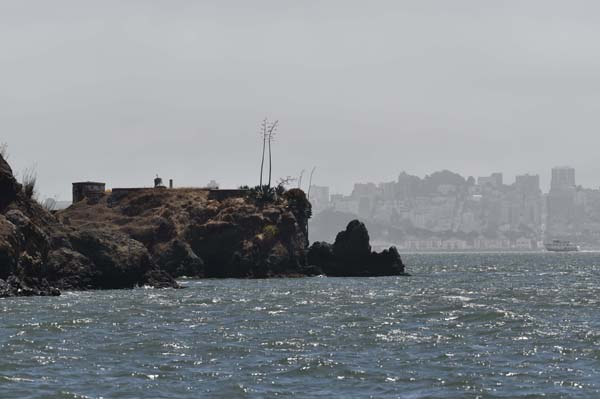
The rocky platform at Point Knox where the lighthouse once stood. Only the fog bell remains. In 1960 a new, more modern lighthouse and fog station was opened at Point Blunt on Angel Island and the Point Knox lighthouse and fog station was closed and removed.
The first lighthouse on Angel Island was a fog station, built in 1886 at Point Knox, a rocky outcropping on the southwest corner of the island. A light was added in 1900. One of the keepers was Juliet Fish Nichols whose heroics after the 1906 earthquake I wrote about in an earlier post on this blog.  On foggy days and nights, her job was to set the fog bell machine in motion. The 3000 pound bronze bell at Point Knox was operated by a Gamewell Fog Bell Striker machine, in which a heavy weight suspended below the mechanism powered a mallet that struck the bell.  Once the mechanism was wound, it ran for several hours.  Gamewell mechanisms were used widely at lighthouses along the coasts of the United States for many years, but were known to be temperamental.  Juliet Fish Nichols reported in her log at least eight failures of the Point Knox bell machine.  Eventually, (after the 1930's) the fog bell at Point Knox was replaced by a much more reliable compressed air siren.
Fresnel lens on display at the Visitor Center; a photo of the Point Knox Lighthouse is behind it.
The light at Point Knox was a type known as a Fresnel lens.  The glass rings of a Fresnel lens are prisms that concentrate light from inside the lens (originally provided by an oil or kerosene lamp, later by an electric bulb) making the light visible for 20 miles or more.  The lenses came in various sizes. The light at Point Knox was a 5th order red lens, one of the smaller Fresnel lenses, but sufficient for distances in San Francisco Bay.
The barracks of Camp Reynolds, the West Garrison of Fort McDowell
The remains of Fort McDowell, both the earlier West Garrison (Fort Reynolds) and the larger East Garrison are found on the island. Thousands of soldiers left from Angel Island during World War I and II. After World War II, the military bases were closed. A Nike missile site was installed on top of the island; after it was removed in 1962, the U.S. government gave Angel Island to the state of California. It is now Angel Island State Park, a fascinating place to spend the day and to relive a bit of California history.

Facilities on Angel Island include a cafe, tram tours, and Segway and kayak rentals. For more information about Angel Island and links to ferry schedules, click HERE.
For more about the history of the island and activities, go to the Angel Island Conservancy site.

For more about Juliet Nichols, her log, Angel Island, the Point Knox Lighthouse, 1906 San Francisco earthquake, and more go to https://carolinearnoldart.blogspot.com/p/extra-material-for-keeper-of-light.html .