 |
| Houses of Parliament, London. |
With many thanks to my daughter Jennifer for her report of her recent trip to London with my grandson, who met her there during the spring break from his semester abroad in Madrid. They packed a lot in during the week they were in London!
My son and I recently spent a week being tourists in London
(Easter week 2025), visiting some of the major sites and learning about British
history and contemporary life. One theme that seemed to connect the different
sites we saw is the long history of England and the British empire, and the
continued class conflict and power struggles.
 |
| The "tower", which is now a gift shop. |
Tower of London. The Tower of London is really a castle, although it does have one building called “the tower”. This used to be where the kings and queens lived, and it represents both a long and fraught political history as well as the proud history of the royal family.
 |
| Guards marching as a part of the ceremony of the password, which is solemnly shared with the guards. |
There are informative and entertaining tours given by the “beef-eaters” (no one knows where that name came from), who live on site with their families and take care of the Tower. The charming man who gave our tour told us that he had been in the British military for 30+ years, serving as the principal violinist in their orchestra! As part of the tour, he told us about the many political prisoners and beheadings that took place nearby. This castle was the primary seat of English political and military power for hundreds of years.
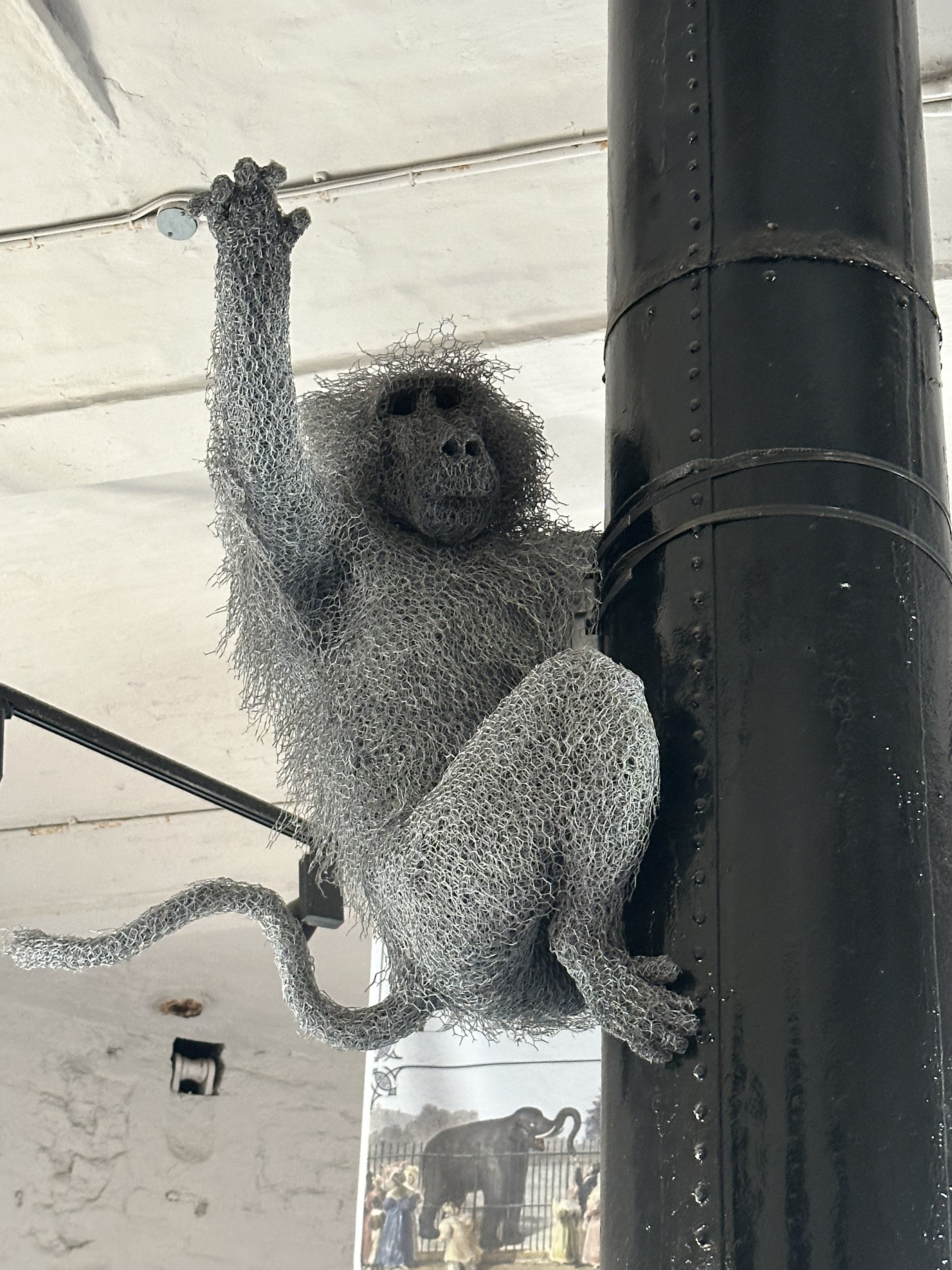 |
| Metal monkey sculpture. |
Artistic metal sculptures depict some of the animals that used to be kept at the tower of London; these animals from far-off places were given as gifts and kept in the tower, which was not always the best habitat.
 |
| Observatory ball. Every day at exactly 1:00 pm Greenwich Mean Time, this red ball on the top of the observatory drops. It is visible from the Thames and allows ships to synchronize their clocks with the official time. |
The Greenwich Royal Observatory A little south of London is the Greenwich Royal Observatory. This observatory marks the location of the Prime Meridian, which is the line that is used across the world to count as the start of a “day”. The museum teaches about the astronomers and mathematicians who worked there, and the long endeavor to develop a method of calculating longitude accurately from a ship. This project took decades, spurred on by a monetary award offered by the British government. There were many attempts along the way that weren’t successful but nevertheless made scientific and engineering contributions. Ultimately the solution was to develop a clock that would be accurate within seconds when aboard a ship. You can read more about this in Dava Sobel’s book Longitude.
 |
| Royal Observatory.. This line marks the prime meridian. |
It’s striking how the financial support of the English government was critical to both the scientific advancements as well as the social infrastructure of marking time consistently across the globe. This is an early example of a federally funded grant, and it accrued power to England.
 |
| Houses of Parliament. This photo was taken in one of the only places we were allowed to take pictures. |
The Houses of Parliament .
Unfortunately, we were visiting during Easter week, which is a holiday in
England, so we couldn’t see the houses of parliament in action. But we still could
enter the space and take an audio tour. British Parliament includes both the
House of Lords and the House of Commons. Originally these parliamentary roles
were only open to men of wealth, but later they opened up to “commoners”, and
today the only real political power lies in the House of Commons. But we also
learned that the House of Lords plays an important negotiating role, precisely
because they do not have the same level of power as the House of Commons. The
rooms dedicated to the House of Lords are also a lot more ornate than the rooms
for the House of Commons!
The 80’s: Photographing Britain at the Tate Britain. This powerful exhibit depicted several major class struggles in the 70’s and 80s, including union strikes, the coal miner’s strike, and the struggle for recognition of the LGBTQ+ community.
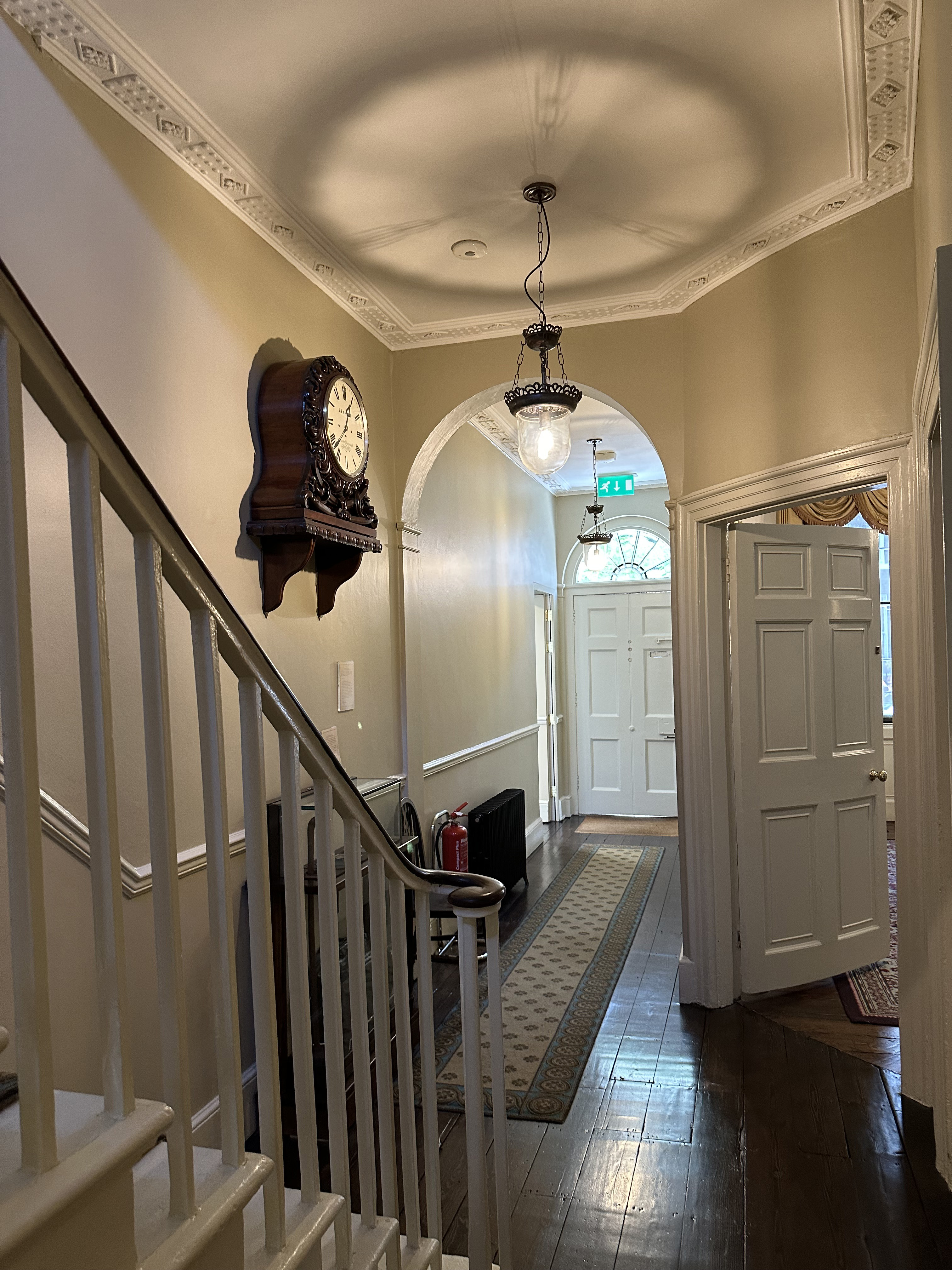 |
| Dickens Museum |
Charles Dickens Museum . This museum is built in one of the houses where Dickens lived in the 1800’s, in a beautiful and somewhat secluded neighborhood of London. We learned that Dickens himself came from a financially insecure background, which was blamed on his father’s inability to manage his debts. At age 12 Dickens was sent to work in a factory doing grueling and uninspiring work. This undoubtedly motivated the themes in his novels, which portrayed the poor in a positive light and championed their cause. We also learned that Dickens’ had a flamboyant and entertaining personality. He enjoyed financial success during his lifetime due to the popularity of his writings, and he frequently entertained at his house and performed his books.
 |
| Handel House. The room where Handel entertained visitors and musicians, next door to the room where he did most of his composing. |
Handel and Hendrix House . In an unusual twist of fate, two major musicians lived in neighboring houses in London at very different times. The composer George Frederic Handel rented a house in the early 1700s, where he composed his famous Handel’s Messiah and many other works, and from where he developed his career in London.
 |
| The bedroom of Jimi Hendrix’s flat. |
Two centuries later, Jimi Hendrix rented a flat next door where his career took off in the 1960’s.


