Showing posts with label Basque. Show all posts

Monday, May 6, 2024

BASQUE SPAIN: Donostia-San Sebastian, Guest Post by Jennifer Arnold

Jennifer in Donostia (San Sebastian) Spain.

My daughter Jennifer, a professor at the University of North Carolina, recently traveled to Spain for a professional meeting and had a little extra time to be a tourist and explore. I thank her for sharing her photos and impressions of the Basque city of Donostia-San Sebastian. She writes:

Basilica of St. Mary of the Angelic Choir.

I travelled to San Sebastian in April 2024 to visit BCBL (The Basque Center on Cognition, Brain, and Language). It was a short trip, but I was pleased to be able to walk around the beautiful city a little, and to visit the museum of San Telmo, which focuses on Basque history.

Hotel on a plaza; the doors have numbers that apparently were used when they used to have bull fights in the plaza and people would rent the rooms to watch the fights.


San Sebastian (“Donostia” in Basque) lies on the north side of Spain in Basque country near the French boarder. I arrived in the San Sebastian airport, which is about 30 minutes from the city. When I asked my taxi driver what I should try to see, he said really the main attraction is food. 

Pastries.

He was right – the culinary experience in San Sebastian was a highlight.


Pinxos.

My host took me out for “pinxos” the first night, which is the local style of tapas. One goes from bar to bar, sampling one or two specialties at a time. The typical pinxos you see everywhere are pieces of bread with spreads and seafood piled on top, often anchovies, sardines, or shrimp. My host also took me to Bar Nestor, a famous place that makes tortilla espaƱola (a sort of omelet with potatoes).  They only make one tortilla for lunch, and one for dinner. To get a slice, we had to show up at 7pm on the dot to get our names on the list. They told us to come back 45 minutes later, when we found a lucky group of people clustered outside. They called our names one group at a time to come in and be served. 

Basque cheesecakes.

Another specialty of the area is Basque cheesecake, which is very dense and creamy, and kind of liquidy in the middle. We also enjoyed sit-down meals at local restaurants, both traditional Basque and innovative Japanese-Basque fusion. 

Asparagus--white and green.

I happened to arrive at the brief but celebrated time of the white asparagus, which was featured in many restaurants (it’s delicious).


View from Monte Iqueldo--reached by a funicular.

The city is also beautiful and easy to enjoy on foot. It sits on a bay, with beautiful walks along the sea. The city is very compact, with many apartment buildings instead of houses, and diverse architecture.

Building with arches.

Plaza.

Modern building at the University of the Basque Country.

It seems to be a very family friendly place to live, with countless beautiful refuges nestled between the apartment buildings, including playgrounds, plazas, green areas and ponds. I saw lots of people outside, many with their dogs, who were often wearing collars and little jackets and allowed to roam within sight of their owners.


San Telmo Museum.

On my last day it was rainy so I visited the San Telmo museum, which is a good way to get to know more about Basque history. 

Armor.

Dictionary in Basque, Spanish, and Latin.


Painting by Antonio Ortiz Echague (1883-1942), “Mi mujer y mi hija a la distancia”


They have ancient artifacts and displays about Basque culture from the middle ages, the enlightenment, to modern times. They also have a selection of art by Basque artists. As we left the museum, we saw a quatrilingual “Exit” sign in Basque, Spanish, English, and French.

Exit sign in four languages.


Monday, October 31, 2022

THE FREAK ALLEY GALLERY IN BOISE, IDAHO: A STREET ART WALK, Guest Post by Caroline Hatton at The Intrepid Tourist

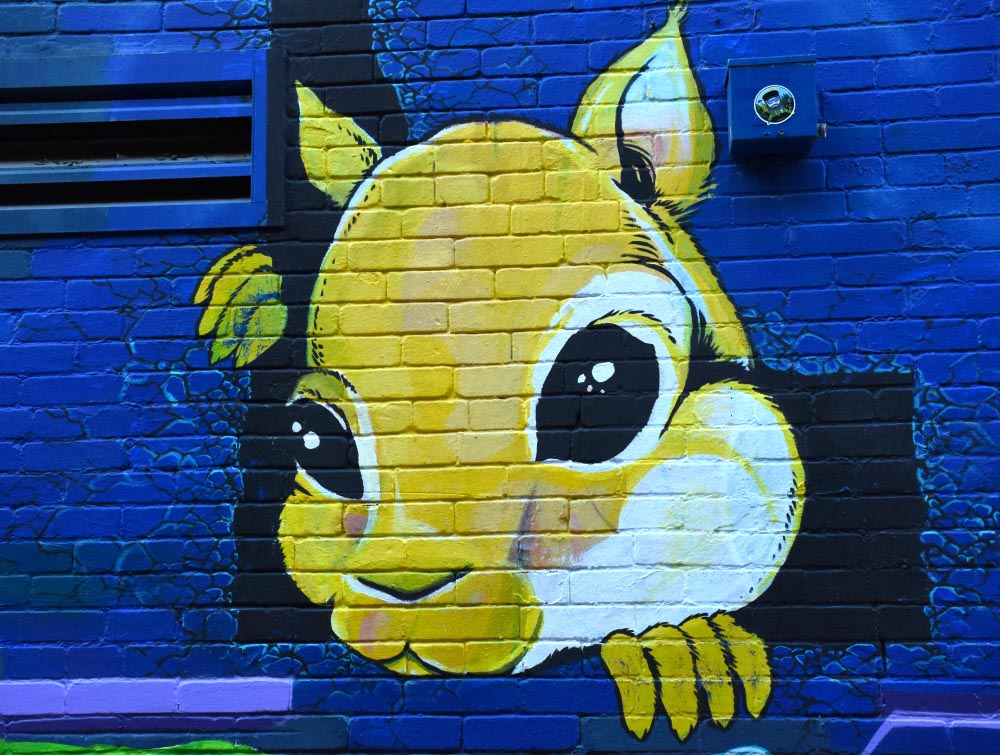
One of the Freak Alley Gallery murals in downtown Boise, Idaho

My friend Caroline Hatton, a children’s writer and frequent contributor to this blog, enjoyed taking the
photos in this post in October 2022.

Mural on the back of the West Elm store, Boise, Idaho

While traveling by car through Boise, Idaho, my husband and I jumped at the chance to see the FreakAlley Gallery, a collection of diverse outdoor murals painted by many artists over twenty years, so far. The gallery is in the alley that goes from 8th to 9th Street through the city block between Idaho and Bannock Streets in downtown Boise.

Nine artists painted these. See the Twinkie and cockroach holding hands--the only nuclear apocalypse survivors?

At 8:30 a.m. on a sunny October Friday, the streets were still in the deep shade of buildings, car traffic was light (compared to L.A. traffic… maybe traffic is incomparably lighter most everywhere else?), and only a few pedestrians walked along the sidewalks carrying cardboard cups from coffee shops. Finding a parking spot at a meter was not difficult.

Buildings’ side walls = space for more paintings.


I like blues and black and white.

Freak Alley was covered with more paintings than I expected, not only on the back walls of buildings, but also on side walls and doors and doorways. I looked for interesting photos to take or works I liked, feeling a bit overwhelmed by how much there was to see.


My favorite: cats in kimonos.

Most of the artworks were big and loud and weird, with few exceptions such as the cats in Japanese kimonos inside one doorway. You can see more photos at the above link, including by clicking on the down-arrow on that web page, then on 2019. The Freak Alley Gallery is a testament to the ongoing community support that makes it possible.

Some filming in progress.

I was glad I visited before 9 a.m. on an October Friday, when the trash containers smells had barely begun to develop in the mid-50s F (~13 C) temperature. We were alone in the alley except for two delivery truck drivers unloading restaurant supplies, and a cameraman on a hoverboard filming his subject.

Before the parking meter expired, we strolled around the Capitol and past the City Hall, and sipped lattes on a coffee shop patio on one of the two pedestrian blocks lined with restaurants, closed at that time, as were gift shops and art galleries. Then we drove a few blocks to the Basque Block a charming cluster of Basque buildings and businesses with a community center.

From left: explorer and merchant ship; farmhouse; fragment of Picasso’s Guernica; historic tree, buildings, dance teacher, accordion player; Boise cathedral; weightlifting contestant; sheep camp

At the Basque Market shop and eatery, we admired cheeses and sausages, and chatted with the chef who was cooking the Friday seafood and chorizo paella on the outdoor patio. Some other time, we might visit the Basque Museum to learn how some 16,000 Basques ended up living in Boise now. This time, I just took a photo of the very well done Basque Mural.

 Downtown Boise seemed like a safe, clean, and interesting place for a walk.

 All text and photos, copyright Caroline Arnold. www.theintrepidtourist.blogspot.com