Monday, July 8, 2024

BOLIVIA: Inca Ruins, Salt Flats and More, Guest Post by Owen Floody

Pre-Incan ruin at Tiwanaku, Bolivia

With many thanks to our friend Owen Floody for another exceptional contribution to The Intrepid Tourist.

No, I didn’t see Butch Cassidy or the Sundance Kid, but I did visit the area in which they disappeared on Bolivia!, a June 2024 trip run by Wilderness Travel and expertly led by Andrea Heckman and Danny Viveros. The trip was challenging due to low temperatures and high altitudes (9,500-16,400 feet).  But our efforts were repaid by outstanding landscapes and a wide range of historical and cultural experiences extending from pre-Incan ruins to cutting edge Bolivian foods and wines.

The tour began in La Paz, where we struggled to adjust to the altitude and “Incan” slopes and steps.  We soared above the city on its impressive cable-car system and explored Old Town areas including the Sagarnaja artisan district and “witches’ market.” But the high point was a day at Tiwanaku, a pre-Incan (peaking in 500-950 AD) ruin between La Paz and Lake Titicaca.

From La Paz, we flew to Sucre, the main streets of which were busy hosting an auto race. Our activities here included visits to the fine ASUR Museum of Indigenous Arts and Casa de la Libertad, an important site in Bolivia’s struggle for independence. Inspired by the beautiful textiles in the museum, we escaped the car races by traveling to the nearby town of Maragua, where we had a delightful visit with a local weaver.
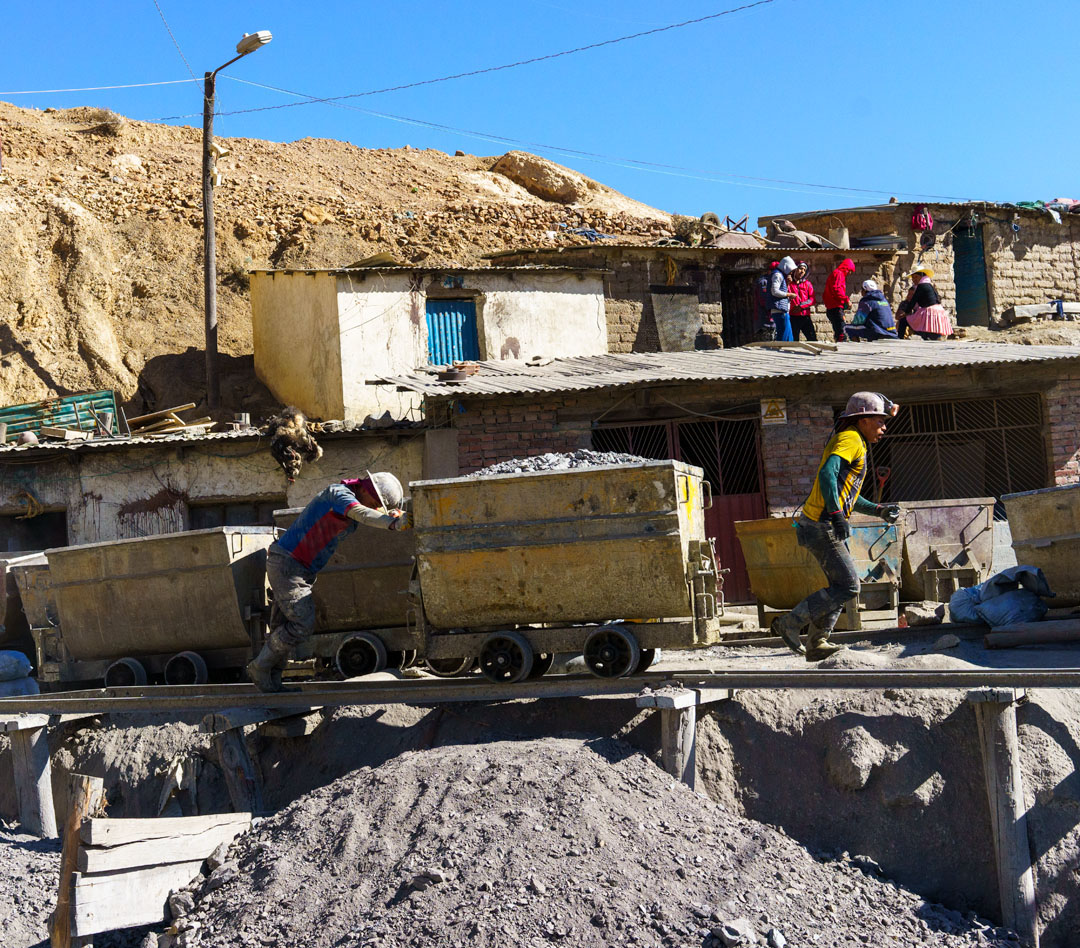
Silver mining at Potosi, Bolivia.

From Sucre, a long drive took us to Potosi.  The first thing that any visitor to Potosi notices is the city’s dominance by hulking Cerro Rico (Rich Mountain). This dominance extends far beyond first impressions. From the 1545 discovery of silver here, the resulting mines made Potosi rich and bankrolled the Spanish empire for hundreds of years: In the 16th – 18th centuries, it is estimated that 80% of the world’s silver came from Cerro Rico.  Mining continues, though the diminished return requires effort (note the young miners straining and running) and exacts significant health tolls.

Though the highlight of our stop in Potosi was a visit to a still-active mine, a close second was a tour of the National Mint.  On display here are some of the huge wooden mule-driven machines used to press silver ingots into sheets for coin stamping. While these and sample products might be expected at such a site, a lovely chapel and some interesting religious art were more surprising. Perhaps the most memorable of the latter was La Virgen del Cerro, a painting in which the central figure’s shape mimics that of Cerro Rico.


The Salar (salt flats)

The next phase of the trip was my favorite.  This took us to the Salar de Uyuni and Eduardo Avaroa National Reserve. The first is the largest salt flat on earth, extending over 4100 square miles. It is flat, flat, flat and white, white, white, punctuated just occasionally by rocky “islands” that are impossible to judge for size or distance due to the lack of familiar landmarks.  Despite, or perhaps because of, its uncompromising uniformity, it is a fascinating landscape.

Laguna Colorado

Other than the Salar, some of the sites we visited on this leg included a train “cemetery” in Uyuni, a cave near Colchani containing mummified human remains dating back many (possibly 3000) years, a field of fancifully shaped rocks, a thermal area, and a series of colored lakes, some sporting flamingos.  Among the lakes, the most impressive was the famous Laguna Colorado (Red Lake). 

Night sky, Bolivia

One of the outstanding characteristics of this area is its isolation.  This reduces light pollution, making it an ideal site for night-sky photography. I made one such effort from a vantage point just 20 yards from our hotel.  Whether for photography or not, any visitor to this area must step outside at night and look up!

Isla del Sol at Lake Titicaca

Finally, it was on to our last stop, Lake Titicaca.  On the way, we enjoyed the blessing of new cars at the Copacabana cathedral.  But our focus was the lake and its major islands, the Isla del Sol and Isla del Luna (Islands of the Sun and Moon), both of which offer impressive Incan ruins. On the Isla del Luna, the major site is the Temple of the Virgins, dedicated to the Virgins of the Sun. A striking aspect of this is its division into chambers, each presumed to have been the residence of a woman living on the island.

View of Lake Titcaca from Isla del Sol

The Isla del Sol gave us wonderful (though not always welcome) exercise: Those Incan steps again.  But it also exposed us to what I thought was the most impressive of the Incan ruins we encountered.  These included a beautifully constructed road, an altar that may have been the single holiest site in the Incan empire, and an extensive complex of buildings called El Laberinto (The Labyrinth). It is hard to imagine a structure that better combines beauty in structure and location. Apparently, the Incans appreciated a good view. 

So maybe the Incan steps were worth the effort after all. 

Monday, July 1, 2024

PRESIDENTS, SPORTS HEROES and Much Much More at the National Portrait Gallery, Washington, DC

Abraham Lincoln, National Portrait Gallery, Washington, DC

My visit to the National Portrait Gallery in Washington, DC, was on February 12th, Abraham Lincoln’s birthday, so, of course, my first stop was in the gallery of American Presidents. Lincoln is depicted life size, standing in his office at the White House. The guide at the Visitors' Desk in the lobby told me that when Mary Todd Lincoln first saw the painting she thought he looked so real that he was still alive.

The National Portrait Gallery shares a building with the Smithsonian American Art Museum (SAAM). (See my post of June 10, 2024.) Each of the four floors of the museum has galleries for both museums. During my visit I zigzagged between them before returning to the courtyard on the first level.

Justices Elena Kagan, Sonia Sotomayor, Sandra Day O'Conner, Ruth Bader Ginsberg 

A visit to the Portrait Gallery is a walk through American history, beginning on the first floor with portraits from 1600 to 1900. In the American Presidents gallery on the second floor George Washington greets visitors at the entrance, looking very much the Father of our Country.

American Presidents Gallery. George Washington at entrance.

Paintings of other Presidents vary considerably in size and style—each President choosing his own portraitist. Some of the paintings are in a traditional portrait style...

Bill Clinton, painting by Chuck Close

...while others, like those of John F. Kennedy, Bill Clinton and Barack Obama, are depicted larger than life and in a more contemporary style.

John Kennedy, painting by Elaine de Kooning

Barack Obama, painting by Kehinde Wiley

Adjacent to the President's Gallery is a gallery dedicated to The Struggle for Justice, beginning with a large painting of Congressman John Lewis. 

Congressman John Lewis, painting by Michael Shane Neal

Other figures in the gallery include singer Marian Anderson, activist and journalist Charlayne Hunter Gault, Frances Perkins, Secretary of Labor in the Roosevelt Administration, and Minaru Yasui, civil rights attorney who fought for Japanese American rights during and after World War II. Each portrait is accompanied with a panel briefly citing the person’s role in history.

Michelle Obama, painting by Amy Sherald

I then climbed the elegant stairway to the third floor in search of Michelle Obama’s portrait in the gallery of Twentieth-Century Americans. The painting by Amy Sherald, of Michelle Obama in a flowing white dress, dominates the room.


I then climbed more stairs to reach the third-floor mezzanine where paintings of American sports heroes line the wall. 

Gallery of Champions, Arthur Ashe

There I found baseball players, football stars, tennis champions—men and women athletes whose names have become part of history. At the other end of the mezzanine are portraits of people from the entertainment world—actors, singers, dancers.

Third floor mezzanine.

The paintings on exhibit are just the tip of the iceberg, a selected few of the thousands of portraits in the Smithsonian collection. You can find more by searching the National Portrait Gallery's website. You may be surprised at what you will discover!


Monday, June 24, 2024

BERGEN, NORWAY, 3 DAYS IN MAY: Old and New and a Walk About Town

The Domkirken (Cathedral) in Bergen, Norway, dates to the 12th Century.

Conventional wisdom says to always carry your umbrella when you are in Bergen, and on our recent trip to Norway in May, we were glad we did. Unlike Oslo, where we had enjoyed warm, sunny weather, it was cool and cloudy in Bergen with periods of rain. But that didn’t stop me from going out and walking around the city.

Our hotel and the colorful building fronts of Bryggen.

Our hotel, the Radisson Royal Blu, where Art’s conference was being held, was in the heart of Bryggen, the historic center of the city, now preserved as a UNESCO Heritage site. 

Historic buildings of Bryggen. View from our room at our hotel.

From medieval times through the late 1800s, Bergen was the focus of trade on Norway’s west coast. Colorful storefronts facing the waterfront were once busy offices and warehouses and other buildings connected to the shipping business. Today they are restaurants and souvenir shops.

Entrance to the Bergen Castle.

Just beyond the warehouse district is the entrance to the old castle/fort and its large ceremonial hall, the Hakenshallen, a structure dating back to the 1200s. The opening reception of Art’s conference was held there and we were greeted by the mayor. It was not hard to imagine knights in armor dining in the magnificent room long ago.

Hakonshallen (ceremonial hall)

My first job after arriving in Bergen was finding a laundromat to do our laundry. I learned that, like virtually everything else, all the machines were operated by credit card. We had gone to an ATM machine when we arrived in Norway and gotten cash (Norwegian kroners), but almost never used it. Even the smallest purchases (like a cinnamon roll at the local bakery or the toilets at the train station) was paid for with a tap of a credit card. 

Spring flowers in the Bergen city park.

Armed with a map picked up at the hotel, I took a self-guided walking tour through the streets of Bryggen, then circling the city park, where strollers ambled down flowered paths and swans floated past a fountain in the center of lake. 

Swan in the lake at the Bergen city park.

Bandstand at the Festplaza.

Tulips, rhododendrons, and all kinds of flowers were in the glory of the spring bloom, brightening the overcast weather. At one end of the park a bandstand was ready for summer concerts.

Sample piece (from Brazil) in the Indigenous Histories exhibit at the Kode art museum in Bergen.

Facing the park on one side are three of Bergen’s art museums. One afternoon I met a friend for a visit to a fascinating exhibit called Indigenous Histories. (For a virtual tour of some of the pieces in the exhibit, go to my June 22, 2024 post my Art and Books blog.)

At the main shopping plaza in downtown Bergen, a modern portico has been added to provide protection from rain or snow. Look carefully at the metal column and you can see multiple images of me with my camera.

I then returned to the waterfront by walking through the business district of downtown Bergen. There a wide plaza with memorial sculptures is flanked by commercial buildings dating from the 19th Century.

A food stand at the fish market offered burgers made of salmon, whale, elk, and reindeer meat.

In the fish market along the waterfront stalls were filled with artfully arranged fish, caviar, and sausages made from reindeer, whale, elk. There were also stalls with various cooked foods to go. (I didn't try any.) The fish market 
seemed to be more of a tourist draw than a place where locals went to purchase seafood to cook at home.

White building at end of the street is the beginning of the Floibanen Funicular.

A popular attraction in Bergen is the funicular, a skyride that whisks you up from town to the mountain overlooking the city for a spectacular view. But on the day I planned to do it, it was raining and the clouds were so thick that I knew it would be impossible to see anything from the viewpoint. So, instead, I went to the archeology museum next to our hotel and joined a one hour tour.

Trade routes from Bergen in the Middle Ages.

In the Middle Ages, Bergen was a transportation hub, sending ships to ports in Europe, Asia, Africa and North America.

Layers of history revealed in the archeology museum.

Over the centuries the wooden buildings of Bryggen burned many times and were rebuilt many times. As archeologists dig through the layers of remains they have uncovered evidence of life going back to medieval times. In the museum there were displays of ancient shoes, combs, tools, knitting needles and more--even a communal wooden toilet seat! I was particularly fascinated by the display of wooden sticks covered in runic writing.

The Futhark are ancient writing systems used by the Old Norse people of Northern Europe.

Both sides are carved with Runic inscriptions. "Hakon carved me, but the boy owns me." and "Bard owns me. He found much to object to in the person who carved me."

And on our last morning, after the conference was over Art and I did a tour of another museum in Bryggen, which introduced us to life in Hanseatic times. (Bergen was a member of the Hanseatic League, a confederation of German city/states involved in trade in the 14th to 16th centuries. Norway did not become an independent country until 1905.) We then checked out of our hotel and made our way to the ferry building to board the ship for our overnight trip to Alesund. As the ship steamed out of the harbor, the sky cleared and the sun came out as we said good-bye to Bergen. We no longer needed our umbrellas.

Leaving the harbor and the cloudy skies of Bergen.

For more about our ferry trip from Bergen to Alesund go to my post of May 27, 2024, Two Weeks in Norway: Trains, Planes, and Automobiles, and a Few Ferries, Too.

And for an overview of our three days in Oslo, go to my post of June 17, 2024, Oslo, Three Days in May: Opera, Art, History and Sunshine. 


The Bryggen waterfront, historic buildings, with the addition of a modern Ferris Wheel, constructed while we were there, perhaps in preparation for the summer tourist season.


Monday, June 17, 2024

OSLO, THREE DAYS IN MAY: Art, Opera, History and Sunshine

View of Oslo from inside the Opera House.

We landed in Oslo on May 1st, our first stop on a two-week trip to Norway. We had three days to get over jet lag before traveling to Bergen, where my husband would attend a professional meeting. We wanted to see as much as we could of Oslo, knowing that in our short time there we would have to pick and choose. 

Pansies in a sidewalk planter in front of our hotel in Oslo.

Our hotel, the Thon Hotel Rosenkrantz, was located in the center of town within walking distance of most things we wanted to do.

Boat in the harbor, Oslo fjord.

On our first evening, after dinner in the excellent Italian restaurant in our hotel, we walked to the harbor on the Oslo Fjord, enjoying the evening sunshine of the far north spring. (Because it was close to midsummer, the sun didn’t set until nearly 10pm and rose again early in the morning!) 

Family of Four, Sculpture by Gustav Vigeland, Oslo.

In the plaza by the harbor stood “Family of Four,” by Gustav Vigeland, Norway's most famous sculptor. Unfortunately, we didn’t have time to see the museum and park in Oslo that features so much of Vigeland’s work. 
A tiny painter puts dots on the side of a storage building at the harbor.
But we saw lots of other public art everywhere we went, including this whimsical painting on the side of a building alongside the harbor.

Nobel Peace Center, Oslo.
The next morning, we visited the Nobel Peace Center. (Gustav Vigeland is the designer of the Nobel Peace Prize Medal.) At the Peace Center we learned about Alfred Nobel (Swedish chemist and inventor of dynamite) and about the history of the Peace Prize and all the individuals who have received the award. I was reminded that Jane Addams, social activist and founder of Hull House in Chicago, was one of the early recipients.

Astrup Fearnley Museum.

All along the waterfront people were enjoying the warm weather, walking, sitting on benches, and eating at the many outdoor restaurants. Further along the Oslo Fjord we came to the Astrup FearnleyMuseum, one of Scandinavia’s most notable museums for contemporary art. The museum, designed by Renzo Piano, spans two buildings bisected by a canal. We walked over a bridge from one to the other. In one building, selected items from the Astrup Fearnley collection are displayed. They include paintings, textiles, sculpture, and other works by a wide variety of artists from around the world. There is also a room for children and families to create their own art.

Looking at Art Institute of Chicago 2, photograph by Thomas Struth at the Astrup Fearnley Museum, 2024.


Looking at Paris Street Rainy Day by Gustave Caillebotte at the Art Institute of Chicago, 2022.

We were particularly engaged by a photograph entitled ­­Art Institute of Chicago 2 by Thomas Struth. In 2022 we were with our family in Chicago in front of the very same painting depicted in the photo, taking our own picture! (See the second photo above.) Our photo in Oslo (with me in the foreground) adds another layer of reality.

Bird Cabinet by Leonard Rickhard.

On the other side of the canal, the Astrup Fearnley Museum building features rotating temporary exhibits. We chose to see the retrospective of the work of Norwegian artist Leonard Rickhard. (It ended on May 19. ) The exhibit was organized around repeating themes in Rickhard's work—a bird cabinet, the night painter, the model table, the birch forest, deserted barracks, workers sheds—often in combination. I was struck by the contemporary look of his paintings, even those done fifty years ago. (For more samples of items at the Astrup Fearnley Museum, see my June 17 post at my Art and Books blog.)

Inside the Oslo Opera House on the ground floor.

That evening we had tickets for the opera, performed at the spectacular new opera house, where the roof is also a giant patio. 

From the roof of the Oslo Opera House your can see the Munch Museum next door. It is dedicated to the work of Norwegian painter Edvard Munch and has three versions of his famous painting The Scream. 

The opera we saw was Cenerentola (Cinderella) by Rossini. The production was lively and humorous and easy to understand—a small screen at our seats followed the libretto translated into either Norwegian or English. (We chose, English, of course. Throughout Norway, at least in areas frequented by tourists, we found that almost everyone speaks English.) At intermission, as we stood on the balcony and gazed out the windows, the sun was just setting over the Oslo skyline.

At Henrik Ibsen's grave in the Memorial Cemetery.

On our second full day in Oslo we had arranged to meet an American friend who has lived in Oslo most of her life. It was wonderful to have a personal guide and insight on what it is like to live and raise a family in Norway. On the way to her apartment she took us through the Memorial Cemetery, a beautiful park-like area open to the public. It is the burial place of both ordinary citizens and Norwegian notables like Henrik Ibsen and Edgar Munch. 

Old Aker Church was built as a three-naved Romanesque style basilica.

From the cemetery we walked to the Gamle Aker Church, the oldest church in Oslo. It dates back to the 12th Century and continues as an active congregation. The next day, on our visit to the Folk Museum in Bygdoy, we saw a 19th Century painting of the church. 

Our guide for our tour of the Folk Museum.

Our last full day in Oslo was devoted to a visit to the Folk Museum, a large park-like complex with museums and historical buildings from rural parts of Norway. Interpreters are dressed in traditional costumes. With a little imagination you almost feel as if you have taken a trip back in time. We took a one-hour English language tour that ended at the famous stave church, dating from the 13th century.

Stave Church at the Folk Museum. It is built entirely of wood.

We then wandered on our own, visiting a traditional farm kitchen, where young women in period clothes were baking lefse (a slightly sweet soft flat bread) on a griddle over hot coals. We bought two slices, served hot and slathered with melted butter. They were delicious!


The next morning we headed for the train station for the next part of our trip—a train ride over the mountains to Bergen. For a report of that journey and more about Oslo, see my post of May 27. We enjoyed our three days in Oslo, had beautiful sunny weather, made progress on adjusting to the time change, and felt we got a taste of the city. Someday we’ll have to go back and explore more.

At the Folk Museum with our two slices of freshly baked lefse.