Monday, November 27, 2023

“SO SMALL” MINIATURE ART AUCTION IN EUGENE, OREGON Guest Post by Caroline Hatton at The Intrepid Tourist

Stone and driftwood picture by Julie Walsh (2" x 3") 

My friend Caroline Hatton, a children’s writer and frequent contributor to this blog, showed miniatures she had handcrafted and took these photos at this event
in September 2023.

As a lover of miniatures, I was thrilled to learn about So Small, the annual miniature art show, silent auction and fundraiser in Eugene, Oregon. Even better, the organizer (the OSLP Arts & Culture Center*) solicits donations of mini art and craft items from any and all artists, offering a welcome outlet for my creations! Item dimensions must not exceed 3” x 3” x 3”.

What could I make? Something quick and easy and likely to “sell” in September: a seasonal decoration or gift for the Fall, Halloween, Thanksgiving, or Christmas!

Christmas gift by Caroline Hatton 

Christmas gift by Caroline Hatton

To craft mini, fake Christmas gifts, I split a Post-It-Note-pad in two halves and wrapped them in salvaged holiday-card-envelope paper. On the green gift, I glued rescued ribbon, holly leaves previously cut from a fabric remnant, alder cones previously collected on nature walks and sterilized by baking, fake berries previously cannibalized from a damaged decoration, and used acrylic paint for snow. For the red gift’s ribbon, I cut strips from envelopes. After I dropped my contribution one hour before the submission deadline, I couldn’t wait for the show, to see what other people made.

"So Small" art auction and fundraiser in Eugene, Oregon

On the late-September Saturday evening when the 8th annual show was scheduled, parking in downtown Eugene was easy and free. At the event entrance, I provided my contact info and was assigned an anonymous bidder number, such as, for example, 177. Then I was ready to bid simply by writing down 177 and my bid ($2 or more in $1 increments) on the form next to any wee wonder I wanted.  

Mini Halloween decoration by Charlotte Pearce (1" cubic box)

Mini adobe abode by Ms. Hirsch (about 1" tall)

Artworks donated by miniature making students

Mini ceramics by Carolyn Craig (about 2" diameter)

Needle-felted mini pumpkins

Over 600 tiny treasures were up for auction! Paintings, drawings, mixed media sculptures, jewelry, dioramas, 1:12 and smaller-scale miniatures, hand-painted gift enclosure cards, laminated bookmarks, painted rocks…

Mini snacks from event sponsors Killer Burger and Community Cup Coffee

A mere 20 minutes into the two-hour event, the line at the check-in table stretched out the door and down the sidewalk, and the interior space no longer had elbow room.

"Black Red & Gold" handmade blank book by Deb Ingebretsen

I won a beautiful blank book, “Black Red & Gold,” handmade by Deb Ingebretsen. My little Christmas gifts were sold. The event raised some $4,000 for the Scholarship Fund, a huge success, given that an 8-week class including instruction and materials costs about $100 per person. To nurture an inclusive creative community, the Center offers some classes that facilitate participation in local events. For example, students who took a lantern-making class walked in the parade that is a highlight of BEAM, an annual celebration of illumination arts in downtown Eugene.

So Small was sponsored or supported by a number of local businesses and non-profits, including MECCA (the Materials Exchange Center for Community Arts), a thrift shop for arts and crafts supplies, where teachers never have to pay and mere mortals pay what they can. It’s next on my list of places to visit, to donate salvaged and surplus craft supplies, and to browse and dream up what to make for… next year’s So Small!

*“OSLP (the Oregon Supported Living Program) was founded in 1978 under the auspices of the University of Oregon to serve adults with mild developmental disabilities who lived independently. In 2012, in response to the limited and segregated artistic opportunities available to people with disabilities, OSLP created its Arts & Culture Center. Through classes, workshops, and exhibitions, the Center is inclusive, open to adults with and without disabilities, one of only a few programs of its kind in the United States.”

 All text and photos, copyright Caroline Arnold. www.theintrepidtourist.blogspot.com


Monday, November 20, 2023

THE BIRDS OF NYANDUNGU, RWANDA, AFRICA, Guest Post by Karen Minkowski

Black-headed Heron, Nyandungu Urban Wetlands Eco-Tourism Park, Kigala, Rwanda

My friend Karen Minkowski, a frequent contributor to The Intrepid Tourist and definitely an intrepid traveler, is currently in Africa, a place that she has visited often. Karen is a keen birdwatcher and I thank her for sharing her wonderful photos of the birds of Nyandungu with The Intrepid Tourist.

While visiting Kigali, Rwanda’s capital city, in early 2023, I took my camera to NyandunguUrban Wetlands Eco-Tourism Park, in one of Kigali’s many valleys. The Park comprises 120 hectares (297 acres) of a restored wetland complex -grasslands, ponds and a small fig forest. It was created to reestablish some of Kigali’s lost biodiversity and to provide the community with social and economic benefits (lots of jobs!). Somewhere between one and two hundred species of birds reside in or use the Park’s habitats. The Park is buffered from the surrounding suburbs by agricultural fields. In the photo above a Black-headed Heron flies across the grassy wetland.

I’ve recently returned to Rwanda for a longer stay, and I visit Nyandungu frequently. My photos are annotated with a few facts I gleaned from Google and Google Scholar. Cornell University’s online Birds of the World is a favorite source. Here are some of the birds I’ve seen:

African Openbill

The African Openbill is a stork that feeds primarily on mollusks. Within seconds, it can pry open and extract a snail from its shell, using the tip of its lower mandible. It cuts the muscle that keeps the shell closed, rather than crunching it.  Greater effort is needed to open mussel shells, so Openbills may deposit captured mussels on the shore, leaving the sun to kill them.  As the mussels die, they release their hold on their shells. In this photo the Openbill is likely probing for insects in the dead wood.

Spur-winged Goose

The Spur-winged Goose derives its name from a small spur, or spike, at the bending point of each wing and is used in fighting during the breeding season. Spur-winged geese that eat the poisonous Blister Beetle store the toxin in their tissues, which may kill whatever subsequently eats the geese.

African Stonechat

The African Stonechat is an Old-World flycatcher that feeds almost exclusively on insects, their larvae, and other invertebrates. It occupies a wide range of habitats on the continent.

Common Bulbul

A very common bird throughout much of Africa south of the Sahel, the Common Bulbul is primarily a fruit-eater, but also takes a few insects and small vertebrates.

White-browed Coucal

The elegant White-browed Coucal has a lovely call, a kind of soft, warbling sound. Its body pulses to the rhythm of the call, a bit like bellows. Male White-browed Coucals spend more time than females incubating the eggs, but both sexes share the task of feeding their young. They eat mostly insects, spiders, and small invertebrates.

Fork-tailed Drongo

Fork-tailed Drongos are known to give false alarm calls to scare other bird species into abandoning their food to a thieving drongo. They also mimic the alarm calls of other species for the same purpose. Why hunt when there are easier ways to get a good meal?

Black-lored Babblers

Black-lored Babblers are highly sociable birds. The one on the left had been grooming the bird in in the middle, then moved a short distance away and returned a few seconds later. It is tempting – if hopeless - to imagine what they are communicating with these postures and expressions! These birds literally babble when grouped together, as if they cannot contain their excitement. The authors of a bird guide describe the sound as having a “slightly insane and hilarious laughing quality”.

Monday, November 13, 2023

LASCAUX CAVES, DORDOGNE, FRANCE: A Treasure House of Prehistoric Art, Guest Post by Susan Kean

Lascaux Caves, Dordogne, France.

My friend Susan Kean and her partner George recently went on a driving trip from Lisbon in Portugal, through Spain, to the Dordogne region in the South of France, where they visited friends and toured the countryside, including a visit to the famous painted caves of Lascaux (a replica). Susan has graciously agreed to share her photos with The Intrepid Tourist. I have divided them into three sections, starting with the first leg of the trip, Lisbon to the Pyrenees; the second, sightseeing in the Dordogne; the third, a visit to the Lascaux Caves. Susan writes:

Area of the original cave.

We visited the Lascaux caves on the 3rd day of our visit to Dordogne. 
We were early for the English language tour so walked around the area of the original cave

Using candlelight to see the paintings on the ceiling.

Four teenagers discovered the caves in 1940. They are full of ancient wall paintings (600 or more) that are over 20,000 years old. 

Diagram of Lascaux Caves.
The paintings are primarily of horses, aurochs (an extinct type of large ox) and various other animals. As there are virtually no pictures of humans (except one horse with a human head) it is thought that the paintings were of religious significance. They are are also thought to be the combined painting efforts of several generations.

Exiting the reconstructed cave.

The original cave was closed in 1963 because the visitor traffic caused enormous deterioration of the bright colors of the paintings. Two amazing replicas have been built and are well worth a visit. Lascaux 2 is on the original site. Lascaux 4 is very recent recreation with a large museum, large gift shop and restaurant. I’m glad we saw both. However, I liked Lascaux 2 best as it is the location of the original cave.

Painted auroch.

The tour guide explained how they got the primitive colors. They used Magnesium for black which is different than the usual charcoal. If they had used charcoal the paintings would be have been easier to date. Apparently the diet of the people was primarily reindeer. No reindeer appear in the paintings.

Lastly we visited Thot park where more recent versions of the animals from the area can be seen.

Thot Park reindeer.

The Thot park recent ox are much smaller than the extinct wild ox (auroch) as displayed in the cave paintings.

Thot Park ox.

Previous posts about Susan's trip:

    ROAD TRIP: LISBON TO THE PYRENNEES, October 30, 2023

    ROAD TRIP: THE BEAUTIFUL DORDOGNE REGION OF FRANCE, November 6, 2023


Monday, November 6, 2023

ROAD TRIP: THE BEAUTIFUL DORDOGNE REGION OF FRANCE, Guest Post by Susan Kean

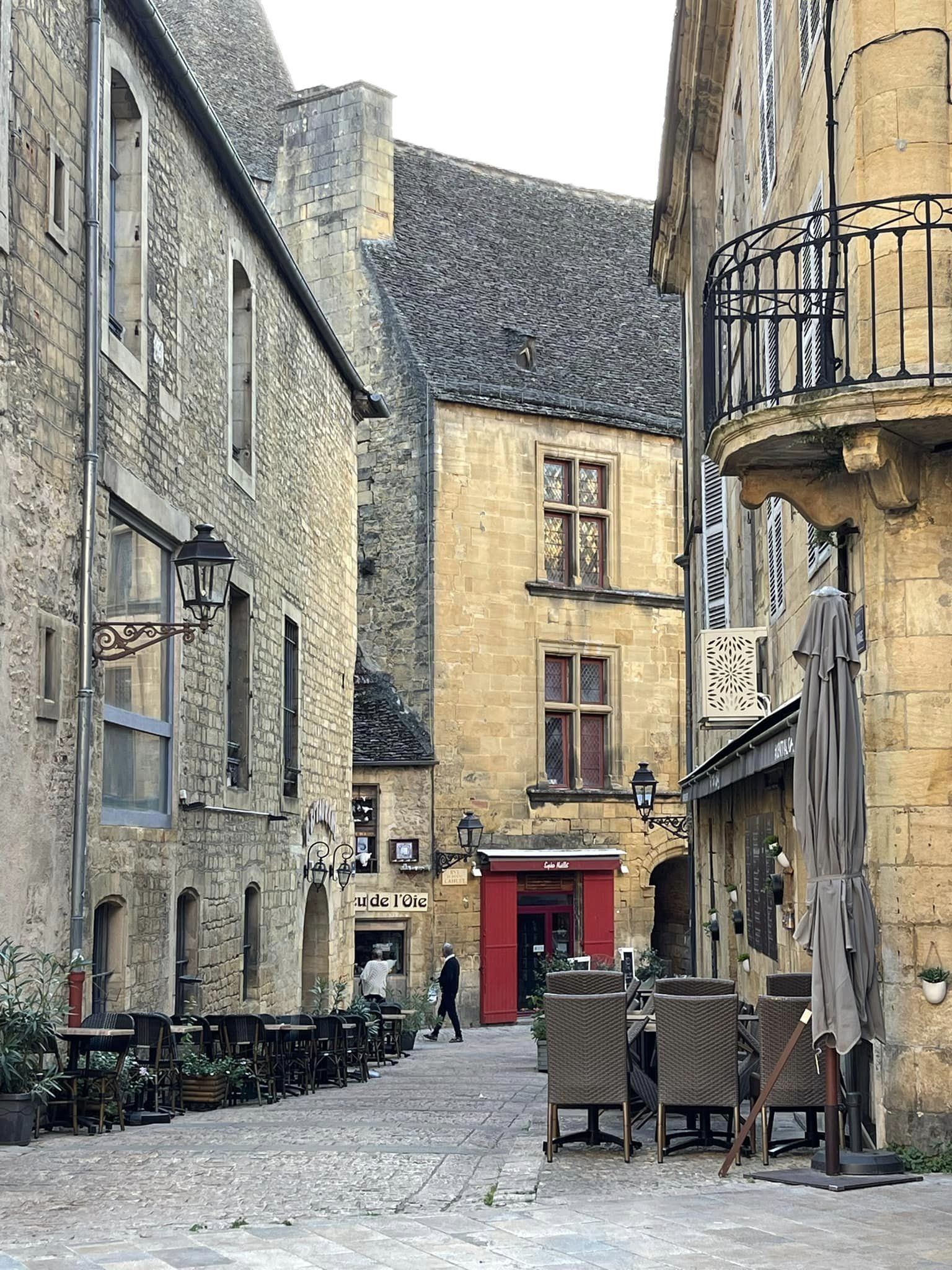
Market in Sarlat, town in the Dordogne region of France.

My friend Susan Kean and her partner George recently went on a driving trip from Lisbon in Portugal, through Spain, to the Dordogne region in the South of France, where they visited friends and toured the countryside, including a visit to the famous painted caves of Lascaux (a replica). Susan has graciously agreed to share her photos with The Intrepid Tourist. I have divided them into three sections, starting with the first leg of the trip, Lisbon to the Pyrenees; the second part, sightseeing in the Dordogne; the third, a visit to the Lascaux Caves. This is part 2. Susan writes:

Sunrise in Dordogne.

After a 3 day 1000 mile drive from Lisbon through Portugal, Spain, and South of France, we were thrilled to arrive in the Dordogne area of France to the Air B&B home of our friends. The
next day we enjoyed breakfast in Sarlat and experienced the ‘old’ town. We shopped at the local market for dinner ingredients. By the time we got to the meat stall everything was gone except a shoulder of lamb, so that is what we cooked (it turned out great!)

Wonderful streets of Sarlat.

This is a glorious part of France. In fact, I’d forgotten what a beautiful country France is. Everything we have seen so far is spotless and well kept.

Author signing his book.

We decided to buy a children’s book and one of the authors sketched the inside cover before signing.

Sarlat Cathedral.

A gaggle of geese.

This is Fois Gras country. The goose is revered

The Truffle Museum in Sarlat.

Also Truffle country.

View of Bynac Castle from our canoe.

Canoeing down the Dordogne river is amazing. I was concerned I’d find it a bit challenging getting in and out but our captain
made it easy!

Canoeing on the Dordogne River.

Susan's next post:
LASCAUX CAVES, DORDOGNE, FRANCE. November 13, 2023


Monday, October 30, 2023

ROAD TRIP: LISBON TO THE PYRENEES, Guest Post by Susan Kean

The Pyrenees, on the border between Spain and France.

My friend Susan Kean and her partner George recently went on a driving trip from Lisbon in Portugal, through Spain, to the Dordogne region in the South of France, where they visited friends and toured the countryside, including a visit to the famous painted caves of Lascaux (a replica). Susan has graciously agreed to share her photos with The Intrepid Tourist. I have divided them into three sections, starting with the first leg of the trip, Lisbon to the Pyrenees. The next sections will appear in the following weeks. Susan writes:

Our first stop was just beyond Madrid in a town called Guadalajara.

Infantado Palace in Guadalajara, Spain


Lunch of "baby eels"

My lunch at a ‘Rest’ stop in Spain was a local delicacy…baby eels… I thought we asked for shrimp! It took us awhile to work out what they were. Happily, they were not real baby eels but made from fish like our mock crab meat. Eating real baby eels is controversial and they are a delicacy and very expensive.

Bull (toro) silhouette along side of the road in Spain.

This was originally an ad for Toro Brandy but has now become a symbol of Spain and they are all over the country.

CanFranc Estacion

Spanish roads were very good.
We arrived in the CanFranc Estacion, an incredible hotel which one once a railway station high up in the Pyrenees. George had read about it in the Financial Times.

Check-in at the CanFranc Estacion Hotel.

Crocuses.

We drove up the mountains a bit and George spotted these wonderful Autumn Crocuses growing wild.

Susan's next posts: 

ROAD TRIP: THE BEAUTIFUL DORDOGNE REGION OF FRANCE. November 6, 2023

THE LASCAUX CAVES, TREASURE HOUSE OF PREHISTORIC ART. November 13, 2023


Monday, October 23, 2023

CRETE: HOME OF THE ANCIENT MINOANS, Guest Post by Steve Scheaffer and Karen Neely

View of seaside village at Lygria, on the north coast of Crete, just west of Iraklio.

My brother Steve and his wife Karen traveled to the Greek island of Crete in September, staying in hotels in Elounda, Heraklion and Chania.  Crete, with a history going back thousands of years, was an opportunity to visit museums and ancient sites, as well as to enjoy the Mediterranean climate and fruits (and wine and olives) grown by today's inhabitants. Steve and Karen have graciously agreed to share a few of their photos with The Intrepid Tourist. 

Their first night in Greece was spent at the Cypria Hotel in Athens, and from there they flew to Heraklion on Crete. Here's the view from their room at the Elounda Ilion Hotel on Main Street.

Ships and ferries in port as seen from the Elounda Ilion Hotel. 

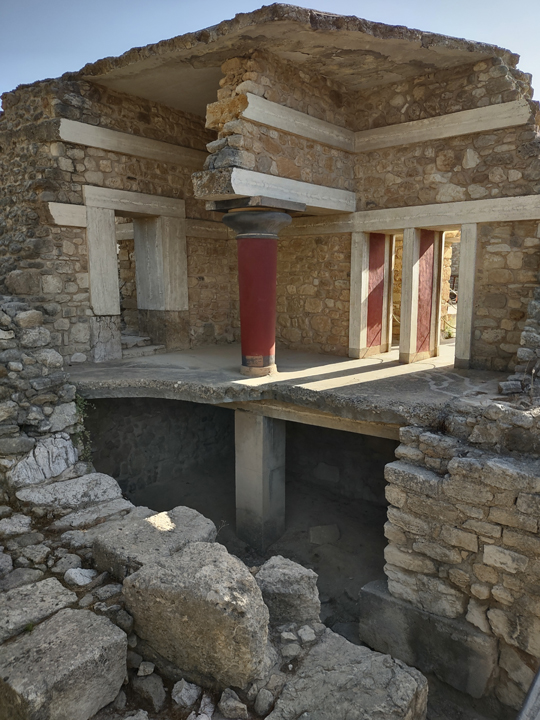
Near Heraklion is the Palace of Knossos, center of the ancient Minoan civilization (1600 - 1400 BC.) Steve and Karen did a tour of the palace as well as visiting the Archeological Museum.

Palace at Knossos, Crete (rebuilt from archeological remains.)

Replicas of paintings discovered at Knossus. The original paintings are on view at the museum.

Typical street in Epano Archanes, a small village south of Iraklio up in the mountains. Although the narrow streets are used by cars, they are pedestrian friendly. 

Doorway to home in Epano Archanes. Note bowl to feed local cats--which are found everywhere in Crete.

Blue glass container for olive oil tasting. 

Purchasing olive oil directly from the maker. Olive oil is a major export of Crete.


Wagon with ancient olive tree behind. Olive groves were all over the island.
The olive tree of Vouves, on Crete. This tree, which has a trunk 15 feet in diameter, is at least 2,000 years old, and likely 2,900 years old, based on the graveyard found nearby. This tree likely lived through the writing of the Iliad, the golden age of Athens, the rise of the Roman Empire, and the birth of Christ and then lived for 2,000 years after that. It still produces olives, as well.
Results of day spent at a cooking lesson at a country villa with a group of 10 other people.  Using local ingredients they prepared stuffed tomatoes and peppers, filled pastries, made toasted bread with tomatoes and goat cheese, along with a bowl of tzatziki, a classic Greek side dish made with yogurt, cucumbers, garlic and olive oil.
 
View from their room on the top floor of the Porto del Columbo Boutique hotel in Chania. The Lighthouse of Chania is visible at the entrance to the harbor. 

Housed in an imposing, tall, 650 year old building, the Porto del Columbo Boutique Hotel has gathered a rich history over the centuries. During the Ottoman days, inhabited by senior members of the Turkish military who made many changes in the architecture of the building – still retained the metal rings nailed to the walls. In the early 19th century, the building was used as a French embassy and later inhabited by the great Greek politician Eleftherios Venizelos, who used it as a political office until moving to Athens when he took power as prime minister of Greece. 

With many thanks to Steve and Karen for providing us with a vicarious trip to Crete!