Monday, November 6, 2023

ROAD TRIP: THE BEAUTIFUL DORDOGNE REGION OF FRANCE, Guest Post by Susan Kean

Market in Sarlat, town in the Dordogne region of France.

My friend Susan Kean and her partner George recently went on a driving trip from Lisbon in Portugal, through Spain, to the Dordogne region in the South of France, where they visited friends and toured the countryside, including a visit to the famous painted caves of Lascaux (a replica). Susan has graciously agreed to share her photos with The Intrepid Tourist. I have divided them into three sections, starting with the first leg of the trip, Lisbon to the Pyrenees; the second part, sightseeing in the Dordogne; the third, a visit to the Lascaux Caves. This is part 2. Susan writes:

Sunrise in Dordogne.

After a 3 day 1000 mile drive from Lisbon through Portugal, Spain, and South of France, we were thrilled to arrive in the Dordogne area of France to the Air B&B home of our friends. The
next day we enjoyed breakfast in Sarlat and experienced the ‘old’ town. We shopped at the local market for dinner ingredients. By the time we got to the meat stall everything was gone except a shoulder of lamb, so that is what we cooked (it turned out great!)

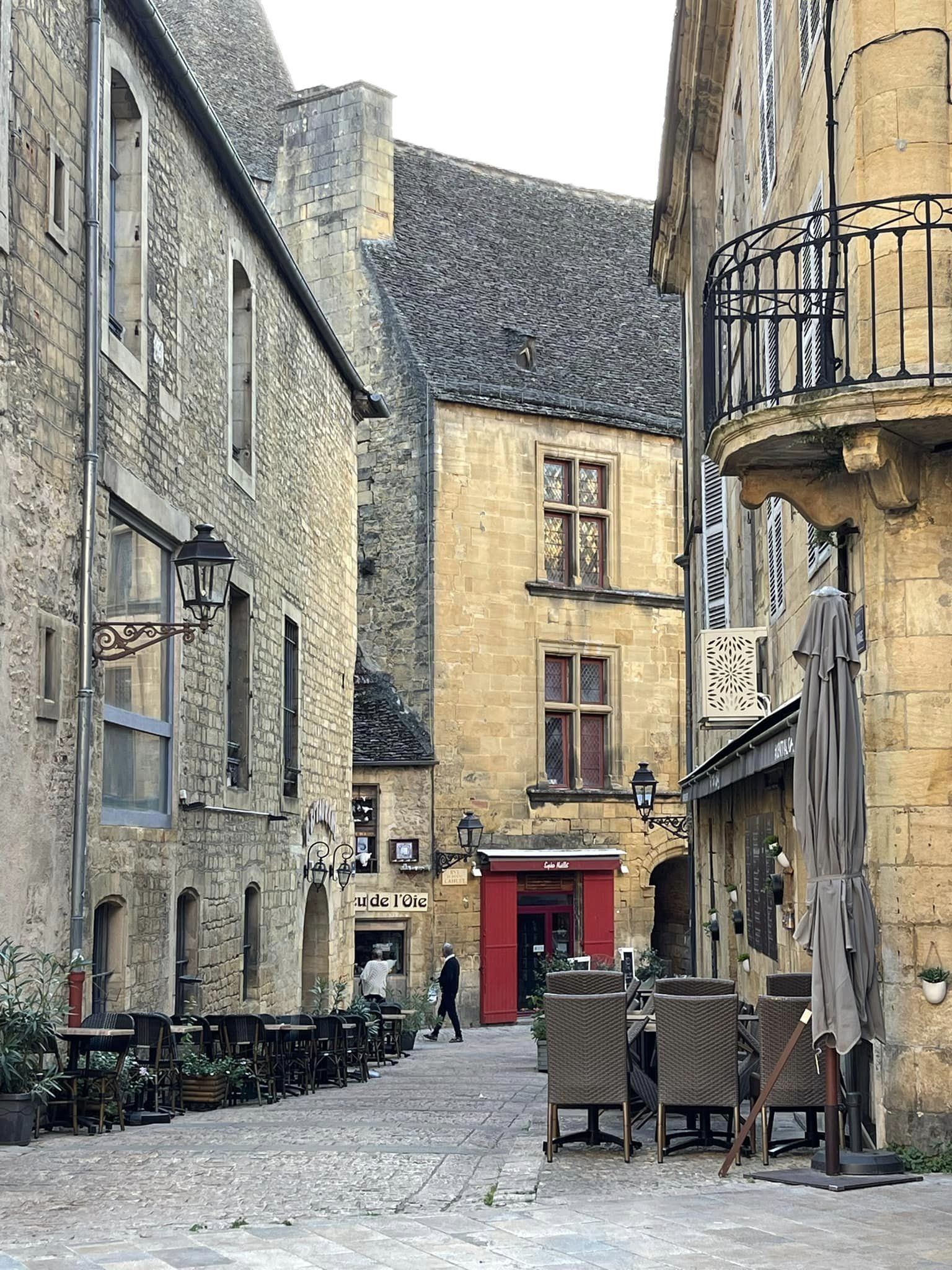
Wonderful streets of Sarlat.

This is a glorious part of France. In fact, I’d forgotten what a beautiful country France is. Everything we have seen so far is spotless and well kept.

Author signing his book.

We decided to buy a children’s book and one of the authors sketched the inside cover before signing.

Sarlat Cathedral.

A gaggle of geese.

This is Fois Gras country. The goose is revered

The Truffle Museum in Sarlat.

Also Truffle country.

View of Bynac Castle from our canoe.

Canoeing down the Dordogne river is amazing. I was concerned I’d find it a bit challenging getting in and out but our captain
made it easy!

Canoeing on the Dordogne River.

Susan's next post:
LASCAUX CAVES, DORDOGNE, FRANCE. November 13, 2023


Monday, October 30, 2023

ROAD TRIP: LISBON TO THE PYRENEES, Guest Post by Susan Kean

The Pyrenees, on the border between Spain and France.

My friend Susan Kean and her partner George recently went on a driving trip from Lisbon in Portugal, through Spain, to the Dordogne region in the South of France, where they visited friends and toured the countryside, including a visit to the famous painted caves of Lascaux (a replica). Susan has graciously agreed to share her photos with The Intrepid Tourist. I have divided them into three sections, starting with the first leg of the trip, Lisbon to the Pyrenees. The next sections will appear in the following weeks. Susan writes:

Our first stop was just beyond Madrid in a town called Guadalajara.

Infantado Palace in Guadalajara, Spain


Lunch of "baby eels"

My lunch at a ‘Rest’ stop in Spain was a local delicacy…baby eels… I thought we asked for shrimp! It took us awhile to work out what they were. Happily, they were not real baby eels but made from fish like our mock crab meat. Eating real baby eels is controversial and they are a delicacy and very expensive.

Bull (toro) silhouette along side of the road in Spain.

This was originally an ad for Toro Brandy but has now become a symbol of Spain and they are all over the country.

CanFranc Estacion

Spanish roads were very good.
We arrived in the CanFranc Estacion, an incredible hotel which one once a railway station high up in the Pyrenees. George had read about it in the Financial Times.

Check-in at the CanFranc Estacion Hotel.

Crocuses.

We drove up the mountains a bit and George spotted these wonderful Autumn Crocuses growing wild.

Susan's next posts: 

ROAD TRIP: THE BEAUTIFUL DORDOGNE REGION OF FRANCE. November 6, 2023

THE LASCAUX CAVES, TREASURE HOUSE OF PREHISTORIC ART. November 13, 2023


Monday, October 23, 2023

CRETE: HOME OF THE ANCIENT MINOANS, Guest Post by Steve Scheaffer and Karen Neely

View of seaside village at Lygria, on the north coast of Crete, just west of Iraklio.

My brother Steve and his wife Karen traveled to the Greek island of Crete in September, staying in hotels in Elounda, Heraklion and Chania.  Crete, with a history going back thousands of years, was an opportunity to visit museums and ancient sites, as well as to enjoy the Mediterranean climate and fruits (and wine and olives) grown by today's inhabitants. Steve and Karen have graciously agreed to share a few of their photos with The Intrepid Tourist. 

Their first night in Greece was spent at the Cypria Hotel in Athens, and from there they flew to Heraklion on Crete. Here's the view from their room at the Elounda Ilion Hotel on Main Street.

Ships and ferries in port as seen from the Elounda Ilion Hotel. 

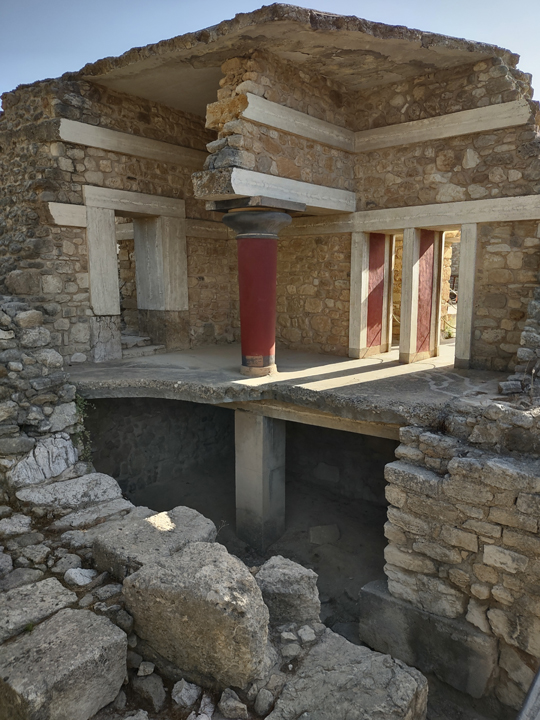
Near Heraklion is the Palace of Knossos, center of the ancient Minoan civilization (1600 - 1400 BC.) Steve and Karen did a tour of the palace as well as visiting the Archeological Museum.

Palace at Knossos, Crete (rebuilt from archeological remains.)

Replicas of paintings discovered at Knossus. The original paintings are on view at the museum.

Typical street in Epano Archanes, a small village south of Iraklio up in the mountains. Although the narrow streets are used by cars, they are pedestrian friendly. 

Doorway to home in Epano Archanes. Note bowl to feed local cats--which are found everywhere in Crete.

Blue glass container for olive oil tasting. 

Purchasing olive oil directly from the maker. Olive oil is a major export of Crete.


Wagon with ancient olive tree behind. Olive groves were all over the island.
The olive tree of Vouves, on Crete. This tree, which has a trunk 15 feet in diameter, is at least 2,000 years old, and likely 2,900 years old, based on the graveyard found nearby. This tree likely lived through the writing of the Iliad, the golden age of Athens, the rise of the Roman Empire, and the birth of Christ and then lived for 2,000 years after that. It still produces olives, as well.
Results of day spent at a cooking lesson at a country villa with a group of 10 other people.  Using local ingredients they prepared stuffed tomatoes and peppers, filled pastries, made toasted bread with tomatoes and goat cheese, along with a bowl of tzatziki, a classic Greek side dish made with yogurt, cucumbers, garlic and olive oil.
 
View from their room on the top floor of the Porto del Columbo Boutique hotel in Chania. The Lighthouse of Chania is visible at the entrance to the harbor. 

Housed in an imposing, tall, 650 year old building, the Porto del Columbo Boutique Hotel has gathered a rich history over the centuries. During the Ottoman days, inhabited by senior members of the Turkish military who made many changes in the architecture of the building – still retained the metal rings nailed to the walls. In the early 19th century, the building was used as a French embassy and later inhabited by the great Greek politician Eleftherios Venizelos, who used it as a political office until moving to Athens when he took power as prime minister of Greece. 

With many thanks to Steve and Karen for providing us with a vicarious trip to Crete!


Monday, October 16, 2023

SPAIN PHOTO ALBUM, Part 2: Granada, Cordoba, Toledo

Courtyard in the Alhambra, Granada, Spain.

In the spring of1991, I met my daughter for a ten day driving trip through central and southern Spain.  Jennifer, doing a semester abroad in France, had a week’s vacation and met me in Madrid. Jennifer is fluent in Spanish, which was a big help since my Spanish is limited. After a visit to the medieval walled town of Avila, we did a circle trip to the south, returning to Madrid. The April weather was sunny and cool and the roadsides abloom with red poppies. It was my first trip to Spain and exposure to its historic past--from an ancient Roman outpost, to its Moorish occupation, to the kings and queens of the Age of Exploration, to the present. Here is Part 2 of some highlights from my photo album of the trip.

Granada and the Alhambra

Sunset. View from our hotel in Granada.
Passageway at the Alhambra.

We found that the best time to wander among all the buildings and gardens of the Alhambra was during lunchtime, when all the tour groups had left.

Circular courtyard at Alhambra.


Lion fountain at Alhambra.


Column top at Alrambra.

Arabic inscription carved into wall of Alhambra.

Nearly every surface inside the Alhambra is richly decorated.

Gardens and fountains provided relief from the hot sun at the Alhambra.


Cordoba and the Mosque

Red and white striped arches are a distinguishing feature of the mosque at Cordoba.


View from our hotel at Cordoba.


Charming courtyards with baskets of red geraniums are a typical sight in Cordoba.


Corinthian columns from Spain's Roman era outside of Cordoba.


We attended a flamenco concert while in Cordoba.

Toledo, City of El Greco

View of Toledo, 1991.


Artist's view of Toledo.


Our hotel in Toledo was located not far from a bull fighting stadium.


Large bull "bill board" along the highway from Toledo to Madrid.


Monday, October 9, 2023

SPAIN PHOTO ALBUM, Part 1: Madrid, Avila,

Walled town of Avila, Spain

In the spring of1991, I met my daughter for a ten day driving trip through central and southern Spain.  Jennifer, doing a semester abroad in France, had a week’s vacation and met me in Madrid. Jennifer is fluent in Spanish, which was a big help since my Spanish is limited. After a visit to the medieval walled town of Avila, we did a circle trip to the south, returning to Madrid. The April weather was sunny and cool and the roadsides abloom with red poppies. It was my first trip to Spain and exposure to its historic past--from an ancient Roman outpost, to its Moorish occupation, to the kings and queens of the Age of Exploration, to the present. Here is Part 1 of some highlights from my photo album of the trip.

Poppies.

Madrid, the Center

The Trinity by El Greco, Prado Museum, Madrid, Spain

Sabatini Gardens, Madrid.

Baroque architecture, Madrid.

Carved wooden door, Madrid.


Avila, home of St. Teresa

Entrance to the walled city of Avila. Avila is a UNESCO World Heritage Site.

Saints on Church in Avila

We couldn't leave Avila without purchasing the traditional confection known at Ymas de Avila, basically a sweet made from egg yolks and sugar. 

In many places in Avila you can walk on the walls.

View from the wall of bell tower topped with a stork nest.

The four posts. Roman ruin outside the city walls of Avila.

Look for Part 2 next week, as we visit Granada (the Alhambra), Cordoba, and Toledo.