Monday, August 28, 2023

HULIHE’E PALACE, Kona, Hawaii, A Peek at Hawaii's Royal Past

Hulihe'e Palace, Kona, Hawaii, is a heritage site of Hawaii.

On Alii Drive in the center of Kona on the Big Island of Hawaii is Hulihe’e Palace, an elegant historic structure, one of  the few reminders of Hawaii’s past amongst the many tourist hotels and eateries around Kailua Bay.

Hulihe’e Palace was built using lava rock, coral lime mortar, koa and 'ohi'a wood. It was completed in 1838.

Examples of historic Hawaiian houses.

For centuries, the west part of the island of Hawaii has been associated with royal chiefs. The land on which Hulihe'e Palace sits was once part of a traditional homestead developed by King Kamekameha in the early 1800s. Grass houses (hale pili) once stood on the grounds along with a pavilion and a two story bungalow.

Statue of King Kamekameha in his royal finery.
Kamekameha's brother-in-law Kuakini built Hulihee Palace in 1838 as his royal residence. It is the oldest building on the island except for the Congregational Church on the opposite side of the road.

View of Mokuaikaua Church from front door of Hulihe'e Palace. It is the oldest Christian church in Hawaii. The congregation dates to 1820 and the building to 1837.

A number of the royal family inhabited Hulihe'e until 1914, when it was sold to a non-royal, Bathsheba Allen. She died a month later and the house was vacant for ten years. In 1925,  Hulihe’e was bought by the state of Hawaii with the purpose of preserving it as a museum. It is operated and maintained by the Daughters of Hawaii.

The Royal Lineages of Hawaii (Bishop Museum).

I visited the museum during my recent visit to Hawaii. I made a reservation online, but if the museum isn’t crowded, walk-in visitors are welcome. (Before going inside, you must leave your shoes on the porch--or wear booties over your shoes--to protect the beautifully polished dark wooden floors.)

From the ocean front lanai you can view directly across Kailua Bay to a site known as Kamakahomu. This is where Kamekameha I lived out the rest of his days after he consolidated the kingdom. The many ancient temples and royal residences have been replaced by hotels, restaurants and shops that line Kailua Bay. (The Kamekameha Hotel nearby was the site of my husband’s conference during our visit to Hawaii.)

Shark skin drum (paha). The paha is one of the most important instruments used to accompany the hula.

After confirming my reservation at Hulihe'e Palace, I received a brochure for a self-guided tour. On the main floor are the entry hall, parlor and dining room. The parlor, known as the Kuakini room, displays items such as bark cloth, wooden bowls, stone fishhooks, and other items used by traditional Hawaiians prior to modern times. 

Tapa (bark cloth) with bamboo block prints.

Feather cape.

The extinct O’o bird was prized for its few yellow feathers. Skilled bird catchers collected the feathers by listening and observing the birds and identifying the branches on which the birds would land. They spread sap on the branches to catch the birds. They then removed the yellow feathers, cleaned the sap off the bird’s feet and let it go. Feathers were used in helmets, capes, leis, or tall royal standards called kahili. The feathers are a symbol of Hawaiian royalty.

Princess Ruth Ke’elikolani in Western style clothes.
 
The upper floor of the Hulihe’e Palace consists of a sitting room and two bedrooms. In the sitting room are mounted portraits of the royal residents of Hulihe'e and a chart of the lineage of the royal family.
In 1887 Queen Kapi'olani traveled to England for Queen Victoria's Jubilee Celebration.  

This large wooden box made from the trunk of a coconut tree with a lid and legs of a koa tree was the hat box of Princess Ruth Ke’elikolani. She was the longest royal owner of Hulihe’e. 

Wooden hat box in the bedroom of Ruth Ke'elikolani.

The second bedroom is dedicated to Prince David and Priness Abigail Kawananakoa. As some of the last royal owners, Prince David and his wife visited Hulihe'e on their honeymoon in the early 20th century. This royal line thrives today and the family graciously loans many items to this room for display.

On my visit to Hulihe'e Palace I loved learning about the royal inhabitants of the palace and their history, and I especially enjoyed the Kuakini room with examples of crafts and everyday items from the time before Europeans came to Hawaii. If you are visiting Kona and have an afternoon free, a visit to Hulihe'e Palace is well worth the time. 

For more information go to the Hulihe'e Palace website.

One enters the palace grounds through an ornate iron gate.


Monday, August 21, 2023

THE LANGUAGE OF LACE: Armenian Lace Doilies at the Fowler Museum, Los Angeles, CA

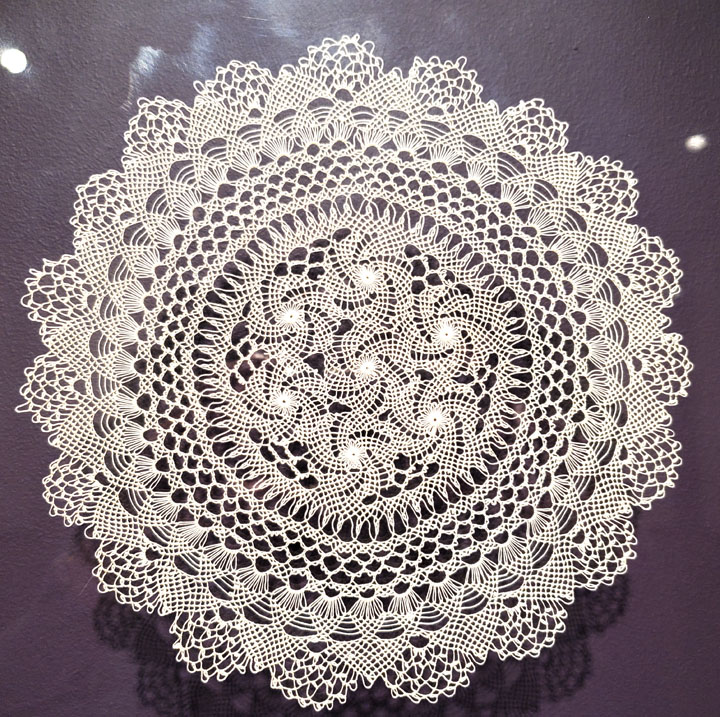
Armenian lace doily made by Marie Pilibossian. At the Fowler Museum, UCLA.

Until my recent visit to the Fowler Museum at UCLA in Los Angeles, California, to see Janyak: Armenian Art of Knots and Loops, I never appreciated the artistry of lacemaking and its cultural significance. A fascinating exhibit in a small inner gallery displays a variety of beautiful lace doilies made by Marie Pilibossian (1898-1986) an Armenian genocide survivor who emigrated to America, with explanations of the various designs and what they represent.

Fine thread tied in knots and loops is used to make the doilies.

The craft of lacemaking is called Janyak in Armenian, and each region has its own embroidery styles.

Symbolic meanings of various motifs.

 “Among the shapes identified by scholars is a triangle that alludes to Mount Ararat, symbolizing the Armenian homeland. Other elements represent eternity, the tree of life, Zangezur (a region in Armenia), and Armenian folk dancers. In this way, janyak carried within its knots and loops an understanding and affirmation of familial and cultural roots—a shared and treasured history.”


Designs and techniques are passed down from mother to daughter.


If you go to the Fowler museum to see the permanent exhibits or one of the other special exhibits (see my earlier post about the amazing beaded art of Haitian artist Myrlande Constant) be sure to stop in to see Janyak: Armenian Art of Knots and Loops. The exhibit will be up until February 2023. You will be amazed at the intricacies of the designs.

The center swirl design is symbol of eternity.

For information about the exhibit:

https://fowler.ucla.edu/wp-content/uploads/2023/07/Fowler_PR_Janyak-Armenian-Needle-Lace.pdf

Fowler Museum of Cultural History, UCLA, Los Angeles, CA.


Monday, August 14, 2023

NEW FOREST AND HAMPSHIRE COUNTY SHOW, Guest Post by Susan Kean


Winning cow at the New Forest and Hampshire County Show, England

My friend Susan Kean, who has contributed to The Intrepid Tourist before, travels frequently to England to visit friends and family. On her recent trip she spent two days at the New Forest and Hampshire County Agricultural Show in southern England. I thank her for sharing her thoughts and photos.

Heifer on parade.

The first agricultural show was held in 1920 and was a celebration of the traditional agricultural lifestyle of the region. The earliest shows featured judging of cattle, pigs, goats, poultry, rabbits and vegetables. Following this were parades of cattle, horses and ponies and the day always ended with musical stalls and dancing. Today, the New Forest and Hampshire County Show is a three day event, held at the end of July. Show jumping is a major feature, with international classes held throughout the three days.

Lunch and show jumping.

Susan writes, “The highlight was a delicious lunch while watching show jumping."

Winning carrots and beets. 

She adds, "The vegetable and flower displays were also amazing”

Arrangement by the Alverstoke Floral Decoration Society.

All of these are real flowers!

Wild flower display.

The New Forest and Hampshire County Show promotes and encourages the development of agriculture, forestry, equestrianism and horticulture and encourages the improvement in the breeding of stock. It helps raise funds to support the New Forest Agricultural Show Society and other local and national charitable organizations.
 

Monday, August 7, 2023

WALKING AROUND REYKJAVIK, ICELAND, Part II, Guest Post by Caroline Hatton

Reykjavik, Iceland. Looking down from the Hallgrimskirkja church tower: Across the street, Einar Jonsson Sculpture Museum and Garden.

My friend Caroline Hatton, a children’s writer and frequent contributor to this blog, loved strolling through Reykjavik in June 2023 and taking all photos in this post
. This is Part 2 of her report. Part 1 appeared last week.

I stayed near the far end of Lauvavegur, the main shopping street downtown. From there, I walked in a few minutes to the seashore and in less than half an hour to everything else I saw. Here are some outdoor highlights.

THE EINAR JONSSON SCULPTURE MUSEUM GARDEN

Glima (wrestling) or is it tango? Sculpture by Einar Jonsson, 1912-1927.

Online photos of the late Einar Jonsson’s sculptures didn’t show anything I liked, so I didn’t want to pay to visit the museum building. But walking through the surrounding garden was free, a chance to see a variety of sculptures I did find interesting.

Sorg (grief), sculpture by Einar Jonsson 1926-1927.

The garden sculptures’ balletic grace and emotional impact were a pleasant surprise.

CORRUGATED-IRON-CLAD BUILDINGS

Old corrugated-metal-clad home.

After realizing for the first time that a nearby building was covered with painted corrugated metal, I started seeing many more everywhere, primary red, blue, and yellow, grass green, pastels, black, white, gray, khaki, sage, merlot, burgundy, moss green, eggplant! Corrugated-iron-clad buildings are uniquely Icelandic and Reykjavik has the largest cluster in the world. After living in turf homes for about a thousand years, Icelanders started building wooden and stone houses, then covering wooden ones with imported corrugated iron. The metal layer kept occupants warm and dry in fierce wind and rain, and safer from fire.

Modern corrugated-metal-clad home.

Most of Reykjavik’s ironclad homes were built between 1880 and 1925, but I saw one modern example.

 STREET FOOD

Baejarins Beztu Pylsur, Icelandic hotdog stand on the right. One of many locations.

As a last outdoor experience to write about, the only street food I tasted was a famous Icelandic specialty… a hotdog, from Bæjarins Beztu Pylsur. At noon on a June Thursday, I was the 20th in line at the hotdog stand. Of the standard trimmings, chopped raw onions, crispy onions, ketchup, mustard, and remoulade, I wanted only crispy onions (which went in the bun first, with the hotdog on top to hold them down) and the mustard (a mushroom mustard which was tan-colored and mild-tasting). The thin long hotdog was a mix of lamb, beef, and pork meat. I almost never eat the first two and rarely the third, but I made an exception for the sake of a cultural experience. It was a satisfying lunch on a sidewalk bench and it cost only 690 Icelandic kronur (US $5), which is uncharacteristically cheap for food in Iceland.

 Before and after this lunch, I visited museums, but that’s another story.


All text and photos, copyright Caroline Arnold. www.theintrepidtourist.blogspot.com


Monday, July 31, 2023

WALKING AROUND REYKJAVIK, ICELAND, Part I, Guest Post by Caroline Hatton

Reykjavik, Iceland. Bravo bar in a quintessential Reykjavik corrugated-iron-clad building.

My friend Caroline Hatton, a children’s book writer and frequent contributor to this blog, loved strolling through Reykjavik in June 2023 and taking all but one photo in this post
. This is Part 1. Part 2 will appear next week.

When the Covid pandemic hit in 2020, the week-long horse trek I had previously booked in Iceland got canceled. But after a few years staying safe at home, and getting vaccinated and boosted against Covid and its variants, I booked it again, this time for June 2023.

Riding a horse safely requires my sharpest focus and reflexes, so I planned to arrive in Iceland a few days early to get over jet lag. Buffer days would also reduce the impact of potential flight delays or cancellations, or lost luggage, which had been a higher risk in the past two years (but didn’t happen to me).

Where would I spend the extra days? At the horse farm, perhaps the only guest in an isolated, rural location, enjoying a personal retreat, reading about Iceland, and hoping for photo opps with horses? Or in Reykjavík, which I had skipped on two previous visits to Iceland, hungry as always for time in the wild? I can read about Iceland at home, so I chose to explore Reykjavik. I stayed near the far end of Lauvavegur, the main shopping street downtown. From there, I walked in a few minutes to the seashore and in less than half an hour to everything else I saw. Here are some outdoor highlights. 

THE SUN VOYAGER

The Sun Voyager sculpture by Jon Gunnar Arnason.

The art work I ranked as most inspired was the Sun Voyager,
 or Sólfar in Icelandic. It’s a large steel sculpture by the late Jón Gunnar Árnason, an Icelandic mechanical engineer who pursued art in his spare time. The Sun Voyager symbolizes the promise of undiscovered territory, a dream of hope, progress, and freedom. As it stood outdoors on the seashore, its slender arcs reaching for the sky gave it an exuberant lightness, unusual for a Nordic creation.

When I took the above photo, I framed it to exclude a stranger on the right side, but this truncated the shiny disk under the sculpture—oops—and removed a convenient indication of scale—oops again! The disk reflects the changing sky, including dramatic colors, clouds, or northern lights, as shown by postcards in every shop. After glancing to the right, at Mount Esja across the bay, I turned left to follow the waterfront walking path to the Harpa Concert Hall, 600 m (~1/3 mile) west. 

THE HARPA CONCERT HALL AND CONFERENCE CENTER

Harpa Concert Hall


The glass walls mirror nature's moods.

Shiny! The Harpa Concert Hall 
is a glass building that lets light through and reflects it, mirroring nature’s moods, and it is a winner of the European Union Prize for Contemporary Architecture Mies van der Rohe Award. Harpa was designed by Henning Larsen Architects and its facade by Icelandic-Danish artist Olafur Eliasson, inspired by Iceland’s volcanic crystallized basalt. Harpa is the home of the Iceland Symphony Orchestra, The Icelandic Opera, and the Reykjavik Big Band.

Harpa wall from inside.

I loved hunting for photos inside and outside, zooming in on the repeating glass blocks or the occasional panes of different colors which made walls and ceilings shimmer like gemstones.

Himinglaeva sculpture by Elin Hansdottir.

Outside Harpa, the stainless-steel-coil sculpture by Elín Hansdóttir, named Himinglæva
 after a Norse mythic figure, is an Aeolian harp: it produces sounds when wind blows through it, which wasn’t the case when I saw it.

HALLGRÍMSKIRKJA

Hallgrimskirkja, the largest church in Iceland and Leif Eriksson statue. Photo credit: Jakub Halun, Wikimedia Commons.

Hallgrímskirkja 
 is the largest church in Iceland, a tall reference point visible from all around town.

In some online photos, it looked like a solid concrete bulk. But up close, the minimalistic design and slim columns reminiscent of volcanic basalt, separated by slivers of transparent glass, felt airy and elegant. The interior felt serene because it was free of adornments.

Looking down from the Hallgrimskirkja church tower: Across the street, Einar Jonsson Sculpture Museum and Garden. Beyond, row of concrete homes painted green, blue, yellow, beige, gray, pink, red...mauve! Beyond, Tjornin Lake and the ocean.

As for the view from the tower, having seen Paris from the top of the Eiffel Tower as a toddler, then London, Taipei, Ulaanbaatar, and Seattle from up high, I had decided to skip seeing smaller Reykjavík from above. But when nature mirrored my mood, and the overcast sky turned clear blue and the sun warmed the day (after the weeks of cloudiness and frigid rain I had monitored before traveling), I changed my mind because it felt like an exceptional opportunity. I rode the elevator and climbed the few steps up to the observation deck. My experience was worth every Icelandic króna I paid.

The 360-degree view unexpectedly popped with the happy colors of roofs and buildings. I spotted the Reykjavik Airport where I once took a flight to Greenland, the oldest part of Reykjavik, new condo high-rises on the waterfront, the Harpa Concert Hall, ocean, mountains, and more.

A sign had warned me that the bells, hanging just above the observation deck, chime every fifteen minutes. I should have set an alarm to cover my ears just before, instead of just after the ringing stabbed my ear drums and rattled my rib cage.

From the observation deck, I saw the Einar Jonsson Sculpture Museum garden across the street, where I walked next.

Next week at The Intrepid Tourist: Part 2 of Walking Around Reykjavik, Iceland.


All text and photos, copyright Caroline Arnold. www.theintrepidtourist.blogspot.com


Monday, July 24, 2023

DESCANSO GARDENS, La Canada Flintridge, CA: Something in Bloom at Every Time of Year

Descanso Gardens, La Canada Flintridge, CA

Recently, when June Gloom brought day after day of cloudy weather to the California coast, we headed inland to get some sun. Our destination: Descanso Gardens, tucked in the hills of La Canada Flintridge, California, just a few miles from downtown Los Angeles. It was the perfect escape into nature from surrounding city life. Its many trails go through cultivated gardens and Southern California’s natural landscape. 

Climbing roses.

Famous for its camellias and tulips in the spring, Descanso Gardens has something new in bloom at every time of year. During our visit in June, the roses were in full bloom, as were the early summer garden flowers and wildflowers on the hillside.

Succulent in bloom.

After purchasing our tickets, we headed down the main promenade, past the seasonal plantings, before deciding which path to take.

Roses.

The gardens include a network of paths ranging from paved walkways to more secluded trails. Using a map we picked up at the entrance to guide our way, we made a circular tour of the gardens, starting with the promenade and roses, then walking around the lake to the oak woodland and California garden, then through the camellia forest and Japanese garden before returning to the entrance.

View of San Gabriel Mountains.

We made our way uphill to the California garden and got a view of the valley and the mountains beyond. 

Giant chalk dudlea.

Along the path we discovered California's only native succulent, Dudleya, and some of its relatives. 

Lizard.

As we walked along we kept an eye out for wildlife that makes the garden its home. An addition to birds, we spotted a ground squirrel, turtle, a mother mallard with her offspring, and a lizard that popped up on top of a fence, performed several pushups, and then scampered away.


Koi in the Japanese Tea Garden.

Throughout the gardens there are numerous benches and shelters inviting one to sit and enjoy the scenery. 


Poppies.

A visit to the garden is always an opportunity for photography, especially close-ups.


So many plants. So little time. We missed seeing the hilltop gardens and Ancient Forest. We’ll have to go back another day.


 For information about visiting Descanso Gardens, go to their website.