Monday, November 26, 2018

GRAND CANYON: Hike on the South Kaibob Trail, guest post by Tom Scheaffer

On the South Kaibob Trail of the Grand Canyon in Arizona
In early November my brother Tom and two friends took a trip to Northern Arizona and visited the Grand Canyon and Sedona. He has graciously shared a report of his trip and some of his beautiful photos.
View of the Grand Canyon from the South Kaibob Trail
We flew from our  home in San Diego to Phoenix, rented a car, and drove to the South Rim of the Grand Canyon, where we stayed overnight in a hotel (the Maisik Lodge.) The next morning we got up before dawn and went to the rim so we could see the sun come up over the canyon. It was a beautifully clear and cold morning. At 7,000 feet altitude the temperature at the rim was below freezing!
View at sunrise from the South Rim of the Grand Canyon
After breakfast back at our hotel, we took a shuttle bus to the trail head for the South Kaibob Trail and set off on our walk.
Looking down the South Kaibob Trail
The first part of the walk consists of steep switchbacks down the cliff face. The views are amazing.
We walked for about two miles into the canyon to a rest stop, where we found a sheltered place behind some rocks and ate our picnic lunch.
Tom at a great view spot on the South Kaibob
We then retraced our steps back to the top, the whole time going up and down–none of the trail was level and much of the trail is steps. Going back was much slower than going down. We were lucky there was no heat to deal with as there is when hiking during the summer. The crisp fall air made perfect hiking weather.
Red rocks of Sedona, Arizona
On our drive back to Phoenix we stopped in the town of Sedona for a night. Our hotel had a beautiful view of the spectacular red rock formations Sedona is famous for. Altogether, we had a short but inspiring trip.

Go the Grand Canyon National Park website for more information about visiting the Grand Canyon.
In the winter of 2014, Tom went another trip to the Grand Canyon, that time with a friend who hiked down the South Kaibob Trail and back up to the rim on the Bright Angel Trail (more than 20 miles round trip!) For Tom's Intrepid Tourist report of that trip, click HERE

Monday, November 19, 2018

CERAMICS MUSEUM IN YINGGE and ZUSHI TEMPLE IN SANXIA: Day Trip from Taipei, Taiwan

Bridge to Zushi Temple, Sanxia, Taiwan
On our recent trip to Taiwan we had a free day and decided to take a day trip from Taipei to see the new Ceramics Museum in Yingge and the Zushi Temple nearby in Sanxia. Yingge has long been the center of the ceramics industry in Taiwan and is home to numerous ceramics factories as well as the museum and a restored “old street” with pottery shops.We arranged for a taxi driver to pick us up at our hotel in Taipei for the hour's drive to Yingge.
Gymnast ceramic sculpture, Yingge Ceramics Museum
When we arrived at the museum we bought our tickets and went inside the bright, glass-walled building where we were advised to tour the outdoor portion of the museum first. As it turned out, it was good advice, because as the day goes on the weather outdoors becomes quite warm. It is better to walk around when it is relatively cool. (The inside of the museum is air conditioned.) In the outdoor garden ceramic sculptures are arrayed over a large expanse--on lawns, along tree lined walkways, on pedestals and amongst the shrubbery.
Master potter Chan Kao Hsiang; demonstration at Yingge Ceramics Museum
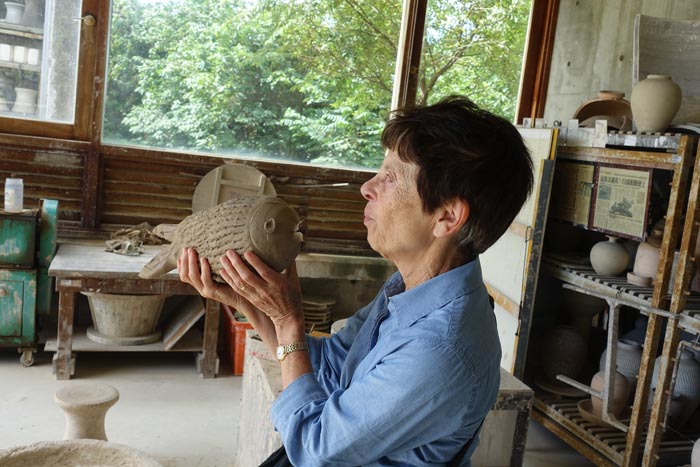
Workshops were going on in several buildings and there were activities for families and children. We stopped to look in on an open studio where a potter was giving a demonstration. When he saw us, he invited us down to take part in the program. He had just finished throwing a tall pot, and, as we watched, he proceeded to turn it into a clay fish, using us as his accomplices.
Breathing life into a clay fish
Although he spoke no English and we no Chinese, all this was accomplished through sign language, much to the enjoyment of the audience. It was the highlight of our day!
Ceramic roof tiles
The inside of the museum chronicles the history of Taiwan as seen through its pottery, beginning with early pots made by local tribes and continuing through the colonial period to modern times.
Vases
Objects on display include everything from dishes and roof tiles to ceramic toilets to elegant sculpture.  Exhibits are well labeled in both English and Chinese. We ate a light lunch in the museum cafeteria before leaving to visit Sanxia.
Gate to the Zushi Temple
In Sanxia our driver dropped us off at the gate to the bridge that leads to the Zushi Temple (also spelled "Tzushr") on the other side of the river. It was Sunday and the bridge was crowded with pedestrians and vendors hawking souvenirs and games of chance.
Bell tower of the Zushi Temple with modern apartment building in the background.
The Zushi Temple and its surrounding "Old Street" reflect the town as it was one hundred years ago. They stand in contrast to the surrounding modern architecture. The temple has been described as an “Eastern Palace of Art”. It is certainly a riot of color–red, yellow, green, blue, gold-- with every conceivable surface decorated with birds, animals, flowers, dragons,  human figures and more.
Incense sticks are guarded by two stone dragons.
While many of the people there were tourists like us, others were lighting incense and offering prayers at this Taoist temple. The main part of the temple was at the rear of the inner courtyard. There were smaller rooms on either side.
The drum tower and a few of the 126 hand-carved stone pillars that adorn the temple.
Stairs led to a second story with access to the bell tower on one side and the drum tower on the other.
Flowers and other offerings adorn the rooms inside the temple.
The Zushi Temple honors Qingshui Tsu-Sze, a Song-dynasty general worshiped for his power to protect the local tea industry. First erected in 1769, the current building is a restoration begun in 1947 and still in process. With its lavish decorations it was truly a feast for the eyes.
Then it was time to cross the bridge again to meet our taxi driver for the trip back to Taipei.
Realistically carved kingfisher holding its prey on a wooden screen along the temple corridor.

Monday, November 12, 2018

WATCHING THE STARS at the GRIFFITH OBSERVATORY, Los Angeles, CA

Griffith Observatory, Los Angeles, CA
The Griffith Observatory sits high on a hill above the city of Los Angeles, its white walls and domed roofs visible from miles away. It is the ideal place to get a panoramic view of the city and to watch and learn about the stars–the real ones, not the movie variety.
City view from the Promenade Walkway of the Observatory
The Griffith Observatory in Griffith Park is one of the premier public observatories in the world. Griffith J. Griffith wanted the public to have the opportunity to look through a telescope, which he felt might broaden human perspective. Mounted in the copper-clad domes on either end of the building, the Zeiss and solar telescopes are free to the public every day and night the sky is clear.
Jennifer and me, in front of the Observatory. The Griffith Observatory opened to the public on May 14, 1935
When my daughter Jennifer was in high school and college, she worked as a guide at the Observatory. She was in town last summer with her family, so we decided to spend an afternoon there.
Astronomer's Monument and Sun Dial on plaza in front of the Observatory
Traffic and parking are always a challenge near the Observatory, so we parked along the road near the Greek Theater. We then ate a picnic lunch on the grass before heading up the hill, about a mile’s walk. One can also get to the top by riding one of the free shuttle buses that stop across the road from the Greek Theater.
Foucault's Pendulum
Just inside the main door of the Observatory is Foucault’s pendulum, a heavy ball that swings in an arc following the Earth’s rotation. It is a favorite exhibit at the Observatory. Visitors crowd around the railing around the pit, waiting to see the ball knock over a peg every few minutes.
The 240-pound brass ball moves back and forth on a 40-foot steel cable suspended from the dome. At Los Angeles' latitude, it takes 42 hours for the pendulum to complete a circle as the earth beneath it rotates. The movement is visually represented by small wooden dowels that are knocked over one at a time by a pointer on the bottom of the ball.
Tesla Coil
Another favorite Observatory exhibit is the Tesla coil. When it turns on, giant flashes of light explode as electricity flows into the air of the chamber.
During our visit we looked at dozens of other exhibits as well, learning about the sun, moon, planets and things astronomical. We ended our stay with a live show in the Samuel Oschin Planetarium, settling into the comfortable reclining seats for the show. (Tickets for the shows can only be purchased at the Observatory on the day of the show.)
It was a great family outing and opportunity for our grandchildren to see where their mother had worked when she was just a little older than they are now.
Admission to the Griffith Observatory and Grounds is FREE. For more information click HERE.
North Doors of the Observatory

Monday, November 5, 2018

SUN MOON LAKE, TAIWAN: Hiking, Temples, and the Beauty of Nature

View from Longfeng Temple, Sun Moon Lake, Taiwan
On our recent trip to Taiwan, our last night was spent at Sun Moon Lake, located in the mountains about two hours from the coastal city of Taichung. This beautiful alpine lake (altitude 2,545 feet) is surrounded by thick green forest and majestic mountains. It is part of a National Scenic Area and a popular vacation spot.
 Sun Moon Lake. Ci'en Pagoda, on a hill overlooking the lake, was built by late President Chiang Kai-shek in 1971 in memory of his mother.
We traveled to Sun Moon Lake by taxi from Taichung, passing through a series of long tunnels as we climbed from the level plain along Taiwan's west coast through the hills and valleys in the center of the island. (Taiwan is a long island, with a line of steep mountains down the center as its spine.)
View of the lake and bikeway from our seventh floor room at the Sun Moon Lake Hotel.

Street light along the coast road in Sun Moon Lake. The east side of the lake resembles a sun while the west side resembles a moon, hence the name.
After checking into our hotel, we took a walk along the bikeway/walkway.

Reflector on the walkway around the lake
The 29 km scenic bikeway goes all around the lake and we were passed by people on bikes of all sorts–electric, tandem, and 10-speed with families carrying children in baby seats.  (We could have rented bikes at our hotel, but we preferred to walk.)
This bridge is popular for wedding photos.
Our destination was the new modern Xiangshan Visitor Center, which happened to have a bonsai show that week. The low, organically designed building blends harmoniously into the landscape and provides an overlook of the lake and is surrounded by broad reflecting pools enhancing the view.
Bonsai plant in front of the Xiangshan Visitor Center
The Visitor Center also has a small museum with exhibits about the Bunun culture, the local indigenous people. Living on both sides of the Central Mountain Range, Bunun people were known to be one of the “high-mountain tribes.” Singing and dancing are an important part of the Bunun culture. Pestle music is performed by a number of people wielding wooden pestles and involves the rhythmic pounding of the pestles against stone slabs.
Traditional Bunun clothing
The next morning, before we left, we walked to LongfengTemple close to our hotel. At sunset the evening before and at sunrise we had listened to the temple bell ring and echo over the water.
Longfeng Temple
At this temple and the one we visited earlier in our visit to Taiwan in Sanxia, (near Taipei) every single surface was decorated with dragons, birds, animals, people, flowers and more. It was hard to stop taking pictures.
Bird and plant decorations at Longfeng Temple
We then took a short hike on the trail leading to Mount Maolin and the Tea Research and Extension Station.
Tea plantation. With similar latitude and growing conditions to India's Assam tea farms, the area around Sun Moon Lake has become the main base for the cultivation of Assam tea in Taiwan.
We had brought our binoculars, but we saw surprisingly few birds considering the lush forest all around the lake. However, we did see a lot of butterflies. (Taiwan is famous for its wealth of tropical butterflies, once collected and exported by the ton. Now they are protected as a natural resource.)
Junonia orithya butterfly
Then it was time to leave. A taxi took us directly to the airport in Taipei for our flight back to Los Angeles. One day wasn’t really enough to fully explore Sun Moon Lake, but it gave us a taste of Taiwan’s rich natural beauty.

Monday, October 29, 2018

TASTES OF TAIWAN: From Peking Duck to Dim Sum

Peking Duck, W Hotel, Taipei, Taiwan
Taiwan is a great place for food lovers. You can find local foods everywhere from fancy restaurants to neighborhood cafes to shopping malls and street markets. Although not all menus include English translations for the Chinese names, one can order simply by pointing to a picture or the food itself. During our week in Taiwan our first meal was an elegant Chinese dinner at the W Hotel restaurant, a few blocks from Taipei 101, the skyscraper we had visited earlier in the day. The first course was Peking duck, carved at the table and served with sauces and small pancakes. It was followed by a variety of other delicious dishes, shared with our host and his family. (Our dexterity with chopsticks improved over the course of the week!)
Making pork dumplings (xiao long bao) at Din Tai Fung
Later in our trip our host took us to the food court in a nearby mall for a dim sum meal at the very popular restaurant Din Tai Fung. While we waited for our food to come to the table we watched through a window as an assembly line of cooks produced the thousands of xiao long bao (pork dumplings) in the kitchen–rolling, filling and pinching the dough before putting the bao into bamboo steaming baskets.
Cooked pork dumplings (xiao long bao) in bamboo steamer basket
A short time later the finished dumplings arrived at our table cooked to perfection. I have eaten pork dumplings before, but they have never tasted more fresh or more delicious than these. (You don't have to travel to Taiwan to dine at Din Tai Fung--they have numerous restaurants in the USA and internationally.)
Boba tea served in a light bulb shaped bottle
Our host insisted that we not leave Taiwan without tasting boba tea, a popular drink found both at street markets and at stands in the shopping mall. Boba tea (also called pearl tea, or bubble tea) is a sweet drink that combines milk, flavored tea and tapioca pearls that are sucked up through an extra large straw and chewed. The boba drink pearls have a soft, chewy consistency similar to that of gummy candy. (“Boba” is a Taiwanese slang term meaning “pearl”.) We found it quite tasty!


Yixing clay teapot, Palace Museum, Taipei
And, of course, tea came with almost every meal. We saw no end of beautiful teapots displayed at museums and for sale in stores, often made with Yixing clay. Teapots in this traditional style originated in China, dating back to the 15th century, and are made from clay produced near Yixing in the eastern Chinese province of Jiangsu. We also saw many varieties of Taiwanese tea for sale in the shops. When we were in the mountains at Sun Moon Lake we took a walk through a tea plantation.
Sashimi at Dozo Restaurant, Taipei
Many foods in Taiwan reflect the influence of Japanese culture. (Taiwan has had a complicated political history, including being under the control of Japan for the first half of the 20th Century.) One evening we ate at a Japanese restaurant called Dozo, sitting at the counter where we watched the sushi chefs assemble artistic constructions of raw fish.
Fresh fruit for breakfast
Our days always started with the breakfast buffet at our hotel, which included traditional Chinese savory porridge, rice, noodles and other typical Asian foods, as well as typical Western breakfast items such as cereal, bacon and eggs. My favorites were the fresh fruits--watermelon, grapefruit, oranges, papaya, star fruit and more. Taiwan has a semi-tropical climate and a variety of delicious fresh fruits were always available.
Sausage vendor at the Shilin Night Market, Taipei
For a quick snack, one can always stop in at one of the ubiquitous Seven Eleven minimarts or at neighborhood bakery or coffee shop. One evening, at the Shilin Night Market, we wandered through the rabbit-warren of shop-lined streets and watched cooks prepare their wares. Although we didn’t sample any of the street food, we saw long lines of people waiting to purchase everything from grilled meat, boba tea, filled buns, fruit and much more.
Handcrafted Taiwanese beer with evocative English names
On one of our last evenings we had the chance to sample Taiwanese craft beer in the bar on the top floor of the National Taichung Theater. With our host, who had treated us royally during the week of our visit, we looked out over the sparkling night lights of the city. It was a relaxing end to a busy and stimulating week in Taiwan.

Monday, October 22, 2018

TAIPEI, TAIWAN: Skyscrapers, Art, Street Markets and More

At the National Palace Museum in Taipei, Taiwan
We arrived in Taipei early on October 10th, not realizing that it was a national holiday. Flags were everywhere as we made our way to our hotel near the center of the city.
We had come to Taiwan because my husband, Art, had been invited to give lectures at several Taiwanese Universities. I came along as a tourist. Although Art would be working part of the time, we tried to squeeze in as much sightseeing as we could during his free time.
Sun Yat Sen Memorial Hall, Taipei. The roof is made of copper.
After resting for a while to recover from our 14 hour plane ride from Los Angeles, we took a short walk to the Sun Yat Sen Memorial Hall, located a few blocks from our hotel in the middle of a large park with fountains, a lake and a sculpture garden. A giant statue of Sun Yat Sen towers over the main lobby and we watched families wearing red, white and blue shirts pose for pictures with the figure revered as the founding father of modern China.  
Flag of the Republic of China (ROC)
Outside, throngs of people had gathered on the plaza in front of the building listening to speeches and shouting their support. Colorful umbrellas added to the festive feeling. The steady rain didn’t seem to dampen anyone’s enthusiasm.
Taipei 101, with its 101 stories, is the tallest building in Taipei. The elevator to the top travels at a maximum speed of 1010 meters a minute.
Our next stop was a visit to Taipei 101, the skyscraper and office tower that dominates Taipei’s skyline day and night. After buying our tickets, we zoomed to the top in the world’s fastest elevator for a 360 degree view of the city. Even with the rain, the view was spectacular.
View to the north from the top of Taipei 101. The copper roof of Sun Yat Sen Memorial Hall can be seen in the upper left.
Interactive boards with English labels helped us identify the buildings below and multiple exhibits explained the history of the tower and of the city. When it was built in 2004, Taipei 101 was the tallest building in the world. (The Burj Kalifa in Dubai has the current record.)
A large weight in the center of the tower acts as a stabilizer for Taipei 101
A giant ball suspended in the center of the tower acts as a steadying weight to compensate for effects of wind or earthquakes. On the same level where we went to view the ball there is also a huge display of coral, jade, amethysts and other gems native to Taiwan. The lower three floors of Taipei 101 are an elegant shopping mall with a bustling food court at the bottom. Later in our trip we went back to the food court for a dim sum meal at the very popular Din Tai Fung restaurant.
National Palace Museum, Taipei
On our second day our host arranged a visit to the National Palace Museum, a treasure house filled with metalwork, ceramics, carvings, paintings and calligraphy originally collected by the imperial family in Beijing but moved to Taiwan after the end of World War II.
Vase, National Palace Museum
We took the English tour and got an excellent overview of the collection, including the famous Jadeite cabbage, a piece of jade so beautifully carved that the leaves look real, as do the two tiny grasshoppers nestled inside them. After our museum visit we walked across the plaza to the Silk Restaurant for a delicious dinner.
Painted pottery figure of a standing lady, Tang Dynasty, National Palace Museum
Our other sightseeing in Taipei included shopping at the Eslite department store, a visit to the Songshan Cultural and Creative Park and a trip on the Metro (MRT) to the Shilin Night Market. The Eslite department store is more a collection of upscale boutiques than an American style department store and features everything from clothing and furniture to food items and books.
Entrance to children's book store, Eslite Department Store
I was most interested in visiting the children’s book department. Although most of the books were in Chinese, a surprising number were in English. Taiwanese children begin studying English in first grade in school.
Entrance to the Design Museum, Songshan Cultural and Creative Park
The Songshan Cultural and Creative Park is a repurposed tobacco factory, originally built in 1937 as a state of the art industrial village with restrooms, dormitories, a hospital, dining hall, entertainment lounge and nursery room for use by its 2000 employees. The buildings are now used as offices and display spaces for galleries, craft shops and cafes. An enthusiastic volunteer in the information center gave us a tour.
Shilin Night Market, Taipei
Our guidebook proclaimed the Shilin Night Market as one of the most popular places in Taipei for both tourists and locals, who come to enjoy “the carnival of street-side snacking, shopping, games and people watching.” So, on Saturday afternoon we boarded the Metro to go there an see it for ourselves. Along with other shoppers, we wandered through the rabbit-warren of shop-lined streets. Although we didn’t sample any of the street food, we passed long lines of people waiting to purchase everything from grilled meat, tea, filled buns, fruit and more from the many food vendors.
Taipei is a large, bustling city of 7 million people. During our few days there we only had time to see a few of its many sights. If we have the chance to visit again, we will definitely stay longer!