Monday, August 28, 2017

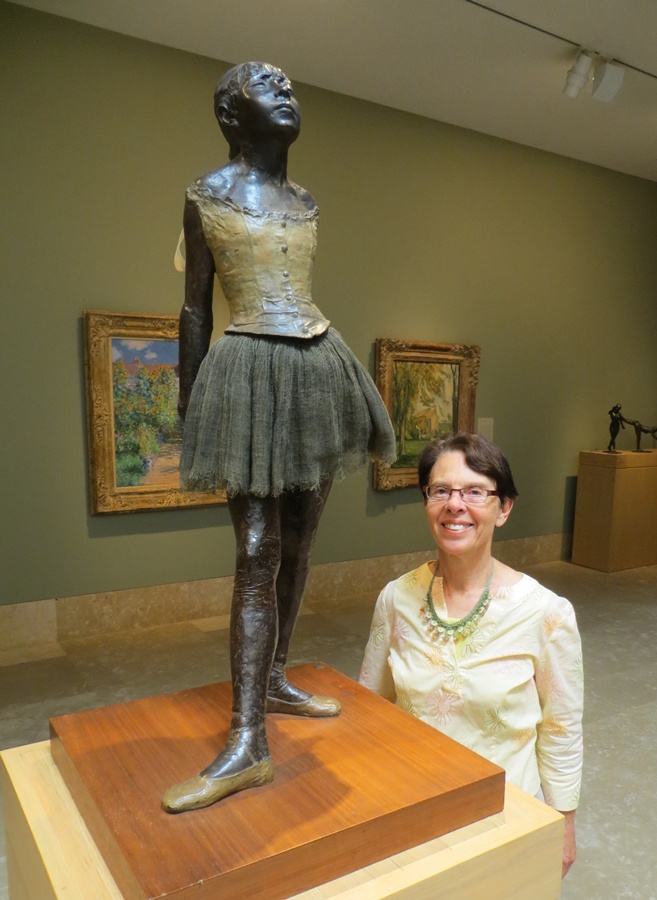
FOUR YOUNG DANCERS by Edgar Degas

Young Dancer by Edgar Degas, Art Institute of Chicago
On a recent visit to the Art Institute of Chicago, I met, once again, the famous sculpture of a young dancer by Edgar Degas. It was like meeting an old friend. In each case, her tutu was a different color, but the figure, paused in thought, was the same.
Little Dancer Age Fourteen, Musee D'Orsay
My first encounter with her was in Paris at the Musee D'Orsay in 1998.
Little Dancer, Norton Simon Museum
I then met her again a few years later in Pasadena, California, at the Norton Simon Museum.
Original Wax Sculpture of the Little Dancer, National Gallery, Washington, D.C.
And then, on a trip to Washington, D.C., three years ago, I saw her again. My previous views–in Paris, at the Norton Simon Museum in Pasadena, and in another exhibit at the National Gallery–were all casts made after his death.  This time I saw Degas’ original wax sculpture of the Little Dancer from which the casts were made, so for the first time I could see how the surface was modeled.  The figure is made of wax over a metal armature to which the artist added wood, rope, and even old paintbrushes in the arms.  Then a wig of human hair was added as well as a cotton-and-silk tutu, a cotton faille bodice, and linen slippers. Her turned out toes, erect posture and raised chin seem to convey an inner determination.The wax model of Little Dancer Aged Fourteen was on view from October 5, 2014 to January 11, 2015.
For a fascinating history of the various versions of the young dancer sculpture, click HERE.

Monday, August 21, 2017

Chicago River Cruise: MAGNIFICENT ARCHITECTURE

Chicago Skyscrapers
No one who visits Chicago can fail to be impressed by the soaring skyscrapers and other large historic buildings that crowd the downtown. One of the best ways to appreciate their beauty, origin, and role in Chicago’s history is to take a river cruise sponsored by the Chicago Architecture Foundation, which I did on a recent visit. The cruises are narrated by knowledgeable volunteers who point out key features of the buildings, tell about who designed them and when, and about their significance.
We are directed to the dock at the top of the stairs to the river walk
It was a beautiful sunny day, not too warm or windy. To board the boat we went to the dock, located on the river walk just east of the stairs descending from Michigan Avenue.
Chicago River and River Walk
We sat in long rows of chairs on the top deck of the ship, affording us with a 360 degree view of our surroundings. The trip began by sailing westward up the river to the north branch, passing under numerous bridges. Although built as drawbridges, we were told that they are now raised only twice a year, in spring and fall, to let large boats into or out of  their winter docks. After the cruise was finished, we walked along the river and visited one of the bridge houses, now turned into a museum.
View of the bridge from inside the bridge house
Most of the buildings in Chicago today were constructed after the great Chicago Fire of 1871 that had destroyed much of the city. As we made our way up the river, it was a trip through history, although jumbled together. Side by side are old and new, lavishly decorated and starkly plain, utilitarian and almost whimsical.
Going under the Dearborn Street Bridge

Reflections
I was particularly fascinated by the reflective glass of some buildings that echoed and altered their neighbors across the river. Or, in some cases, the river itself.
River Point marks the confluence of the river's main stem with its two branches. The arches at the top and the bottom are designed to reflect  the shape of the building and the curves of the surrounding banks--both literally and figuratively .
River Point, built 2017. Designed by Pickard Chilton Architects
 Marina City, built in 1967, are two giant towers that are part of a multi-use complex. The curved balconies remind people of giant corncobs.
Marina City towers
At the end of the cruise we headed toward Lake Michigan, turning around at the Marina. To our left was the amusement park on Navy Pier.
Giant Ferris Wheel, Navy Pier
 As we turned around we were treated to the full panorama of the Chicago skyline. It was spectacular.
After docking, we ate lunch at one of the many riverside restaurants, and then took a walk along the river to enjoy the sights and sounds of life along the water's edge. I thank Jim Akerman and Luann Hamilton and their daughter Claire, for treating me to this wonderful view of their city and for being most generous hosts during my visit.
To learn more about Chicago architecture, visit www.architecture.org
View of skyline from the cruise
 

Monday, August 14, 2017

THE CHICAGO ART INSTITUTE: From Paperweights to Impressionists and More

Two stately lions guard the entrance to the Art Institute of Chicago, one of the oldest and largest art museums in the United States, and one of my favorites. As I walked up the steps from Michigan Avenue and opened the door, stickers proclaimed it to be Chicago's number one museum choice on TripAdvisor
Rainy Day, Paris, Gustave Caillabotte, 1877
My visit to the museum on a recent trip to Chicago was an opportunity to become reacquainted with some of the museum's most famous paintings, including George Seurat's Sunday Afternoon on La Grande Jatte, Vincent Van Gogh's Bedroom at Arles and a number of Claude Monet's haystack paintings. 
Detail, Sunday Afternoon on La Grande Jatte by George Seurat
I have fond memories of visiting the Art Institute as a child and when I was in college and art school in Iowa (we rode to Chicago on the train.) I haven't been back since, so it was a delight to visit again. The museum has grown enormously with several additional modern wings.
Sculptures in the Modern Wing
Like most large museums, it is impossible to see everything in one visit so I decided to focus on the modern European and American wings. But on my way, I saw a sign pointing downstairs to an exhibit of paperweights and a special photography exhibit.
Paperweights from the collection of philanthropist Arthur Rubloff
My parents had their own small collection of paperweights so I was intrigued to see that exhibit–hundreds of glass paperweights arranged in artful designs.It is one of three premier collections of paperweights in the world. Other well-known paperweight collectors include Truman Capote, who wrote that the paperweight was like "some fragment of a dream."
Juvisy, France, photograph by Henri Cartier-Bresson
I am always interested in photography, so I went to see that exhibit too. It was a selection of photographs acquired by Hugh Edwards, curator of photography from 1959 to 1970. Edwards wrote about a photo by Cartier-Bresson of children playing by the Seine, "There are many great photographs by Cartier-Bresson, but this always remains my favorite."
Haystacks by Claude Monet
My visit to the museum was short and I was able to see only a fraction of the pieces on exhibit. I hope it won't be so long before I go back again.
A special exhibit of Gauguin paintings opened June 25th and will be open until September 10th.
Paul Gauguin: Artist as Alchemist, exhibit

Monday, August 7, 2017

EXTREME MAMMALS: Odd Creatures, Unusual Features at the Natural History Museum of Los Angeles County

Model of Indricotherium at the Natural History Museum of LA County
Imagine a furry creature more than fifteen feet tall living in your back yard–but only if you were around 33 million years ago. This giant animal, weighing in real life more than 20 tons, is Indricotherium and once lived all across Eurasia. Today, as a life-size model, it greets visitors to the new Extreme Mammals exhibit at the Natural History Museum of Los Angeles County.
Ambulocetus
This special exhibit, on view from May to September 10, 2017, focuses on mammals that have unusually developed body parts ranging from a walking whale with giant feet (Ambulocetus), bony body armor (Glyptodont) and even venomous feet (the platypus).
Glyptodont
While some of the animals featured in the exhibit are long extinct and known only from their fossil bones, such as Repenomamus, who feasted on small dinosaurs in the Mesozoic, others, such as the Tazmanian Devil, native to Australia, are alive and well today.
Mountain lion and photo of one prowling the hills of Griffith Park above the city of Los Angeles
The final animal shown in the exhibit is a mountain lion, a creature that has managed to survive even in populated areas like Los Angeles.
Visiting the exhibit requires a separate ticket after entering the museum. It is free to members of the museum.

Monday, July 31, 2017

Washington, D.C. MUSEUMS ON THE MALL

Alexander Calder mobile at the entrance to the East Wing of the National Art Museum, Washington, D.C.
Washington, D.C. is a city designed for tourists, especially around the National Mall. On a warm sunny day at the end of April I spent a day walking the Mall, visiting a number of the many museums. I took the Metro from my hotel in Bethesda, and got off at the Smithsonian station, not far from the “castle” that was the first Smithsonian museum, and now the headquarters for what has sometimes been called “our nation’s attic”. Nineteen museums and galleries, as well as the National Zoological Park, make up the Smithsonian museums and eleven are on the National Mall, the park that runs between the Lincoln Memorial and the United States Capitol. Obviously, I did not have time to visit all of them in one day, but I did stop in at several.
Brushstroke, sculpture by Roy Lichtenstein in front of Hirshhorn Museum
 My focus for the day was art museums, the first being the Hirshhorn Museum, which specializes in contemporary art and was featuring a large exhibit by the Japanese artist Yayoi Kusama called Infinity Mirrors. (See my post for last week.) In a futuristic looking building, shaped like a giant donut, the galleries form a circle around a large open courtyard.
Natural History Museum viewed from Hirshhorn Museum window (dots are an extension of the Kusama exhibit)
From the upstairs windows one can look across the mall to the Natural History Museum and the Museum of American History, both favorites of mine but not on my list for the day.
Frederic Bazille was a French painter in the early days of the Impressionist movement
I then crossed the Mall and walked through the National Art Gallery, with its much more formal display of traditional art from various historic periods (including a perennial favorite, Young Dancer by Degas), for lunch at the cafeteria on the ground level. In a small gallery on that level I visited an interesting exhibit of early impressionists, focusing on the French artist Frederic Bazille.  I then rode the level walkway through the long underground corridor to the East Wing where one of the featured exhibits was of the work of sculptor Alexander Calder, with giant mobiles hanging overhead and smaller pieces displayed below.
Arthur M. Sackler Gallery of Asian Art
Then, as I circled back across the mall to the Metro Station, I stopped at two smaller museums in facing symmetrical buildings–the Museum of African Art, where I stopped to view some of the masks and to enjoy the air conditioning, and the Freer/Sackler Museum, which specializes in Asian art. The special exhibit there was of a newly discovered painting by a eighteenth century Japanese artist Kitagawa Utamaro, one of three large panels he had painted of geisha life.
In late April spring flowers were at their height in the Smithsonian gardens
All along the mall, between the museums, are many beautiful gardens, with shady paths, benches for resting, and labels to identify the plants. It was a lovely spring day and in between my museum visits it was a pleasure just to walk outdoors and enjoy the sunshine and spring flowers.

Monday, July 24, 2017

POLKA DOTS: Yayoi Kusama at the Hirshhorn Museum, Washington, D.C. and Four City Tour

Inside the Hirshhorn Museum, Washington, D.C.
“Our earth is only one polka dot among a million stars in the cosmos.” Yayoi Kusama, 1968.
Polka dots were everywhere when I visited the Hirshhorn Museum in Washington, D.C. in April and peeked through the open doors to the crowded galleries exhibiting the amazing artwork by this 87 year old Japanese artist.
Video of Yayoi Kusama is part of the exhibit
Infinity Mirrors at the Hirshhorn was just the first of a five city American tour of Yahoi Kusama’s amazing work. It will be at the Seattle Art Museum (June 30–Sept. 10, 2017), The Broad in Los Angeles (October 2017–January 2018), the Art Gallery of Ontario (March–May 2018) and the Cleveland Museum of Art (July–October 2018). It is a show not to be missed.
Paintings and whimsical sculptures
The Hirshhorn Museum of Contemporary Art is one of the nation's many Smithsonian museums.To quote the Smithsonian news release: “Yayoi Kusama: Infinity Mirrors” provides visitors with the unique opportunity to experience six of Kusama’s most iconic kaleidoscopic environments at once, alongside large-scale, whimsical installations and key paintings, sculptures and works on paper from the early 1950s to the present. It also marks the North American debut of numerous new works by the 87-year-old artist, who is still actively creating in her Tokyo studio.”
Looking into the Obliteration Room, where visitors apply multicolored stickers to walls and furniture
Tickets were so popular that I was not able to get one for my short stay in Washington. Luckily, the design of the Hirshhorn museum (like an oversize donut) is such that open doorways from the outer circular gallery provided a good look into the rooms where her art was displayed.
Polka dot balloons
And there was much more to see. In addition to the Kusama exhibit, there was an amazing display of orchids from the Smithsonian greenhouse on the main floor near the entrance, ranging from sprays of tiny blooms to giant flowers.
Orchids from the Smithsonian greenhouses
On the walls of the inner gallery on the second floor of the museum there were a series of large photographs of public clocks from around the world, one from every one of the world's time zones and each photo taken at exactly 1:55 p.m. It was a trip through time when time has stopped.
World Time Clock by Bettina Pousttchi
And on the third floor of the museum I viewed a varied display of modern paintings and sculptures, ranging from those by self-taught artists to pieces by many of the iconic names of the twentieth century.
Holy Mountain III, by self-taught artist Horace Pippin
So, even though I couldn’t get a Kusama ticket, my visit to the Hirshhorn was more than satisfying. And, I will get a second chance to see Infinity Mirrors when the show comes to Los Angeles in the fall.

Monday, July 17, 2017

MILAN, ITALY: Guest Post by Cathy Bonnell

Gothic Cathedral, Milan, Italy
My friend Cathy Bonnell, a school librarian (now retired) in Phoenix, Arizona, loves to travel. Recently, she went to Italy, visiting Florence, Siena, and Milan with her daughter Courtney. I thank her for sharing the joys and discoveries of this special trip and for being one of my most faithful followers of The Intrepid Tourist. Here is Part 3, about her visit to Milan.


….and last but not least, Milan

Upon arriving in Milan I took a picture of public art—a colorful knot—that later I would find out had significance to one of the most famous Italian artists, Leonardo da Vinci.

 
The Last Supper by Leonardo De Vinci
In order to see his most famous work—the Last Supper-- we needed to book a tour of the Santa Maria delle Grazie which, in the end, I’m glad we did.  Our group’s fifteen minutes with the tempera-painted wall was fascinating.  In Italian, the part of Leonardo’s name Nardo means knot. 

Knotted tablecloth
Instead of signing the huge piece, the lower right hand corner of the image’s tablecloth is a painted knot.  These tidbits told to us by our guide enhanced the experience.


Frescoes salvaged from the remodel of our Milan Hotel
Like many parts of Italy, Milan was heavily bombed in the war.  Instead of trying to save artifacts and buildings, much of the city was merely bulldozed to make restoration quicker.  Our wonderful little hotel had salvaged pieces of frescoes adorning most of its walls.
Lovely library around the corner from our hotel
Many historic buildings remain, but the stark concrete architecture of the 50’s newer buildings are built right up next to them. 
Inside the Duomo
Surprises around every corner stunned us, including the huge Gothic Duomo with its numerous spires.  After heavy security we were finally able to see the many giant pillars inside and all the spectacular stained glass.
Stained glass window in the Duomo
Since most everything in Milan is closed on Monday, we took a train that day to Varenna, not far away, to enjoy the Lake Como area.  

Snow on the Alps from Lake Como
Snow on the Alps, spectacular villas hugging the lake’s shore, and a beautiful landscape made for relaxing sites along the ferry we took back to Como after lunch on the water.  The whole trip had the most glorious weather and this day was sunny and warm.
Serene landscapes of Lake Como
I can wholeheartedly say this trip was the most wonderful way to celebrate a BIG birthday—many thanks to my fabulous daughter Courtney.