Monday, April 29, 2013

ALASKA IN WINTER: Anchorage and Valdez

Anchorage, Alaska.  View from jogging trail
Most people don’t go to Alaska in the winter unless they are into winter sports, are fans of the Ititarod, or, in my case, attending a conference.  But, if you do go to Alaska in the winter time, the scenery is spectacular and there is plenty to do both inside and out.  I spent a week in Alaska at the end of March–going to Valdez for a library conference and then spending several days in Anchorage afterwards.  I enjoyed the chance to see Alaska in the snow and was reminded of my childhood winters in Minnesota when snow and cold weather were just a normal part of daily life.  I actually arrived in Anchorage on the first calendar day of spring, and although warm weather doesn’t arrive until much later, the days during my visit were twelve hours long just as they are on the equinox in the rest of the world.
Frozen Waterfall, near Valdez
From Anchorage I flew to Valdez, a tiny town at the head of a narrow fiord in Prince William Sound. It was a crystal clear day and as the plane threaded its way through the mountains I could see every detail, including the oil terminal on the shore just outside of town.  The next morning, however, it began to snow and didn’t stop for the next three days. (Valdez is famous for being the snowiest place in Alaska.  The record, set in 1989/90, is 560.7 inches–that’s 46 feet!)  Not surprisingly, all flights in and out of Valdez were cancelled, and my trip back to Anchorage was by bus, a seven hour journey over the Thompson pass, past frozen waterfalls and beautiful snow covered valleys.

Fly an hour or walk a week!  100 years of aviation in Alaska
In Anchorage I stayed at the historic Anchorage Hotel, which is in the heart of downtown and within walking distance of shops, restaurants, art galleries, and the Anchorage Museum.  The museum is huge and I spent the better part of a day there, first taking the elevator up to the fourth floor, which is a gallery of contemporary Alaskan art and has windows looking out to the Chugach Mountains that surround the city.  On the third floor, I found a group of school children exploring the exhibit Arctic Flight: A Century of Alaskan Aviation, which chronicles the importance of the airplane in almost every aspect of Alaskan life.

Inupiaq artifacts including Aqlitiik (dance mittens)
The second floor of the museum has two parts, a huge Smithsonian Arctic Studies Center with exhibits about the many native groups that live in Alaska with displays of clothing, tools, masks, and other items; and the Alaska history gallery which includes everything from Alaska’s prehistoric history to the present day.  The large atrium of this wing of the museum is surrounded by a gallery which happened to have displays of the most amazing art by children in Alaska’s schools.  I ate lunch in the Muse Café at the front of the museum, which has excellent food and a view onto the plaza.
Model of Troodon dinosaur at the Alaska Science Museum
I also visited the Alaska Museum of Science and Nature in Anchorage.  This smaller, privately funded museum, is away from downtown (I took a bus) and has a wide assortment of displays, but specializes in geology and fossils, especially Alaskan dinosaurs.  I was delighted to find many of the dinosaurs I had written about in my book Global Warming and the Dinosaurs:  Fossil Discoveries at the Poles.
Alaska railroad terminal in Anchorage
My last day in Anchorage was as sunny and beautiful as the first, except that the city now had a new blanket of snow.  My hotel was not far from the bicycle/walking trail that goes along Cook Bay.  I walked down the trail part way and was passed by a cross-country skier–definitely the best way to go!  My trip to Alaska was a taste of winter. I had brought warm clothes and sturdy boots so I was comfortable in the outdoors.  I have been to Alaska one other time–in July–so I was glad to have the chance to see it in a different season.

To find out more about the conference I went to in Valdez and my library visits in Wasilla and Anchorage go to my April 10th post at Caroline Arnold Art and Books.
Along the road between Valdez and Anchorage

Monday, April 22, 2013

Patrick Blanc's Vertical Gardens, London


Athenaeum Hotel, London. More than 12,000 plants cover its walls.
On the front of the Athenaeum Hotel in London, a giant wall of plants climbs to the sky, forming a green tapestry of ferns, moss, flowers and thousands of other plants ten stories high.  This vertical garden was created by Frenchman, Patrick Blanc who has turned the idea of gardening on its side.  While most people put plants in the ground, Patrick Blanc’s gardens go up in the air.  In cities all over the world he has created colorful carpets of plants climbing the walls of homes, shopping centers, hotels, museums, and other buildings, bringing nature’s beauty to crowded cities. Earth Day seems the the perfect day to celebrate Patrick Blanc's vertical gardens, which are helping to beautify urban spaces around the world.

On a recent trip to London, I got the chance to see two of Patrick Blanc’s amazing gardens, one on the Athenaeum Hotel and the other on the upper stories of The Driver, a pub near King’s Cross.

Patrick Blanc’s vertical gardens are like giant leafy paintings.
No Dirt!
Patrick Blanc is a botanist at the French National Center for Scientific research.  In 1972, when he was a university student, Patrick Blanc took his first trip to Southeast Asia, where he saw ferns growing high in the trees, orchids hanging over waterfalls, and plants clinging to cliffs and other places with no soil.  The trees and rocks supported the roots and stems of the plants.  Patrick realized then that plants do not need dirt to grow and started to experiment with dirtless gardens at his home in Paris.
        For his first vertical gardens, Patrick Blanc used wood for the frame.  Now, he uses metal. Then he attaches a layer of PVC plastic to the frame to make the structure rigid and waterproof.  Finally, he glues a layer of synthetic felt to the plastic. Water and fertilizer drip onto the felt through holes in pipes at the top of the structure. The plants absorb what they need and, as the roots grow, they penetrate the felt and the plants soon become securely fastened to the structure. Patrick Blanc initially attaches plants to the garden structure with staples, using about thirty plants for every square yard.  As the plants begin to grow, the spaces fill in.  Then the whole surface becomes a living carpet.

The Driver, Kings Cross, London
Living Tapestries
Like a painter, Patrick Blanc chooses the colors and shapes of the plants carefully to make a pleasing design.  He must also pick plants that are best for the location of the garden.  On tall buildings, plants that need more light are at the top.  Shade loving plants go at the bottom. For indoor gardens, he uses tropical plants.  For outdoor gardens, he chooses plants that grow in similar climates. In cities such as London or Paris, he chooses plants that come from cooler parts of the world. On the January day we went to see the gardens on The Driver, it had snowed the night before and the north facing wall still had patches of snow on the leaves.  But the vines that covered the wall seemed to tolerate the cold and thrive.

Patrick Blanc’s vertical gardens keep buildings cool in summer and warm in winter by providing a layer of natural insulation. The plants also help keep the air fresh by taking in carbon dioxide and giving off oxygen as they grow. In 1996, Patrick Blanc began to work with French architect Jean Nouvel.  Together they have designed projects in Seoul, Barcelona, Paris, and elsewhere. Patrick Blanc has created vertical gardens at more than 100 public sites and in many private homes. His largest garden covers an apartment building in Paris on the Rue de Alsace where diagonal bands of leafy plants fill 15,000 square feet of surface space!

At the Athenaeum Hotel, London
Some of Patrick Blanc’s garden designs have been created for garden shows and other temporary exhibits.  But most are intended to be permanent. They are worth going out of your way to see.  If you are in London, take a stroll down Piccadilly Road across from Green Park, and gaze up at the amazing wall of plants that grace the elegant Athenaeum Hotel. You will be amazed!   

In French, the vertical garden is called “Le Mur Vegetal”, a name created by Patrick Blanc.

Here are some places around the world where you can see Patrick Blanc’s vertical gardens:
French Embassy, New Delhi, India
Market and Parking Garage, Avignon, France
Parliament, Brussels, Belgium
Apartment Facades, Rue d’Alsace, Paris
Nave Italia Aquarium, Genoa, Italy
Quai Branly Museum, Paris, France
21st Century Museum of Contemporary Art, Kanazawa, Japan
Caixa Forum Museum, Madrid, Spain
Concert Hall, Taipei, Taiwan
Museum of Natural History, Toulouse, France
Girbaud Boutique, New York, New York
Emporium Shopping Center, Bangkok, Thailand
Phyto Universe, New York, New York
Qantas Lounge, Sydney, Australia
Lan Restaurant, Shanghai, China

For beautiful photos and a history of the evolution of Patrick Blanc’s vertical garden concept, read this book:  The Vertical Garden, From Nature to the City by Patrick Blanc (W.W. Norton and Company, NY, 2008.  You can also see a photo of Patrick Blanc's vertical garden in Madrid is the July 2012 National Geographic in the Now/City Solutions section at the front of the magazine.
Patrick Blanc’s website:  www.verticalgardenpatrickblanc.com

Monday, April 15, 2013

Edinburgh and Dunkeld, Scotland: Castles, Georgian homes, and Macbeth

Entrance to Edinburgh Castle, Scotland
(This is an excerpt from my diary of our London trip in the fall of 1998 when we did a short trip to Edinburgh, Scotland.)

On Thursday morning we took the train to Edinburgh.  The five-hour trip is a pleasant ride through the English countryside and, in Scotland, along the coast facing the North Sea.  Art had been invited to give a talk at the Roslyn Institute (the place where Dolly the cloned sheep was produced) and I went along for the ride.  Art gave his talk on Thursday afternoon and I took advantage of the beautiful sunny weather to visit the Edinburgh Castle.  The castle, which sits on top of a huge rock outcrop and dominates the landscape, was the heart of the original medieval city.  It is still a military post and continues the tradition of firing a cannon at 1:00 each day so people can set their watches. 

View of Edinburgh from Castle
On Friday I met a friend for lunch and a visit to a restored Georgian house on Charlotte Square.  (It was good that we had indoor activities planned for Friday because the weather was rainy and cold, making me glad that I had purchased a hat and tartan wool scarf the day before.)  Edinburgh, which apparently was once known as the Athens of the North, had a burst of development in the early 19th century when many wealthy people built elegant homes there.  I didn't realize that many of the homes in Edinburgh were designed by the same architect who had done the houses in Bath (I don't know if it as the father or son.)   The home we visited is now owned by the National Trust and had volunteers in each room to answer questions such as, why were there pockets in the drape just above the pillows on the bed?  For your pocket watch, of course, because if the watch were laid flat it would stop ticking! In the dining room was a double layered gravy dish.  You put hot water in the bottom portion and the gravy in the top, and the hot water keeps the gravy from getting cold. Afterward, we had lunch at a pub in what used to be an elegant bank.

Dunkeld, Scotland
On Saturday morning we rented a car in Edinburgh and drove about an hour and half north to a little town called Birnam by Dunkeld where we had a reservation at a bed and breakfast.  Both Birnam and Dunkeld are nestled in the hills alongside the river Tay, which is your typical Scottish river with cold rushing water and fly fishermen casting for salmon. This is Macbeth country and Birnam is the same Birnam wood mentioned by Shakespeare’s witches who predict that Macbeth shall remain king until “Birnam Wood shall come to Dunsinane.”  (In real life soldiers apparently cut branches of the trees in Birnam wood and carried them as camouflage as they approached the castle at Dunsinane.)  Along the river we saw a giant oak with a sign claiming that it has been there since Shakespeare’s time.

Walk to a lake near Dunkeld


At the tourist information office we picked up a map of various walks from Dunkeld and Birnam and chose one that went through a forest to a small lake, or loch as they say in Scotland.  We were lucky to have a sunny, beautiful day. 

Monday, April 8, 2013

ROOM WITH A VIEW: Two Year Anniversary of The Intrepid Tourist

Isle of Mull (Inner Hebrides, Scotland)--view from the front door of our country hotel, Tiroran House.
Two years ago, I launched The Intrepid Tourist as an outlet for my accumulated writing and ongoing thoughts from a lifetime of travel.  I didn't know if anyone else would be interested in my posts, but, somewhat to my surprise, the blog has logged more than 28,000 views since it began in April 2011.  Thanks to all of you have been reading my posts!  For this second anniversary I would like to share a few views from my hotel rooms as I have traveled to various places.  I almost always take a photo of the view from my room, both as a document of where I've been, and a reminder that the travel experience is not just the official sights, but also the more personal view.
View of the Dubai skyline with the Burj Khalifa, the tallest building in the world, seen from our hotel near the airport.
In the old days of film cameras, the room views were a way of starting off or finishing a roll of film.  Now, with a digital camera, the view from the room just becomes part of the overall photo album.  Sometimes the view is a spectacular vista, in other cases it may be a glimpse of local life, an unusual perspective, or a momentary event.

On my recent trip to Turkey, my hotel was on a narrow residential street. Each morning as light began to dawn, I was awakened by the call to prayer at the nearby mosque. Later, as I leaned over the small balcony on my third floor street-side room I could see my neighbors, the ubiquitous cats, and the view of the harbor beyond the end of the street. 

View toward the water down Kumbaraci Street, in the Beyglu neighborhood of Istanbul
Occasionally the most interesting view is aerial, sometimes looking down onto an interior courtyard.  On a trip to Barcelona several years ago we stayed in a large, high-rise hotel.  As we looked down into the atrium the umbrellas in the bar area loomed like giant mushrooms.

Looking down onto the bar area of Hotel Rey Juan Carlos in Barcelona.
Sometimes the most interesting view is at night. When I visited Chicago a year ago and looked out of my room one evening, I was struck by the geometric shapes of the buildings framed against the misty night sky.

Night view of Chicago skyscrapers from my room at Hotel 71.
I look forward to more travel in the future and to adding to my photo collection of rooms with a view.  I will continue posting reports and hope that you will continue reading them.  My list of places to go and things to see keeps growing!

Monday, April 1, 2013

PILTDOWN MAN: 100 Year Old Fossil Hoax, Natural History Museum, London

Piltdown Fossils on display at the Natural History Museum, London
A little over 100 years ago, in December 1912, the British Museum announced the discovery of fossils that appeared to be the missing link between humans and apes.  The bones, which included a human skull and an apelike jaw with human teeth, seemed to provide startling new evidence about human evolution.  In fact, the finds were fake.  It was not until the 1940's that the hoax was uncovered, revealing that the bones were much younger than had been originally thought and that the jaw actually belonged to an orangutan.  Today, those fossils, which altered the course of scientific thinking for nearly half a century, are on display at the Natural History Museum in London.  On a recent trip to London I had a chance to see the exhibit.

Reconstruction of skull based on Piltdown finds
The fossils had been found by Charles Dawson, a Sussex solicitor whose hobby was paleontology.  Throughout England fossils are found in gravel pits and road cuttings and Dawson, like many others, had a hobby of collecting them.  When he heard from some workmen repairing a road near Piltdown Common not far from his home in Sussex that they had uncovered a human bone, Dawson went to look for more.  What he found was a thick human skull and an apelike jawbone that appeared to be about five hundred thousand years old. Dawson took his discoveries to the British Museum where he showed them to Dr. Arthur Smith Woodward, head of the geology department.  Woodward immediately recognized the importance of Dawson’s discoveries and returned with him to the Piltdown site, accompanied by a third man, Teilhard de Chardin.  The men continued to dig.  They found more bones, including those of animals such as elephants and hippopotamuses, and more flint tools.

The skull became known as Piltdown Man.  Yet, it presented a puzzle to anthropologists, for it was a piece that simply did not fit into the other known facts about human evolution.  Most people believed that the jaw and teeth began to evolve into their human form quite early in history, and that the enlarged skull evolved later.  However, the Piltdown skull suggested the opposite order of events.  Some scientists developed elaborate theories to make the Piltdown skull fit into the scheme of evolution.  Others were skeptical from the beginning.

Nearly forty years later, Dr. Kenneth Oakley, a British geologist, discovered that bones buried in the earth absorb fluorine from ground water.  The longer the bones are buried, the more fluorine they absorb.  In 1949 Dr. Oakley tested the Piltdown skull and found that it was much newer than previously thought. Further tests were then done–including x-ray spectrography, geiger counter readings, and improved chemical dating techniques–proving conclusively that the “ancient” jaw had come from a modern orangutan and had been artificially stained to create its old appearance.  Telltale scratches on the molars showed that the teeth had been filed to make them look more like human teeth.  Also, the forger had cleverly broken the hinge of the jaw so it would not be obvious that the jaw did not fit with the skull.

Who was the forger?  The evidence pointed to someone with expert knowledge.  Dawson was the logical suspect, for he lived in the area and could easily have planted the fake fossils in the dig.  He also had a large fossil collection that could have included the animal fossils such as those which accompanied the Piltdown skull.  Other people involved in the discovery may also have had a hand in the deception. All the people who were involved in the Piltdown discoveries are now dead, and many of the questions remain a mystery. To mark the centenary of the Piltdown finds, they are being re-analyzed using the latest technology.  Possibly some questions will finally be answered.  In any case, Piltdown man remains one of the most fascinating and longest-running scientific hoaxes of the twentieth century.
Main Hall, Natural History Museum, London
If you are in London and at the Natural History Museum, you will find the display about Piltdown Man in the hallway leading to the entrance of the dinosaur exhibit.  It is not large so it is easy to miss, but worth stopping to look.
For more information, click here.

Monday, March 25, 2013

DINOSAUR NATIONAL MONUMENT: A Jurassic Treasure Trove

Excavating Apatosaurus vertebrae, Dinosaur National Monument, Utah
In 1908, Earl Douglass, a paleontologist from the Carnegie Museum in Pittsburgh, Pennsylvania, began to search the cliff faces and mountain ridges of eastern Utah for traces of dinosaurs.  He knew that fossilized bones had been found in similar places nearby in Colorado and Wyoming in a layer of sandstone rock called the Morrison Formation, which is found throughout this region and is a rich source of Jurassic dinosaur fossils.

The Morrison Formation was created between 145 and 135 million years ago.
A year later, on August 17, 1909, Douglass climbed to the top of a rocky ridge where wind and rain had washed away much of the dirt, revealing layers of older rock underneath.  He looked down and saw below him a neatly arranged row of dinosaur tailbones belonging to the huge plant-eating dinosaur called Apatosaurus. This discovery marked the beginning of one of the most spectacular dinosaur finds of the century.  Further digging revealed these bones to be the most complete Apatosaurus skeleton ever discovered.


Stegosaurus model, top; fossil leg and foot bones, below
In addition, the fossil quarry contained thousands of other bones belonging to at least sixty other dinosaurs.  Ten different kinds of dinosaurs have been identified from the fossils found in the quarry including more than half of all the known types of dinosaurs that lived in North America during the late Jurassic period. The bones removed from the quarry by Douglass and his crew were taken to the Carnegie Museum.  Later, other fossils from the quarry went to the Smithsonian in Washington, D.C. and to the University of Utah in Salt Lake City. 

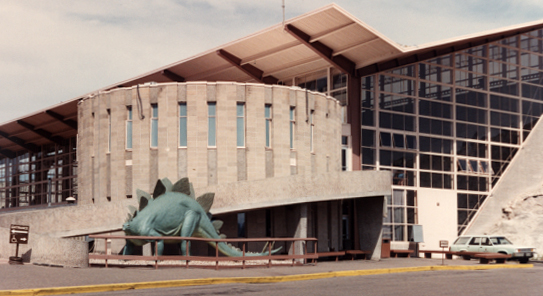
Quarry and Visitor Center, Dinosaur National Monument
The dinosaur quarry discovered by Earl Douglass is one of the most valuable sources of dinosaur fossils ever found.  In 1915, the United States government declared the quarry and eighty acres of the surrounding land to be a national monument.  In 1958, a visitor center was constructed at the quarry site.  It is now a museum and a place where visitors can view dinosaur bones and watch paleontologists at work. Nearly 1500 fossil dinosaur bones are visible in the cliff face enclosed by the museum! The park also includes camping and picnic areas and numerous hiking trails.


Hike in Hog Canyon, Dinosaur Nat. Mon.
In the summer of 1987, I visited Dinosaur National Monument to do research for my book Dinosaur Mountain (Clarion Books, 1989) and watched paleontologists scramble across the giant wall inside the museum where hundreds of dinosaur bones are still in the process of being excavated.  I also had a chance to visit an outdoor site and the laboratories where tiny microfossils are examined under microscopes. After I finished my research, my family joined me and we spent a week camping in the park.  While the Dinosaur Museum is the primary attraction, the hikes in the park are spectacular and the campgrounds are pleasant and not crowded.  We discovered petroglyphs on the canyon walls, watched deer and prairie dogs along the roadside, visited a fish hatchery, and watched people rafting down the Green River which flows through the park.  It was an ideal outdoor summer vacation spot with something for everyone.

Planning a Visit:  For more information and planning a visit to Dinosaur National Monument, go to the National Park Service website at http://www.nps.gov/dino/index.htm .

Monday, March 18, 2013

SAN FRANSICO BAY-DELTA MODEL, Sausalito, California

One of my favorite places in the San Francisco Bay area (and unknown to most people) is the Bay Model, a working demonstration of water flow in and out of San Francisco Bay and the Sacramento/San Joaquin Delta. Tucked along the waterfront in Sausalito, the Bay Model is located inside buildings that were part of a bustling shipyard during World War II.  (An exhibit on the main floor of the building displays photos and artifacts from the shipbuilding era.) 

Built in 1957 by the Army Corps of Engineers to test the impact of proposed changes in the Bay, the Bay Model spreads over 1.5 acres.  As you walk the ramps and platforms around the water, you can orient yourself by signs and the miniature bridges that connect the land around the bay–the Golden Gate connecting Marin County to San Francisco, the Bay Bridge crossing from San Francisco to Oakland on the east side and, to the south, the long San Mateo bridge over the shallow water of the tide flats.  Unlike in real life, in which the tide changes every twelve hours, the schedule of the model is speeded up so that the tide comes in and goes out every 14.9 minutes, whooshing through the Golden Gate and visibly creeping up the adjacent shores. It makes you realize the drama of this daily cycle and how important it is to people and wildlife along the shores.

Until about ten years ago, the Bay Model was used for scientific purposes, as a place where people made important calculations about water movement in San Francisco Bay.  Now, those calculations are done by computer and the model is no longer used in the same way for scientific research.  Instead, it has become an educational facility.  (I remember going to visit when it was a working model and watching scientists taking their measurements.)  The building has been recently remodeled (it was reopened in January 2012) and now has a handsome redwood entrance to the visitor center with a gift shop and art gallery.  In one corner is an amazing scale model of the Golden Gate Bridge made by a 14-year-old student as a 4-H project. Inside the main building along the walkways are photos, state-of-the-art videos, interactive displays, and explanatory panels telling about the history of the model, how it works, and the ecology of the Bay Area.  On the day I visited with a friend we did a self-guided tour, but ahead of us was a school group getting a tour with a docent.  Whether you go by yourself at your own pace, or with a group, it will definitely give you a new perspective on San Francisco Bay.

After our visit to the Bay Model we explored downtown Sausalito, had lunch at one of the many cafes in this popular tourist town, and then went to Fort Baker for a close-up of the real Golden Gate Bridge from below.

Visiting Information:
The Bay Model is at 2100 Bridgeway, Sausalito, CA 94965, telephone (415) 332-3870.  For directions, hours, and more information go to the website http://www.spn.usace.army.mil/bmvc/.

How do they make the tide in the model? To recreate the rising water level of a flood tide, more water is pumped into the Pacific Ocean area with less water allowed to flow out.  To model the falling waters of an ebb tide, less water is pumped in and more water is allowed to flow out.  A valve system controlled by a computer controls the flow of water.