Monday, May 28, 2012

ISTANBUL: Museum of Innocence, Mevlevi Lodge, Pera Museum, Modern Art Museum

Whirling Dervish Dance Floor, Mevlevi Lodge, Istanbul
In late May, I spent ten days in Turkey, which as my seat mate on the plane to Istanbul suggested, was not nearly long enough! My purpose in going was to participate in a writing workshop in Istanbul, which included daily excursions throughout the city. (More about those in future posts.)  We stayed in an area called Beyoglu, a hilly neighborhood full of shops, cafes, museums and hotels, and topped by the Galata tower, which offers a 360 view of all of Istanbul from the viewing area on the top.  Istanbul has dozens of museums.  Here are four in Beyoglu that I visited.

Museum of Innocence 

Museum of Innocence
On our first evening in Istanbul, our group set out to walk to the Museum of Innocence, located in the Çukurcuma neighborhood of Beyoglu, not far from our hotel. The museum, which opened in April 2012, is a construct of the book of the same name by Nobel-Laureate Orhan Pamuk.  It displays a collection of objects evocative of everyday life and culture of Istanbul during the period in which the novel is set. The book, published in 2008, is a long and detailed account of the obsessive love that Kemal Basmaci, a wealthy businessman, bears for Fusun, a lower class shop girl 12 years his junior. In the story, Kemal assembles a collection of objects as a monument to the two women in his life, Fusun and his fiance.  In the process of writing the story, Pamuk scoured antique shops in Istanbul, collecting objects both as mementos of the events of the story (with the plan to assemble them in a museum), but also, in some cases, to inspire the action.  So, the objects both drove the story and reflect the story.
Orhan Pamuk in Museum of Innocence
There are 83 chapters in the book, each with its own exhibit. The exhibits are on three floors.  At some level the museum is a giant doll’s house.  Some exhibits are assemblages of small objects, not unlike the boxes made by Joseph Cornell in the 40's and 50's.  In one instance, the objects are mounted in an old printing press type tray.  Others are like tiny theaters with red velvet curtains, sometimes open, sometimes closed. (Apparently some chapters are still in progress and the curtains will later be opened.)  Luckily, the title of each box is in both Turkish and English, as are quotes on the wall. Each one is provocative.  “It was the happiest moment of my life though I didn’t know it.”  This quote is from the beginning of the book but is a theme that reappears throughout the story.  Two people in our group were reading the book and helped explain the meaning of the exhibits.  In one chapter Kemal keeps seeing the ghost of his lover all over Istanbul.  In the exhibit for that chapter, we see small black and white photos of various places in Istanbul depicting crowds of people, one of whom is a woman dressed in red. In another chapter, Fusun loses an earring.  In that case, one of the objects is a single earring.  On the top level of the museum is a display of Pamuk’s handwritten manuscript for the book and sketches of his plans for the display cases.  In many ways, the museum reminded me of the Kafka Museum in Prague, with its intellectual and philosophical overlay of ideas and reality.  There is the fiction of the museum in the book intersecting with the fiction/reality of the author’s actual museum.

Mevlevi Lodge

Courtyard and cemetery in Mevlevi Lodge
 Istanbul is a city that assaults the senses with the intensity of its colors, sounds, tastes, and smells, and the mix of water and land on two continents.  For a peaceful interlude, a visit to the Mevlevi Lodge, an 18th century Sufi monastery, is a welcome change. Located just off busy Istiklal street, this beautiful garden, cemetery, lodge, and small museum are open to the public.  On the day I visited almost no one else was there except for the ubiquitous cats, which are everywhere in Istanbul.


Drawing of Whirling Dervishes in Mevlevi Muse
Originally, Sufis were disciples of the poet Rumi, who lived in Konya in central Anatolia in the 13th century. The Sufi sect is famous for its whirling dervishes.  The museum has large wooden dance floor where whirling dervishes perform on Sundays.  A number of other places in Istanbul also have performances of dervishes and I went to one of these.  The performances are solemn events–no clapping is allowed–and mesmerizing, as the dancers slowly twirl to somber music in their long white skirts in their ritual dance.  In the side rooms of the Mevlevi museum there were displays of calligraphy and paper marbling.  I recently read the book The Forty Rules of Love by Elif Shafak, a good introduction Rumi and Sufi beliefs.

  
Pera Museum

One day I visited the Pera Museum, located not far from the famous and elegant Pera Hotel where Agatha Christie stayed while writing Murder on the Orient Express.  The Pera Museum’s permanent collections feature Anatolian weights and measures and ceramics, but the main attraction was a visiting exhibit on the upper three floors of the museum, showing paintings and prints by Goya.  The rooms were crowded with groups of school children and other visitors.  One wall displayed prints from his dream sequence with bizarre images of animals and humans.  Another series showed children playing; another showed his bullfight series.  Two large oil paintings of royal figures in the main room seemed surprisingly modern with their realistic and unflattering expressions.


Modern Art Museum
At the end of my stay, I went to the Modern Art Museum, located in an industrial style building along the waterfront.  In one gallery, there were contemporary pieces, including a number of videos, not necessarily by Turkish artists. One of my favorites was the projection of swaying trees in luminescent green onto the walls of a dark room.  If one moved close to the wall, one’s shadow became part of the art.  In another gallery, one could follow the development of Turkish art in the modern era, which follows trends seen elsewhere in Europe and the U.S.  A photography gallery on the ground floor has wonderful black and white photos of Turkish rural life. The museum restaurant on the waterfront side of the building has a spectacular view.

You can read about the Istanbul writing workshop that motivated this trip in my May 23 post at www.carolinearnoldart.blogspot.com.
For a wonderful compilation of photos and writing from 14 members of the Writing Istanbul group, go to this online magazine Writing Istanbul at Issuu.com


Monday, May 21, 2012

Glastonbury, Stonehenge, and Avebury: King Arthur, Stone Circles, and a Medieval Barber-Surgeon

Glastonbury, Lady Chapel
(Continuation of my London diary entry of September 7, 1998)
Our Sunday morning excursion took us back to Medieval times.  We went to Glastonbury to see the ruins of the cathedral (which was destroyed when Henry VIII dissolved the monasteries) and is the supposed site of King Arthur and Queen Guinevere’s grave.  There is some speculation that the “discovery” here of the grave was a 12th century publicity stunt after much of the original church was destroyed by fire.  The monks were hard up and needed to attract pilgrims to the church in order to get more money.
Glastonbury
At lunchtime we climbed to the top of a tall hill nearby which is topped by the ruin of another ancient church.  From the top we could see for miles across the Somerset countryside, with its patchwork of fields and small farms, but the highlight of the walk up was a close encounter with a kestrel (a small falcon) that hovered for several minutes just a few yards in front of us and then dove down into the grass and caught a mouse.
Kestrel hovering near Glastonbury Tor
After a picnic lunch we walked back to town and drove to our final destinations of the weekend, Salisbury (where we made a quick visit to the Cathedral) and Stonehenge, which is nearby.  Throughout the weekend the weather was quite nice (despite dire predictions by the weatherman earlier) but by the time we arrived at Stonehenge it had become overcast and started to drizzle.  We didn’t mind, though, because it enhanced the mystical quality of the place.
Stonehenge
Stonehenge sits on a slight rise in the middle of vast fields.  You can’t actually walk among the stones, because there is a rope barrier around the circle, but this helps to preserve the monument’s integrity and so even though there are busloads of people that go there, you can almost close your eyes and think of being in neolithic times.  (You can also imagine the last scene of Thomas Hardy’s book, Tess of the D’Urbervilles.)  Stonehenge is quite compact as stone circles go.  We saw a much larger one in the Orkneys several years ago and on Friday, on our way to Bath, we stopped at Avebury, another ancient circle site. 

Avebury, standing stones
At Avebury the circle is so large that in medieval times people built a small village in the middle of it.  Today both the village and what’s left of the circle are a historical site.  You can walk around the stones at Avebury, but the only way you can actually  see the circle is from the air. Apparently many of the stones of the Avebury henge were knocked over and buried in the Middle Ages because villagers thought they brought bad luck.  As you can imagine, this was an enormous task because the stones are huge.  Much of what we see today in Avebury has been restored in recent times.  When archeologists dug up one of the buried stones they were surprised to find underneath not only a human skeleton but some coins and all the tools of an itinerant barber-surgeon who must have come to town to cut some hair and pull a few teeth.  Apparently he had been assisting the villagers with the stone toppling and became crushed under the stone when it fell over.  The dates on the coins establish the event as occurring between 1310 and 1320.

English Heritage:  When we arrived in England, I became a member of English Heritage which meant that I could get in free to Stonehenge and other English Heritage historic sites.  Since ticket prices can add up, it turned out to be a good investment.

Monday, May 14, 2012

Bath, England: From the Romans to Jane Austen

The Royal Crescent, Bath.  Typical Georgian architecture.
(Excerpt from my London diary, September 7, 1998)
Last night we got back from our first weekend outside the city and our first experience driving and negotiating traffic circles and all the other peculiarities of the English road system.  (Not to mention that virtually all the rental cars here are manual shift and, of course, the driver is on the right hand side of the car!)

We began on Friday by heading west out of the city toward Bath.  We stayed in a charming bed and breakfast on a small 16th century farm outside Bath. The whole setting, with the gracious stone house (updated in the 18th century), the  tree lined drive, and the large gardens made us feel as if we were living a Jane Austen novel. At our bed and breakfast we made friends with a cat. That night we left our window open for some fresh air.  Suddenly I woke up in the middle of the night to discover that the cat had apparently jumped in the window and was getting ready to settle down on the pillow next to my head!
The Ancient Roman Baths of Bath
On Saturday, we drove into Bath to see the sights and to meet friends from LA.  Underneath Bath there is a natural hot spring, which is one of the reasons that people have lived there since ancient times, and the main tourist attraction is the ruins of the ancient Roman baths.  They are extensive and include statuary, mosaics, inscriptions, and everything that the Romans needed to reproduce what they knew from Italy in their new land.
Taking the waters in Bath
In the late 18th century, it became fashionable to drink the waters of the hot spring as a cure, or just as a tonic, and people flocked to the elegant pump room that was built above the ruins to drink the water and parade in their finery.  (Here’s where you can really imagine Jane Austen’s characters.)  You can still have lunch or tea in the pump room and have a drink from the fountain served to you by a  gentleman in a powdered wig and velvet frock coat.  I tried a glass and wouldn’t have minded the metallic taste if the water hadn’t been so warm.  We walked around Bath a bit to see some of the Georgian architecture for which the city is famous and then we took a scenic boat ride along the Avon river that flows through the city. 
Rugby Match in Bath
It turns out that this is not Shakespeare’s Avon and that, in fact, there are four Avon rivers in England! The boat landing happened to be adjacent to the city rugby stadium and Saturday afternoon was the opening match of the season.  Every time the Bath team scored you could hear a roar of cheering all over town. At the end of the day we went back with our friends to their B and B in Midsomer Norton, formerly a 12th century priory, and had dinner there.
(continued next week with visits to Glastonbury, Salisbury, Stonehenge, and Avebury)

Monday, May 7, 2012

CHICAGO: Marilyn, Millennium Park, and the Art Institute—A Stroll Down Michigan Avenue

One tower of the Crown Fountain, Millennium Park
Recently, I was in Chicago for a conference and had an hour or so on the last afternoon to stroll down Michigan Avenue from my hotel on Wacker Drive to Millennium Park and the Chicago Art Institute about a half-mile away.


25-foot Marilyn Monroe Statue
My first stop was across the bridge over Chicago River.  I wanted to take a closer look at the giant Marilyn Monroe statue mounted in the plaza near the Chicago Tribune building on Chicago’s Magnificent mile.  Sculpted in her iconic pose with skirts flying, she dwarfed the people below.  I didn’t realize that this was a last chance to see the statue in Chicago.  The 25-foot-tall statue of the actress is slated to leave its spot along Michigan Avenue on May 7th and go to Palms Springs, California. The bronze and stainless steel sculpture, created by artist Seward Johnson, depicts Monroe in her famous pose from the film “The Seven Year Itch.” In the film, a draft catches Monroe’s dress as she passes over a subway grate.  Apparently, as soon as the sculpture was unveiled last July, people began positioning themselves under the movie star’s dress to catch a subway-level view and snap pictures.

Every Tree Counts!
I then turned back across the river and headed south past several blocks of shops and restaurants before arriving at Millennium Park.  It was spring, and rows of blooming tulips lined planters along the way.  It also sprinkled off and on so I was glad I had my raincoat. The first thing I noticed when I got to the park, besides the fact that it was an island of green amidst neighboring skyscrapers, was that the trees all had large green tags tied around their trunks, informing us of their monetary value to the community. In celebration of Arbor Day in 2011, the Morton Arboretum tagged hundreds of trees in Illinois with the dollar amount each tree will give back to the community in environmental and socio-economic benefits over the next 15 years. Trees absorb air pollutants, including ozone, nitrogen dioxide and sulfur dioxide, through the leaves and intercept particulate matter like dust, ash and smoke. They also lower air temperature, reducing the production of ozone. 

Jay Pritzker Pavilion, Millennium Park

Peeking through the trees at the back of the park I could see what looked like large metallic sails silhouetted against the sky.  As I walked closer I saw that they formed the roof of an outdoor amphitheater. Designed by Frank Gehry, the Jay Pritzker Pavilion is said to be the most sophisticated outdoor concert venue of its kind in the United States.  It was empty on a weekday afternoon, but I could imagine it filled with people.


Reflected in the Cloud Sculpture
Walking back toward the street I came upon an elevated plaza in the center of the park on which a shiny giant amoeba shaped structure sat, reflecting the surrounding skyline and all the passersby, including me.  The curved surface made it function like a huge fun-house mirror.  The cloud sculpture was designed by artist Anish Kapoor as an interactive piece and it was impossible to not be drawn to it and try to take a picture of myself reflected on its surface.

Caroline in Millennium Park

Every turn revealed a new sculptural surprise.  In a small garden plaza stood three open ball shaped structures in blue, yellow, and white created by Mexican artist Yvonne Domenge. Below the garden was the Crown Fountain, two 50-foot glass block towers of flowing water that project video images of 1,000 different Chicagians onto their surfaces.  Created by artist Jaume Plensa the facing images appear to look at one another and interact as their expressions subtly change and then disappear, or abruptly squirt water out of their mouths, before morphing into a new face. Children were having fun splashing in the water that collected at the base of the towers.

Art Institute of Chicago
Finally, I arrived at the Art Institute with its familiar lions flanking the entrance. I have fond memories of visits to the Art Institute when I came to Chicago as child with my family on visits to my grandmother and later when I was in college in Iowa and rode to Chicago on the train.  I didn’t have time to see any of the current exhibits on this trip, but browsed in the wonderful museum gift shop.  I’ll have to return to Chicago on a longer trip and do all the things that I missed this time.


Monday, April 30, 2012

HAWAII'S BIG ISLAND: The Hilo Side

Hawaii Tropical Botanical Garden, Hilo
Last week, Art and I were on Hawaii’s Big Island.  Most of the week was in Kona, where Art was attending a conference, but before it started we wanted to spend a day on the Hilo side of the island.  The two sides of the Big Island, divided by mountains in the middle,  are like Dr. Jekyll and Mr. Hyde, completely different in almost every way. The Kona side is dry, gently sloping, and vast volcanic flows cover the ground with chunks of black lava. Most of the large resorts are on the Kona side along the coast. The Hilo side is your mental image of Hawaii, lush, wet, green, with steep coastal cliffs indented by narrow  gorges and spectacular waterfalls.
Waipio Valley, View from Overlook
On our way to Hilo from the Kona airport we passed the turnoff to the Waipio Valley and decided to make a slight detour.  It was a sunny day, which meant that we would get a good view of the valley from the overlook.  On a previous trip we had taken a hike to another supposed overlook but instead of a view of the 2000 foot drop to the valley floor, had seen nothing but clouds.  This time, we were rewarded with a sweeping view of the valley with its patchwork of taro fields, the black sand beach, and the cliffs beyond.  The road to the valley is so steep that only four wheel drive vehicles are allowed down.  We did not have a 4WD car, so we contented ourselves with walking a short distance down and then huffing and puffing our way back to the top.  On another trip in the future, we’d like to take a tour to the bottom. (You can arrange to go by car or by horseback.)

Hilo Bay, View from our Hotel Balcony
We then drove from Waipio to Hilo.  Hilo is built around a beautiful moon-shaped bay, famously susceptible to tsumanis.  (All around the island you see signs posted directing you to tsunami evacuation routes.)  After a powerful tsunami wiped out much of the bay front in 1946 and then again in 1960, it was decided to turn the low lying land around the bay into parks and hotels.  We were assured that our hotel (the Hilo Hawaiian Hotel), built at the edge of the water, was designed to withstand even a powerful  tsunami surge, with an open lower structure that would allow water to flow right through.  Our room, on the fifth floor, certainly had a spectacular view of the bay.


Bears' Coffee, Hilo
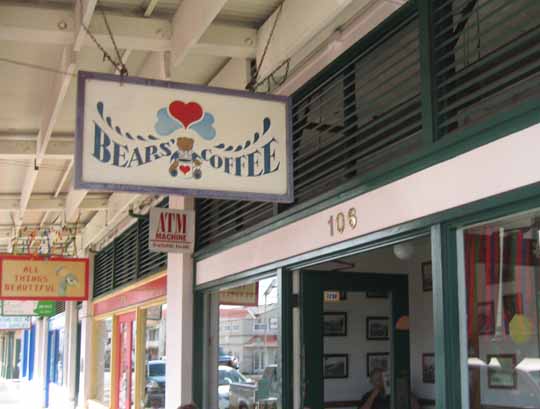
Most of Hilo’s large hotels, including ours, are located on Banyan Drive, a loop road lined  with huge banyan trees, each named after the famous person who planted it.  Planted in the 1940's, the trees now tower over 100 feet high and their hanging roots are like small fortresses.  That night we ate dinner at our favorite restaurant on the island, the Hilo Bay Café.  Located in a shopping mall, it doesn’t look fancy on the outside, but the food is fresh and creatively prepared. [Update in 2015: The Hilo Bay Cafe has relocated to a building right on the water with a spectacular view over the bay. The food is still delicious!]  In the morning, on the recommendation of our waitress at the Hilo Bay Cafe, we ate breakfast at Bear’s Coffee, a small café favored by locals where the food is fresh and inexpensive.

Hanging Lobster Claw, Hawaii Tropical Botanical Garden
Our main goal for our day in Hilo  was to revisit the amazing Hawaii Tropical Botanical Garden, which we had first seen on a previous trip.  The garden, nestled in a lush canyon just north of Hilo, features tropical plants from around the world, meticulously tended and clearly labeled. It is a photographer’s paradise.  We worked our way down the steep path from the garden entrance past tumbling streams and waterfalls, brilliant colored plants with names like hanging lobster claw, beehive ginger and cannonball tree, to a koi pond, a cage of noisy macaws, and finally to a rocky beach at the bottom of the canyon.  In an upcoming post, I will do a more detailed tour of the garden.

For a late lunch, we stopped a few miles up the road from the garden at What’s Shakin, where everything is made from locally grown produce.  We bought sandwiches, a smoothie, a pineapple muffin, and a deliciously sweet papaya.  We then headed for Kona, about a two and half hour drive to the other side of the island.

Note: Be sure you have a good guidebook and map for finding your way around the island.  There are almost NO signs to attractions to help you know where to turn.  Strict laws prohibit commercial signs except on your own property and then they can be no larger than 3 by 5 feet. Our favorite guidebook is Hawaii, The Big Island Revealed by Andrew Doughty.

For my report on the Kona side of Hawaii's Big Island go to my May 13, 2013 post.

Monday, April 23, 2012

Cologne, Germany: The Cathedral, Old Town, and the Rhine

Restaurant in Cologne's Old Town
In early March, my husband Art spent a few days at a meeting in Cologne, Germany, and has allowed me to share a few of his photos. Cologne (Koeln or Koln with an umlaut over the “o” as it is spelled in German) is located on the Rhine River, in western Germany.  It is one of Germany’s oldest cities and its fourth largest.  This was Art’s second visit to Cologne.  The first was when he was in high school and spent a year in Berlin as an exchange student and visited Cologne on a school field trip.

Cologne Cathedral
I have never been to Cologne, but I remember learning about its most famous landmark, the Cologne Cathedral, when I studied northern European art history in college.  Soaring above the city, it seemed to us as students to be the Gothic version of a giant wedding cake. In Art’s photo, you can see how the enormous structure completely dwarfs the people on the sidewalk. (The people in white standing on boxes are mimes.)  The church, started in 1248 and completed in 1880, is now a UNESCO World Heritage site.  The spires of its two towers reach 157 meters high! For some music and a glimpse of the interior click here .

Besides visiting the cathedral, Art enjoyed walking the narrow cobblestone streets of Cologne’s Old Town, savoring traditional food (sauerbraten and spaeztle) at local restaurants, sampling the local beer known as “koelsch”, and walking along the Rhine.  Someday I would like to go there myself.

Cologne:  Bridge over the Rhine

Monday, April 16, 2012

Have Laptop, Will Travel: England's Lake District and More with Gretchen Woelfle (Guest Post)

Derwent Water, Lake District, England
My friend Gretchen Woelfle is spending three months in England this spring, beginning with a writer's workshop in the Lake District.  I think you will enjoy reading about her adventures!  Gretchen is a children’s book author whose newest books are Write On, Mercy! The Secret Life of Mercy Otis Warren and  All the World's a Stage, A Novel in Five Acts.  Find out more at www.gretchenwoelfle.com .
 
 One of the best things about being a writer is our portability, which can incite mobility. Long ago when I was an MFA student at Vermont College, I met a visual arts MFA student who complained about the mighty costs and problems of shipping artworks to the twice-annual residencies.  We writers only had to pack our floppy disks – and now our laptops.
Nonfiction writers aren’t quite as portable as our fiction-writing cousins.  Speaking for myself, my desk is littered with loose papers, file folders bulging with notes and photocopies, books piled high on said papers and stuffed into overflowing bookcases.
Sheep in the Lake District
But the lure of mobility forced me to rethink my portability in March 2012 when I flew off the England to attend the twentieth anniversary retreat of the Kindling Words writing workshop in the Lake District. Fourteen of us spent a week at a four-star hotel, eating four course meals each night, hiking along the lake, into the woods, and up the hills (but not enough, I fear, to work off those four-course meals.) 
Castlerigg stone circle, Lake District
Highlights:  Venturing forth to local literary haunts of Wordsworth and his reputable and disreputable Romantic cohorts. Circumnavigating a Neolithic stone circle. Me alone, finding a local pub to watch a Saturday football (soccer) match featuring my beloved team, Chelsea. Indulging in an Exotic Lime & Ginger Salt Glow at the hotel spa. (I can describe it, but it will be just as intriguing for you imagine the sensuous pleasure of it.) And, yes, attending workshops and writing. 
Seven writers, headlights shining, about to descend into the subconscious of their protagonists, or was it the Honister Slate Mine?

Though I wasn’t the only nonfiction writer there, many were tapping away on fantasy novels. As they retreated to their imaginary worlds by the fireside in the lounge, I time-traveled back to eighteenth century Revolutionary America, to meet my biography subjects.  As others were drawn by guided meditations into the subconscious minds of their protagonists, I tried to do the same, but was interrupted by an annoying inner voice whispering, “Document your sources.”

When the luxurious week was over, I took off for East Yorkshire to visit old friends, including a writer, who live by the sea.  One of the world’s biggest offshore wind farms will soon arise off the Yorkshire coast, but not soon enough to be pictured in my next book, The Wind at Work, a history of wind energy.  So here, instead, is a picture of the local beach with dog Libby chasing a seagull.
 One evening, Marvin Close, my writer friend, arranged an interview on the local radio station, BBC Humberside. The topic of the interview: how a children’s writer from southern California came to be an obsessed fan of English football in general and Chelsea Football Club in particular. I tried to mix it up with writerly talk, but not having many people to discuss football [soccer] with at home, I was happy to talk about the sturm und drang of the current Chelsea season.

View of Notting Hill Gate
Now I’m in London for three months, thanks to my latest travel adventure: home exchanging. Sitting in a top-floor flat in Notting Hill Gate with sun streaming in on all sides -- I brought it with me from LA! -- I’ve got several manuscripts in progress, a few file folders stuffed with research, just a couple of books I need to work with, and – since yesterday, a brand new card from the Borough of Kensington and Chelsea Library system. (They’ve got all sorts of wonderful Dickens programs scheduled in this, his bicentennial year, and since he is my #1 favorite author, I’ll be there.) 

I’m still immersed in the American Revolution, which has a whole different significance from where I sit now. And I’ll be on the lookout for a new subject to research on the ground here. Something about English football perhaps?

More anon on the joys of a writer’s portability and mobility.
Derwent Water, Lake District