Monday, April 30, 2012

HAWAII'S BIG ISLAND: The Hilo Side

Hawaii Tropical Botanical Garden, Hilo
Last week, Art and I were on Hawaii’s Big Island.  Most of the week was in Kona, where Art was attending a conference, but before it started we wanted to spend a day on the Hilo side of the island.  The two sides of the Big Island, divided by mountains in the middle,  are like Dr. Jekyll and Mr. Hyde, completely different in almost every way. The Kona side is dry, gently sloping, and vast volcanic flows cover the ground with chunks of black lava. Most of the large resorts are on the Kona side along the coast. The Hilo side is your mental image of Hawaii, lush, wet, green, with steep coastal cliffs indented by narrow  gorges and spectacular waterfalls.
Waipio Valley, View from Overlook
On our way to Hilo from the Kona airport we passed the turnoff to the Waipio Valley and decided to make a slight detour.  It was a sunny day, which meant that we would get a good view of the valley from the overlook.  On a previous trip we had taken a hike to another supposed overlook but instead of a view of the 2000 foot drop to the valley floor, had seen nothing but clouds.  This time, we were rewarded with a sweeping view of the valley with its patchwork of taro fields, the black sand beach, and the cliffs beyond.  The road to the valley is so steep that only four wheel drive vehicles are allowed down.  We did not have a 4WD car, so we contented ourselves with walking a short distance down and then huffing and puffing our way back to the top.  On another trip in the future, we’d like to take a tour to the bottom. (You can arrange to go by car or by horseback.)

Hilo Bay, View from our Hotel Balcony
We then drove from Waipio to Hilo.  Hilo is built around a beautiful moon-shaped bay, famously susceptible to tsumanis.  (All around the island you see signs posted directing you to tsunami evacuation routes.)  After a powerful tsunami wiped out much of the bay front in 1946 and then again in 1960, it was decided to turn the low lying land around the bay into parks and hotels.  We were assured that our hotel (the Hilo Hawaiian Hotel), built at the edge of the water, was designed to withstand even a powerful  tsunami surge, with an open lower structure that would allow water to flow right through.  Our room, on the fifth floor, certainly had a spectacular view of the bay.


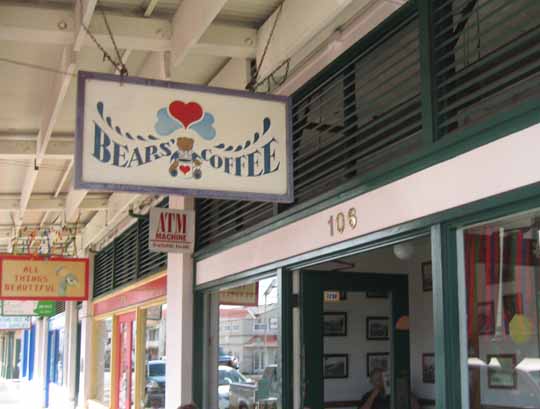
Bears' Coffee, Hilo
Most of Hilo’s large hotels, including ours, are located on Banyan Drive, a loop road lined  with huge banyan trees, each named after the famous person who planted it.  Planted in the 1940's, the trees now tower over 100 feet high and their hanging roots are like small fortresses.  That night we ate dinner at our favorite restaurant on the island, the Hilo Bay Café.  Located in a shopping mall, it doesn’t look fancy on the outside, but the food is fresh and creatively prepared. [Update in 2015: The Hilo Bay Cafe has relocated to a building right on the water with a spectacular view over the bay. The food is still delicious!]  In the morning, on the recommendation of our waitress at the Hilo Bay Cafe, we ate breakfast at Bear’s Coffee, a small café favored by locals where the food is fresh and inexpensive.

Hanging Lobster Claw, Hawaii Tropical Botanical Garden
Our main goal for our day in Hilo  was to revisit the amazing Hawaii Tropical Botanical Garden, which we had first seen on a previous trip.  The garden, nestled in a lush canyon just north of Hilo, features tropical plants from around the world, meticulously tended and clearly labeled. It is a photographer’s paradise.  We worked our way down the steep path from the garden entrance past tumbling streams and waterfalls, brilliant colored plants with names like hanging lobster claw, beehive ginger and cannonball tree, to a koi pond, a cage of noisy macaws, and finally to a rocky beach at the bottom of the canyon.  In an upcoming post, I will do a more detailed tour of the garden.

For a late lunch, we stopped a few miles up the road from the garden at What’s Shakin, where everything is made from locally grown produce.  We bought sandwiches, a smoothie, a pineapple muffin, and a deliciously sweet papaya.  We then headed for Kona, about a two and half hour drive to the other side of the island.

Note: Be sure you have a good guidebook and map for finding your way around the island.  There are almost NO signs to attractions to help you know where to turn.  Strict laws prohibit commercial signs except on your own property and then they can be no larger than 3 by 5 feet. Our favorite guidebook is Hawaii, The Big Island Revealed by Andrew Doughty.

For my report on the Kona side of Hawaii's Big Island go to my May 13, 2013 post.

Monday, April 23, 2012

Cologne, Germany: The Cathedral, Old Town, and the Rhine

Restaurant in Cologne's Old Town
In early March, my husband Art spent a few days at a meeting in Cologne, Germany, and has allowed me to share a few of his photos. Cologne (Koeln or Koln with an umlaut over the “o” as it is spelled in German) is located on the Rhine River, in western Germany.  It is one of Germany’s oldest cities and its fourth largest.  This was Art’s second visit to Cologne.  The first was when he was in high school and spent a year in Berlin as an exchange student and visited Cologne on a school field trip.

Cologne Cathedral
I have never been to Cologne, but I remember learning about its most famous landmark, the Cologne Cathedral, when I studied northern European art history in college.  Soaring above the city, it seemed to us as students to be the Gothic version of a giant wedding cake. In Art’s photo, you can see how the enormous structure completely dwarfs the people on the sidewalk. (The people in white standing on boxes are mimes.)  The church, started in 1248 and completed in 1880, is now a UNESCO World Heritage site.  The spires of its two towers reach 157 meters high! For some music and a glimpse of the interior click here .

Besides visiting the cathedral, Art enjoyed walking the narrow cobblestone streets of Cologne’s Old Town, savoring traditional food (sauerbraten and spaeztle) at local restaurants, sampling the local beer known as “koelsch”, and walking along the Rhine.  Someday I would like to go there myself.

Cologne:  Bridge over the Rhine

Monday, April 16, 2012

Have Laptop, Will Travel: England's Lake District and More with Gretchen Woelfle (Guest Post)

Derwent Water, Lake District, England
My friend Gretchen Woelfle is spending three months in England this spring, beginning with a writer's workshop in the Lake District.  I think you will enjoy reading about her adventures!  Gretchen is a children’s book author whose newest books are Write On, Mercy! The Secret Life of Mercy Otis Warren and  All the World's a Stage, A Novel in Five Acts.  Find out more at www.gretchenwoelfle.com .
 
 One of the best things about being a writer is our portability, which can incite mobility. Long ago when I was an MFA student at Vermont College, I met a visual arts MFA student who complained about the mighty costs and problems of shipping artworks to the twice-annual residencies.  We writers only had to pack our floppy disks – and now our laptops.
Nonfiction writers aren’t quite as portable as our fiction-writing cousins.  Speaking for myself, my desk is littered with loose papers, file folders bulging with notes and photocopies, books piled high on said papers and stuffed into overflowing bookcases.
Sheep in the Lake District
But the lure of mobility forced me to rethink my portability in March 2012 when I flew off the England to attend the twentieth anniversary retreat of the Kindling Words writing workshop in the Lake District. Fourteen of us spent a week at a four-star hotel, eating four course meals each night, hiking along the lake, into the woods, and up the hills (but not enough, I fear, to work off those four-course meals.) 
Castlerigg stone circle, Lake District
Highlights:  Venturing forth to local literary haunts of Wordsworth and his reputable and disreputable Romantic cohorts. Circumnavigating a Neolithic stone circle. Me alone, finding a local pub to watch a Saturday football (soccer) match featuring my beloved team, Chelsea. Indulging in an Exotic Lime & Ginger Salt Glow at the hotel spa. (I can describe it, but it will be just as intriguing for you imagine the sensuous pleasure of it.) And, yes, attending workshops and writing. 
Seven writers, headlights shining, about to descend into the subconscious of their protagonists, or was it the Honister Slate Mine?

Though I wasn’t the only nonfiction writer there, many were tapping away on fantasy novels. As they retreated to their imaginary worlds by the fireside in the lounge, I time-traveled back to eighteenth century Revolutionary America, to meet my biography subjects.  As others were drawn by guided meditations into the subconscious minds of their protagonists, I tried to do the same, but was interrupted by an annoying inner voice whispering, “Document your sources.”

When the luxurious week was over, I took off for East Yorkshire to visit old friends, including a writer, who live by the sea.  One of the world’s biggest offshore wind farms will soon arise off the Yorkshire coast, but not soon enough to be pictured in my next book, The Wind at Work, a history of wind energy.  So here, instead, is a picture of the local beach with dog Libby chasing a seagull.
 One evening, Marvin Close, my writer friend, arranged an interview on the local radio station, BBC Humberside. The topic of the interview: how a children’s writer from southern California came to be an obsessed fan of English football in general and Chelsea Football Club in particular. I tried to mix it up with writerly talk, but not having many people to discuss football [soccer] with at home, I was happy to talk about the sturm und drang of the current Chelsea season.

View of Notting Hill Gate
Now I’m in London for three months, thanks to my latest travel adventure: home exchanging. Sitting in a top-floor flat in Notting Hill Gate with sun streaming in on all sides -- I brought it with me from LA! -- I’ve got several manuscripts in progress, a few file folders stuffed with research, just a couple of books I need to work with, and – since yesterday, a brand new card from the Borough of Kensington and Chelsea Library system. (They’ve got all sorts of wonderful Dickens programs scheduled in this, his bicentennial year, and since he is my #1 favorite author, I’ll be there.) 

I’m still immersed in the American Revolution, which has a whole different significance from where I sit now. And I’ll be on the lookout for a new subject to research on the ground here. Something about English football perhaps?

More anon on the joys of a writer’s portability and mobility.
Derwent Water, Lake District


Monday, April 9, 2012

Window Seat: One Year Anniversary of The Intrepid Tourist

Wetlands of Northern Canada
One year ago this week,  I launched my first post on The Intrepid Tourist, a report on our family’s visit to the Battle of Gettysburg in 1997.  Since then, I have posted a new article once a week (actually sometimes two) for a total of 54 posts, on trips both recent and in the past.  I have been gratified by the response–more than 5000 views in the past year!  When I decided to create the blog, my first choice for a name was Window Seat, but a quick web search revealed that it was already in use many times over, so I had to choose another name.  Nevertheless, I will always be a window seat traveler.

Alaska: Meandering River in Winter
When I travel by car, I like to look out the window and watch the passing scenery.  In an airplane, I love to look down and try to identify the features in the landscape below.  (I also like planes where there is a real-time map screen on the back of the seat in front of me labeling the towns and cities along the route.)  While you can have somewhat the same experience simply by sitting at your computer and clicking on Google Earth, it’s not the same as being there yourself moving through space and time.  Even on routes that I travel frequently, the view constantly changes depending on weather, season, and time of day.  Winter often produces some of the most dramatic scenery.

Midwestern U.S., Crop Circles in Winter
I am frequently tempted to take photos from my window seat to try to capture the drama of the view or the pattern on the ground. In celebration of the one year anniversary of this blog, and to launch a second year of posts, I am sharing a few of my favorite window seat photos, the last one taken by my husband Art just a few weeks ago.   

Art's photo of Greenland from 35,000 feet
There is nothing like changing your point of view to gain a new perspective.  That’s one of the reasons I like to travel.  I hope you enjoy my photos and will keep reading The Intrepid Tourist as I add more articles in the second year.  I'll post some more window seat photos along the way.
I’d love to hear what you think!

Monday, April 2, 2012

Shanghai Zoo: Giant Pandas, Red Pandas, and More

Giant Panda enjoying a roll in the grass
Whenever I travel, I always like to visit zoos.  On both of my trips to China, in 1995 and 2005, I went to the Shanghai Zoo.  Here is what I wrote in my diary in 1995 and a few of my pictures from 2005.
We set off for the zoo, showing the taxi driver the Chinese map with the picture for the zoo. [The Chinese name for zoo sounds like “Dongwa Yuan” but when we tried to say it or any other Chinese word, our pronunciation was wrong and no one understood us. Chinese is a tonal language and we had a hard time knowing the right intonation for each word. Using pictures and maps turned out to be the best way to communicate.] At the zoo we paid at the booth and entered with another Westerner, the only one we saw all day. 

We came first to the reptile house (also fish and amphibians) which required another payment and went in to see an extensive display of fish–large and small–turtles, frogs, snakes, and caimens.  Next we went to the birds.  (The zoo is organized by animal class.)  Only after spending about an hour at the birds did we realize we’d seen just a fraction of the zoo. 
Peacocks
Outside a new flight cage Art interacted with a crested crane, which bobbed up and down with the camera as Art changed positions to get a good angle–much to the delight of the Chinese zoo visitors.  Later we decided that the crane probably thought the red visor on Art’s baseball cap was the very large bill of a female bird!  The zoo also had a huge Ferris wheel, bumper cars, a petting zoo and animal show, which we passed on our way to the mammals.
Red Panda
At the mammal section we found a red panda and giant panda–both displayed quite nicely with glassed in cages inside and a grassy, shady area outside. On our way out we passed the elephants, which were chained in a large open area.  One mother had a very young calf, who was free to roam but never wandered far from the protection of the mother’s body.

Note: Our trip in 1995 was in July.  In 2005, I visited Shanghai in March and went to the zoo on a day when the animals seemed to be enjoying the mild early spring weather.  On both visits, I went during the week and the zoo was not very crowded with people. 
Rare animals of China

Monday, March 26, 2012

Shanghai: Trip to China 1995

Dragon, Yuyuan Gardens, Shanghai
In the summer of 1995, we traveled to China, visiting Shanghai, Beijing, and Xian.  In Beijing and Xian we had an official Chinese tour guide. In Shanghai, we were on our own.  We visited an American friend who was living there while in a cooperative venture to build an auto repair shop in anticipation of the time when more people would own cars.  At the time, the streets were still filled with bicycles and rickshaws, with the primary motorized vehicles being trucks and buses. When I returned to Shanghai ten years later, in 2005, the city had totally changed, with cars jamming every road, and double layered freeways connecting the far reaches of the ever growing city.  Now, as I read my diary from the 1995 trip, and compare our experiences with my trip in 2005 and Sara Kras’s trip to China in 2011 (guest blog post Jan 9, 2012) I am amazed at the contrast.  Here are some excerpts from our first day in Shanghai in 1995:

Traffic
To begin with, it was arranged that the company driver would take us to the tourist office where we needed to get tickets for our next flight.  We proceeded into central Shanghai, the driver dodging between buses, cars, pedestrians, bicycles, trucks and pedal carts.  The streets are packed and driving impossible, but no one ever gets going fast enough to create any real damage in a collision–although we did see two bicycles run into each other.  Everyone uses their horns constantly.  David had a car come into the shop that had 6000 miles on it and needed to have the horn replaced because it was worn out!  Bicycle riders included both men and women dressed to go to work–women often in stylish clothes.  Although a few wore high heels, most had flat shoes.  We saw few children–just a few babies strapped onto their mothers’ backs or young children riding on the bar in front of their parents’ bicycles.
Walkway along the Bund
The Bund
After leaving the tourist office, we set out on foot to meet a young Chinese girl, Chen Ci, and her father, acquaintances of our American friends, who had offered to show us around. We had arranged to meet them at the door of the Peace Hotel on the Bund. [The Shanghai Bund, on the banks of the Huangpo river, was the financial hub of East Asia at the end of the 19th and beginning of the 20th centuries, with imposing structures that housed banks and foreign offices.  Today it is a commercial center with a walk and park along the river.]   At first we walked along city streets, where people spilled out onto the sidewalk in front of small shops.  They were cleaning vegetables, washing clothes and dishes, sitting on chairs and playing cards, tending small gardens planted around the trees next to the street. Our route was clearly not one that foreigners usually took and eyes followed our every move.  At the end of the street we found ourselves at the river about a half mile south of the Bund, so we walked north until the riverfront became a park.  In the river were a variety of watercraft–from sightseeing boats and ocean going vessels to barges and sampans.  The weather was so smoggy and overcast that everything disappeared into a grey Turneresque mist not far from shore.
Watercraft in the Huangpo River
Huangpu Park
We found Chen Ci and her father as planned.  Chen Ci, age 7, had been learning English at school since she was two and was amazingly fluent, unlike her father, who had studied Russian as a student.  We walked with them along the Bund to Huangpu Park.  Apparently, during the colonial era, this was a park for the British only and a had a now famous sign at the entrance that said “No dogs or Chinese allowed.”  Chen Ci (pronounced Chen Suh) was so excited by our visit she could hardly stand still.  As we passed statues of the first mayor of Shanghai and of Mao, she insisted on imitating their heroic poses and having us take her picture.
In the Yuyuan Gardens

Yuyuan Gardens
After the park, we headed for the Yuyuan gardens, a maze of traditional buildings and waterways. [The Yuyuan gardens, built in the 16th century for a government officer of the Ming Dynasty, were restored in the 1950's and opened to the public in 1961.]  When we arrived, we found ourselves in an ornate alleyway with red-painted shops on either side.  It led to another alley and finally out to a courtyard around a small lake crossed by a zigzag bridge.  There were various food stalls around the water, but Chen Ci’s father led us to a stairway up to a second floor restaurant overlooking the lake.
The waitress brought glasses with printed napkins tucked inside, which Chen Ci promptly put into her bag as a souvenir. The menus were in Chinese so we let Chen Ci and her father do the ordering.  When they asked if we wanted one or two dumplings, we said two, thinking that meant two apiece.  Instead, we got two round trays with twelve dumplings per tray!  Each noodle wrapped dumpling was filled with pork and had been steamed.  You put the whole slippery dumpling in your mouth (after you’ve grabbed it with your chopsticks), bite down, and the hot pork juices squirt into your mouth.  The dumplings came with vinegar/soy sauce, but also tasted good with the red sauce that came with the beef.  We also got a plate of tiny shrimp and Chinese peas.  We drank green tea, which Chen Ci kept pouring and wanting us to clink our glasses and say “kempe”, meaning “to your health.”
Zigzag bridge in the Yuyuan Gardens
After paying for lunch, we went across the zigzag bridge and into the Yuyuan garden where Chen Ci jumped on the rocks and posed beside statues for more pictures, chattering all the time.  We briefly latched onto an English speaking tour group, whose guide said the rocks, which had been imported, were fastened together with some kind of rice paste.  Then it was time to say goodbye.  We found a taxi, showing the driver a printout of our friend's address to tell him where we wanted to go.

Monday, March 19, 2012

The Oakland Zoo: New Baby Giraffe!

Maggie, two-month old reticulated giraffe at the Oakland Zoo
Trips to the zoo are a favorite outing with my grandchildren and an excuse for me to go to one of MY favorite places as well.  I always love to watch animals.  Most often, we go to the Oakland Zoo, nestled in the hills of Knowland Park, not far from central Oakland.  It is a medium-sized zoo, with animals displayed in large, naturalistic enclosures and, at the lower end, a children’s zoo with plenty of animal themed climbing structures (such as a giant rope spider web) and hands-on displays (such as the large hollow rabbit head that you can stick your head into and find out how a rabbit’s large ears help it to hear even very tiny sounds.)  The zoo has upper and lower parking lots and entrances.  We always go in at the lower entrance and work our way up the hill.
American Alligators and turtle
Our most recent visit was in early March, on a bright, sunny day.  The animals were active, seeming to enjoy the nice weather.  In the children’s zoo we stopped to watch the otters, always entertaining, as they slid in and out of their pool and performed underwater acrobatics in front of the glass of their tank, just inches from where we stood.  We then checked in on the alligators, basking in the sun, and the lemurs, who only come out where you can see them on warm days. 
Siamang
We then began our walk up the hill, stopping on the way to watch the squirrel monkeys, who were scampering about the branches inside their enclosure.  It was a good day to be a primate.  The chimpanzees next door were all outside, one of them drumming enthusiastically on a tub (perhaps auditioning for a future chimp rock band) and the siamangs were busy foraging on their island.
Giraffes and Elands
At the top of the hill we passed the sun bears, flamingoes, and tigers on our way to the African Veldt, where we got our treat for the day–a new baby giraffe!  The young giraffe, born January 12, 2012, was just two months old.  Weighing in at birth at eighty pounds and seventy-two inches, the healthy baby, named Maggie, was born to Twiga (Mom) and Mabusu (Dad) after a 15 month pregnancy. Maggie is the first female giraffe born at the zoo in nearly a decade.  When we first saw her, she was resting on some straw, but then she unbent her spindly legs and stood up (a feat in itself) and followed mom to the food bin.  Although Maggie is still drinking milk, she will begin to nibble leaves when she is about four months old.  Did you know that giraffes have blue tongues?  We saw them in action. Giraffes use their flexible tongues to grab leaves and pull them into their mouths. I learned about giraffes when I wrote my book Giraffe (Morrow, 1987), illustrated with photos by Richard Hewett. That book was researched at a wild animal park in New Jersey.  When I was in Africa in 1971, I saw wild giraffes in Kenya in Nairobi National Park.

Elands
Other animals in the African veldt enclosure at the Oakland Zoo include Egyptian geese, gazelles, and elands, a large antelope.  While we watched, two eland sparred in a shoving match, butting one another with their heads and horns.

We hadn’t seen everything at the zoo, but it was time for lunch.  So we made our way back down the hill, stopping for one last crossing of the (cement) lily pads in the children’s zoo and to look at the pot bellied pig before heading home.  We knew we’d be back another day

Rides: You can take a short train ride around upper part of the zoo.  A Sky Ride takes you across the zoo in a chair-lift for a birds-eye look at the animals.  However, it has not been operating almost every time we have been at the zoo.  At the upper entrance, there is a small amusement park with a carousel and other rides suitable for young children.  We usually bypass this attraction in favor of spending more time watching the animals.

Getting there: Take the Golf Links Road exit off Highway 580 and turn East following the sign to the zoo.  The zoo entrance is one block from the freeway.

Zoo hours: 10:00 am – 4:00 pm, daily except Thanksgiving and Christmas.