My friend Sara Kras and her husband went on an amazing journey this fall, circling the world with stops in the Middle East, India, China and the Pacific. I think you will enjoy reading the reports of her adventures! Sara is a children’s book author with books about animals and world cultures and geography. Find out more at www.saralouisekras.com .
Around the world in 50 days seems impossible. But here we are, half way around in India! I’m so glad I’ve been taking notes because you forget all the wonderful small incidents that happen.
In England one of my favorite moments was next to the National Museum where I found a small church. I walked inside the chapel which had a domed, white ceiling with golden chandeliers hanging down. A small orchestra was practicing The Four Seasons by Vivaldi for the evening show. Several people were sitting in the chapel enjoying the free show and I was one of them. It was totally magical.
We stayed at the St James Hotel and Club which is close to just about everything. The hotel was a very cute, boutique hotel, but our room was quite small. It overlooked a typical old-fashion courtyard where a small outdoor restaurant had been set up.
We arrived in Cairo, Egypt three days later. Even though we landed at 5:00pm, it took us two hours to get to our hotel. The traffic in Cairo is atrocious. Four lanes on the freeway become five and sometimes six. Everyone is honking their horn and hardly anyone is moving. Granted this was rush hour traffic. But our entire stay in Cairo was spent fighting the traffic. It was difficult to get to all the sites because of this issue.
We stayed at Mena House and were immediately upgraded to a one-bedroom suite because of my 50th birthday. I was given the option to have a room in the new garden wing or the palace wing. Even though the rooms are dated in the palace wing, the view of the pyramids is simply amazing. You feel as though you could literally reach out and touch them! I spent many hours on our two balconies staring at these ancient wonders.
While in Cairo we visited the great pyramids and rode a camel. I only recommend this if you, the tourist, understand that the camel drivers will try to get more money from you. We did not realize that our tour guide had already paid for the camels and my husband gave them too much money. Our guide called the tourist police and they tracked down the camel drivers and got the money back from them. It was a hassle at the time, but actually quite comical later. Joe had to go into a little wooden hut and was surrounded by all of these Arab men, some police, our guide, and one of them we called the “Fat Man”. He was in charge of all the camel drivers and was negotiating the deal.
I also climbed up inside the Great pyramid. I do not recommend this. The slated walkway goes up about 90 degrees with wooden slates as steps. The first set of stairs went up about three stories. You also have to bend over as you walk as the ceiling is too low. Needless to say, I made it up the first set up stairs but refused to go any further. The next set of stairs went another three stories at least. My legs were totally shaking once we emerged.
We also saw the Egyptian Museum, Tahrir Square (where the protest took place), the subway system, Ali Mosque on the hill (the most amazing view of Cairo), a local market before the tourist market and an ancient neighborhood mosque in the local market. The local market was divided into product sections: one section had all kitchenware, another fabrics, and another spices etc. Donkey carts loaded down with goods squeezed through narrow alleyways. Men pushing carts filled with lumber stopped traffic. I was able to buy some very soft Egyptian cotton scarves which the local women wear. It was really a scene and a little bit frightening as we were the only tourist there.
We then flew to Luxor and stayed at the Steigenberger Hotel. The rooms were similar to a Holiday Inn, but the views were amazing. We faced the Nile River and were able to watch the hot air balloons take off in the morning at 6:00am. While in Luxor, which means many palaces, we visited the amazing Karnak Temple and Luxor Temple. These are temples that are featured in a James Bond movie. The tall pillars are filled from top to bottom with hieroglyphs. A long walkway between the two temples is being restored. This original walkway was lined with sculptures of a lion body and ram head which is one of the representations of Amon-Ra, the main god.
We also saw Hatshepsut Temple, which seemed like a lot of walking with not much reward and Habu Temple, which had hieroglyphs still painted with original colors. It was very beautiful.
We also visited an alabaster factory (a usual tourist trap). I, of course, bought a couple of pieces. I then went to use the bathroom. While in there the handle broke and the door would not unlock. One of the boys in the shop had to climb a one story wall and jumped into the bathroom with me and began to use a crow bar to tear the door apart. Our guide rammed the door with his shoulder and the door busted through on the other side. It was very funny. When we left, the owner of the shop ran out to our car and gave me a very ugly necklace and asked me to forget about it. The necklace is now called the “forget about it necklace.” I wore it for the rest of the day.
The next day we saw the Valley of the Kings, which is pretty amazing, but it has a dearth of information. I would have loved to see display panels interpreting the hieroglyphs.
In Luxor we boarded the beautiful Dahabiya Lara. We were the only passengers on board, so were given the master suite which had a sliding door and private balcony to sit and watch as we floated down the Nile River. There was a crew of about ten men. The manager on board was a British woman. She took care of everything. Taking a cruise on the Dahabiya was like stepping back in time. It’s a “gentleman’s houseboat”.
One thing I must mention about Egypt or any Arab country, take ear plugs. The Muslim clerics call all Muslims to prayer starting at 5:00am in the morning, then three other times during the day. This is done via loud speaker (usually blown out and distorted) attached to a minaret. All the minaret callers start at different times so it is not a coordinated song, but rather a disjointed cacophony. When the donkeys start joining in with loud braying, it really becomes a mess.
We traveled through the Esna lock which was very interesting. But then we spent the night in Esna, which was not interesting but loud and extremely annoying. We were there on Thursday night, a very popular wedding night. All the brides wanted their photos taken down by the docks where the dahabiyas dock. So trucks with loud, blown-out speakers drove by. Some parked and yelled and screamed until about 11:00pm. Esna should be avoided on Thursdays, Tuesdays, and Sundays as these are the popular wedding days. I believe there were eight weddings going on the night we were there.
The next day we glided slowly down the Nile in the cool of the morning. Papyrus lined the river bank and beyond it was a lovely bucolic scene. Men in long dresses waved as our boat sailed by.
Once we reached Edfu, we got a horse and carriage to the temple. Most of the horses were in a deplorable state. Their hip bones and ribs poked out. The horse and carriage drivers are in line to take the next tourist. I refused to get on the carriage selected for us as the horse looked completely starved. I selected a later carriage with a healthy horse. This caused quite an argument between the booking agent and our guide, but eventually they gave us the carriage I selected. I gave the driver a very nice tip and motioned for him to feed his horse. When we emerged from the temple, he was feeding his horse fresh green grass.
The next day we proceeded to Kom Ombo. Because of the revolution, we practically had the temples to ourselves. It was really amazing as, I believe, before the revolution the temples could be as packed as Disneyland.
The next night we docked outside of Aswan near a herd of sheep. In the morning, the shepherd took the sheep somewhere to graze and in the evening, he brought them back. One evening, he was carrying a newly-born black lamb.
While in Aswan we flew to Abu Simbel. This temple was quite small, but very interesting. Ramses II basically was sending a message to anyone entering Egyptian territory “Don’t mess with me or I will mess you up!” The temple was filled with battle scenes and huge statues of himself.
A side note: if you want to shop in Egypt, you have to bargain. When given a price cut it down to ¼ of the price and go up from there. Joe asked how much a mask was and was told 350 Egyptian pounds. I got it down to 120 Egyptian pounds with something else thrown in. However I stared the bargaining at 50 Egyptian pounds.
While in Aswan we visited the Philae Temple, the new Sofitel Cataract Hotel, and a large Coptic Church. Our guide had trouble at the Coptic Church as the day before there was a Coptic protest in Cairo and about 25 people were killed and over 200 injured.
Later that night, we had a special dinner on the banks of the river. The staff played drums and sang for us. Even though the dahabiya is not as modern as a cruise boat, it is the only way to see the Nile. Our room was air-conditioned, but the water and electricity was run by a generator. The generator was turned off every night at around 11:00pm and turned on in the morning at around 7:00am. Because of the plumbing, you cannot put toilet paper in the toilet, but rather in a trash can. Our room was cleaned every day and amazing towel “sculptures” were created on our bed. These comprised of cobras, a camel with a rider, and even the Nile River with our dahabiya floating down. Our house man was very talented. Also, the service and food were amazing.
The next morning we flew to Cairo and caught our flight to Amman, Jordan. While waiting to board, several severely injured men were loaded onto the plane. I asked what had happened to them and was told they had been fighting in Libya against Gaddafi. One injured man in front of me showed me videos on his cell phone of a person being beaten by Gaddafi’s soldiers. He was very animated about what happened, but unfortunately, I could hardly understand anything he said.
Once we arrived, we were picked up at the airport and driven to Petra and stayed at the Movenpick. This hotel is very modern and literally steps away from the entrance. We went to Petra at 7:00 am and arranged for a horse and carriage to carry Joe’s camera equipment. Many tourists took pictures of us as we rode through the narrow canyons to Petra. The Treasury was just like the Indian Jones movie. I hiked with our guide all around the area while Joe stayed behind to take photos. I thought it was pretty funny when a boy riding a donkey said taxi̧ basically asking if I wanted a ride.
After Petra we had to go back to the airport for our flight to Delhi. We left on the Desert Highway. Half the way to Madaba, the traffic completely stopped as there was a protest on the highway. Our driver had to cross a gravel area and headed back towards King’s Highway, a much longer route. We stopped at a Bedouin rest stop called “Sunshine” which had pit toilets (totally gross). We drank tea and looked at the amazing view of Wadi Mujib.
We were able to see the famous tiles and the ancient Coptic Church in Madaba, but it was getting close to our flight time. While trying to leave Madaba, the King’s Highway was also blocked off by a rope and a tractor. There was a protest immediately in front of our car. Some of the men with guns. I have to admit I was really scared. We were lucky as within about 15 minutes the rope was dropped and we were able to get the heck out of there.
Overall, the two countries we visited have very few tourists (for obvious reasons). The Middle East seems to be a big fat mess right now. But I do consider ourselves to be lucky as we had many of these amazing treasures all to ourselves and we are still here to tell the tale.
We have since visited Jaipur, India where we have ridden elephants, rubbed shoulders with snake charmers, and tromped through glittering palaces. We just returned from the Taj Mahal this evening. But India is a completely different tale to tell.
(Look for Sara's report on India next week.)
Monday, November 28, 2011
Monday, November 21, 2011
BERLIN IN WINTER: Stollen and Christmas Markets
![]() |
| Friedrichstrasse at night outside our hotel |
![]() |
| View from our hotel window |
The next day while Art was attending meetings, I ate at the hotel again. Dessert came on a plate shaped like an artist’s palette with cake, ice cream, and chocolate sauce in three “paint” compartments. Everywhere in the hotel, walls were decorated with modern paintings, some of them huge. Finally, on the last day of our stay I realized that the concept of the hotel was a giant art gallery! (Hence, the palette for my dessert!) One thing that puzzled me when I got on the elevator to go to our room was that each floor had a name on it. I now understood that these were the names of painters and each floor was dedicated to the work of a single artist. Our floor (the 5th) displayed paintings by German artist Bernd Zimmer.
![]() |
| Carved Christmas Pyramid |
![]() |
| Entrance to the Christmas Market at Gendarmensmarkt |
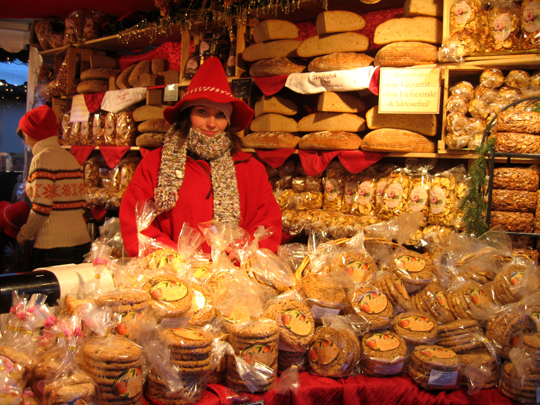
Our real destination, though, was the Christmas market at the Gendarmenmarkt, a few blocks away, where we paid one Euro each to get in. This huge outdoor fair had dozens of booths selling food and crafts. On one side was a stage where entertainers danced and sang. There was also a semi-indoor section tented off from the chilly air where there were more booths. We toured the booths and bought cookies and poppyseed cake to take home, puppets for the grandkids, and a Thuringer sausage on a bun for my lunch. We also took a photo by a large decorated Berlin bear. (Bears are the symbol of Berlin. They are all over the city, something like the cows in Chicago.) That evening, German friends took us to the Berlin Opera where we saw Mozart's The Magic Flute. The staging–lots of smoke and lights–was dramatic and creative. It didn’t matter that I didn’t understand the German lyrics. It was all wonderful. Afterward, we ate in the opera restaurant where Art had smoked eel and I had gnocchi.
![]() |
| Booth selling stollen, cookies and other baked goods |
On Sunday morning we bundled up and walked to the Brandenburg Gate and from there to the New National Art Museum, a large glass box not far from the symphony hall. The main collection is German art of the early to mid-twentieth century. From the outside, the building seems unlikely to have wall space for much art, but the inside is surprisingly spacious. In one room, they were screening a 1927 film called Symphony of Berlin, a black and white visual homage to life in the city as it was then, bustling with industry and commerce. (You can rent the film on Netflix.) Later, we met our friends again for a traditional German Christmas tea with wonderful homemade stollen, fruit bread, cookies, and marzipan, followed by more German food for dinner at a restaurant near our hotel. The next morning we got on a plane to go back to LA.
![]() |
| Caroline at the Brandenburg Gate, Berlin |
Monday, November 14, 2011
Prague: Old World Food and Culture
![]() |
| Prague, view from our hotel window of Prague Castle and St. Vitus Cathedral |
Day 1: We checked into our hotel, The Royal Palace, just as the sun was setting. Our room looked over the large enclosed gardens of the Wallenstein Palace to the Castle (actually St. Vitus Cathedral) high on the hill above. After a short walk, we ate a traditional Czech dinner at a nearby restaurant, Pod Vezi, where Art got duck and I chose fallow (deer) with what they called dumplings but tasted like the bread dressing of a typical American Thanksgiving.
![]() |
| Deer and Dumplings for dinner at Restaurant Pod Vezi |
Day 2: After breakfast at the hotel, a buffet they call a Swedish table (meat, cheese, bacon, bread, pastries, fruit) which filled us up for the day, we set out to explore. We walked across the Charles Bridge (for pedestrians only and filled with vendors despite the freezing weather) from Mala Strana (the town below the castle) to Stare Mesto (old town) on the other side of the river, and walked along the twisty cobblestone streets, filled mainly with tourist shops featuring puppets, jewelry made from local amber (actually from Poland), art glass, Russian nesting dolls, etc.
![]() |
| Toy and Ceramic Shop |
![]() |
| Stained Glass window at St. Vitus Cathedral |
![]() |
| Fred and Ginger building, is an example of deconstructionist architecture |
![]() |
| Afternoon Snack |
![]() |
| Dvorak Hall |
Unlike many other European cities, central Prague was not bombed during WW II, so the heart of the city, which goes back ten centuries or more, retains its historic character. It is best seen by walking, and although the weather was chilly, we wore warm coats and were quite comfortable walking around. A few days after we left, a huge storm blanketed Europe with more than a foot of snow, making it almost impossible to get around. We were lucky that we had mostly clear weather for our trip.
![]() |
| Typical street in the castle area of Prague |
Getting around: The best way to get around central Prague is by walking, which was what we did. You do not need to know Czech to visit Prague. We found that almost everyone speaks English.
Getting there: We flew directly to Prague (via Paris) from Los Angeles. From Prague, we took a train to Berlin (a beautiful ride along the river), and flew back to Los Angeles (via Paris) from there.
Monday, November 7, 2011
Uppsala, Sweden
![]() |
| Uppsala Castle, built in 1549: The Governor's Residence and Site of Several Museums |
A University Town
![]() |
| The Carolina Rediviva University Library |
![]() |
| Globe of the Constellations, Carolina Rediviva Library |
![]() |
| Uppsala Cathedral. Seat of the Archbishop of the Church of Sweden |
![]() |
| Uppsala Cathedral Stained Glass Window with Angels Above |
As I looked at Art’s photos of Uppsala, I tried to imagine that it might have been somewhat similar when Linnaeus was alive and students flocked to his lectures at the university. Carl Linnaeus (also known as Carl von Linne) was a scientist, lecturer, writer, and passionate collector and explorer. In his time, there was no comprehensive system for identifying and classifying plants and animals. Linnaeus' study of plants and the need to name them in an organized way motivated him to develop a two part system for naming all living things, the first part being the genus name and the second the species, as in Homo sapiens, Felis domesticus, or Tyrannosaurus rex. The universal language of science in Linnaeus’ time was Latin. Today, English is the universal scientific language, but we still use Latin and Linnaeus' system for scientific names.
![]() |
| Stora Torget, the main square in Uppsala, for pedestrians only |
While in Uppsala, Art became enamored of the many varieties of flatbread that were served on the breakfast smorgasbord at his hotel. Made from rye, wheat, whole grain, and in various degrees of thickness, this crisp bread is perfect with butter, cheese, meat or by itself as a healthy snack. Of course, you don’t have to fly to Sweden to buy or eat Swedish food. Just go to your nearest IKEA! [For an interesting article on the history and culture of IKEA, go to the October 3, 2011 issue of the New Yorker.]
Thanks to Art for sharing his photos!
![]() |
Dome of Museum Gustavianum of Uppsala University |
Monday, October 31, 2011
September in Sardinia, Part III: Giants' Tombs, Sassari, and the Sinis Peninsula
(A Week in Sardinia, September 2011, Continued)
Our next three nights were spent in Sassari, at the Leonardo da Vinci hotel, in the center of town not far from the university where my husband, Art, was attending a conference for two days. While he was at meetings, I explored the town, visiting the main square and the Cathedral, the Museum Sanna, which displays both costumes and artifacts discovered in the area, and wandering along the narrow side streets.
I also did a little shopping, buying torrone (almond candy) and some orange flavored cookies to take home as souvenirs. I also bought a package of carasau bread to bring home. The bread, so thin that it is almost a cracker, had its origin in the days when shepherds spent weeks alone in the hills with their sheep and needed a food that would stay fresh. We are still enjoying the bread I bought, weeks later!
For our final day in Sardinia, we headed to the Sinis Peninsula, near the town of Oristano, to see the remains of an ancient Roman settlement at Tharros which sit on a narrow spit of land protruding into the bay. Sardinia became a Roman province in 238 B.C. after the defeat of the Cathaginians in the first Punic War and Tharros developed into a major religious center. The buildings are mostly collapsed, but the basalt slabs of the original Roman road remain, making it easy to imagine toga clad citizens making their way to the baths and temples.
After lunch on the beach and visiting the nearby paleochristian church of San Giovanni di Sinis, we drove south to Stagno Ena Arrubia, a seaside lagoon declared by our guidebook to be a “birdwatcher’s paradise.” It was. From the edge of the road, we were thrilled to see hundreds of flamingoes, as well as coots, gulls, egrets, herons and other birds in the shallow water.
Getting there: Sardinia has airports in Cagliari, Olbia and Alghero. You can fly to Sardinia from several cities in Italy on Alitalia, or from Paris on Meridiana. I flew from Los Angeles to Paris, and then to Cagliari via Rome.
Shopping: Most shops, except in tourist areas, are closed on Sundays. During the week they close for lunch between 1:00 and 4:00 and then stay open until dinner time at 8:00 or 9:00. So, if you need to buy anything, plan to shop when they stores are open!
ATMs: Only the larger towns have banks with ATMs and even then, there may be just one or two. It helps to ask at the local tourist office for directions to one.
(Look for Sardinia, Part I: Ancient Crossroads of the Mediterranean posted October 17 and Sardinia, Part II: The Supramonte posted October 24.)
![]() |
| Arzachena, Tomb of the Giants "Coddu Vecchiu" |
Arzachena and Tombs of the Giants
After leaving Su Gologone, we headed north to the town of Arzachena, the center of a half-dozen Nuragic sites. Besides the towers, the other distinctive structures of the Nuraghic culture are the so-called “giants' tombs”, large stone sepulchers, often fronted by a huge stone “door”. In fact, the graves were not for giants, (the ancient Sardinians were of relatively small stature) but intended for multiple burials. At first I thought that the tiny opening at the bottom of the center stone was meant for people to crawl through, but then learned that it was symbolic, intended as a door for the spirits. Sassari, Sardinia’s University Town
![]() |
| Sassari Cathedral, Gargoyle |
![]() |
| Cactus fruit, eggplant, olives |
Bay of Nymphs
![]() |
| Lighthouse, Porto Conte |
On the last afternoon in Sassari, we drove about half hour to the coast for a 4.5 mile walk through a nature preserve at Porto Conte, known in ancient times as Port of the Nymphs. We followed a track through a scrub forest to Punto Giglio (Lily Point) where there are the remains of barracks and gun emplacements from World War II. On the way, we were surprised to hear the noise of vehicles behind us. Soon a policeman appeared on a motorcycle, leading a convoy of jeeps, motorcycles, trucks, and other army vehicles, all decorated with American and Italian flags and filled with men and women in U.S. military uniforms. At first we thought it was some sort of military exercise, but then we noticed that the uniforms were fifty years old! Perhaps, we thought, we had landed in the middle of a movie reenacting the American liberation of Italy. It turned out to be a club of people who collect World War II memorabilia and have excursions like this in “costume” to historic sites. (As it turns out, the war never actually came to Sardinia. The Americans bypassed Sardinia on their march into Europe from Africa, entering Italy via Sicily.)
![]() |
| Punto Giglio (Porto Conte) |
Roman Ruins and Flamingos
![]() |
| Tharros, Roman Ruins |
![]() |
| Flamingos, Stagno Ena Arrubia |
Off the Beaten Track for Americans
Our trip to Sardinia was timed for September to take advantage of the good weather (not too hot, not too cold) and to avoid the summer tourist crowds. Sardinia is a popular tourist destination for Europeans, especially in summer when they flock to the beaches. However, few Americans go to Sardinia. During our week there, we did not encounter any and we only met a few native English speakers including one generous Englishman who helped us navigate our way through Cagliari when we got lost. Earlier that day, when we asked the hotel clerk for directions into the city, she had asked rather incredulously, “You didn’t get GPS with your rental car?” We didn’t opt for GPS because of the expense, and although we did manage without it, there were a few times when it might have come in handy. Much of Sardinia IS off the beaten track. One of the things we liked best, is that in many places we visited, we were the only ones there. ![]() |
| Arzachena: Nuraghic Complex "La Prisgiona", entrance to the tower |
Getting there: Sardinia has airports in Cagliari, Olbia and Alghero. You can fly to Sardinia from several cities in Italy on Alitalia, or from Paris on Meridiana. I flew from Los Angeles to Paris, and then to Cagliari via Rome.
Shopping: Most shops, except in tourist areas, are closed on Sundays. During the week they close for lunch between 1:00 and 4:00 and then stay open until dinner time at 8:00 or 9:00. So, if you need to buy anything, plan to shop when they stores are open!
ATMs: Only the larger towns have banks with ATMs and even then, there may be just one or two. It helps to ask at the local tourist office for directions to one.
(Look for Sardinia, Part I: Ancient Crossroads of the Mediterranean posted October 17 and Sardinia, Part II: The Supramonte posted October 24.)
Monday, October 24, 2011
SEPTEMBER IN SARDINIA: Part II, The Supramonte
(Trip to Sardinia, September 2011, Continued)
Su Gologone
After leaving Barumini, we headed north for the town of Oliena, located at the foot of the mountains of the Supramonte, and Su Gologone, the large, upscale country hotel where we would spend three nights. (Su Gologone gets its name from the ancient spring across the road from the hotel. “Su” is a Sardinian word meaning “the” and “gologone” means “spring”.) The hotel is reputed to have the best restaurant in Sardinia and the food was excellent. Dinners feature suckling pig roasted on spits in a huge fireplace in the dining room. Breakfasts are a smorgasboard of fresh fruits, breads, meats, yogurt, muesli, cheeses, pastries, eggs, juice, plus tea or caffe latte.
The rooms and hallways of the hotel are filled with the art collection of the owner, displaying colorful costumes, masks, paintings, pottery, rugs, and other typical Sardinian crafts. From the balcony of our bright and airy room we could hear the tinkle of sheep bells on the nearby hillside and glimpse the top of the stony massif beyond. To orient ourselves, we signed up for an excursion the next day.
In the morning we met our guide, Antonello, who escorted us to a Land Rover, pointing to the top of the massif and indicating that we were going there. He only spoke Italian so we didn’t get details. We assumed that we’d drive part way and hike the rest. We didn’t realize that he planned to drive nearly all the way to the top! After zigzagging through the narrow streets of Oliena, he turned off the highway onto a dirt track, passing first through a forest, then along the rock face, one hairpin turn after the next, on the narrow boulder strewn road which had no guard rail and dropped precipitously on one side. Finally, he reached a small parking area. From there we scrambled on foot over rocky terrain between the thistle and other low growing plants to the summit of Mount Corrasi. The view was, indeed, breathtaking and worth the rock jolting trip up.
The second half of our excursion with Antonello was to the Lanaitho Valley, a long secluded river valley within the Supramonte. At the far end, after passing through olive groves, horse meadows, and along a tree lined avenue, we came to the grotto of Sa Ohe e Su Bentu and the Nuraghic village Sa Sedda e Sos Carros. After paying our entrance fee for the village, we got a private tour in English from an extremely knowledgeable young woman who pointed out, among other things, the elaborate plumbing system–still in place! Like many prehistoric sites in Sardinia, the village was completely buried and unknown until just a few years ago. It is still being excavated. When we returned from the village, Antonello took us on a tour of the cave, one of the many limestone caverns throughout the Supramonte.
The next day we drove to the coast, about an hour away, winding our way down the mountain to the town of Cala Gonone on the Gulf of Orosei. Our plan was to take a boat to the grotto and beach of Cala Luna a few miles to the south. However, because of expected high winds (which never appeared while we were there) all boat trips for the day were canceled. Instead, we hiked to a closer beach, Cala Fuili, about 2.5 miles away at the end of the road from Cala Gonone. By this time it was noon and warm in the full sun (the temperature was in the low 80's), making a swim in the sea even more attractive. As we arrived at Cala Fuili, we discovered dozens of rock climbers scaling the walls of the canyon. For ourselves, we walked down the steps to the beach!
At the end of the day we returned to Su Gologone to enjoy a glass of Sardinian red wine on the terrace and watch the sun set over the valley below.
(Look for Sardinia, Part I: Ancient Crossroads of the Mediterranean posted October 17 and Sardinia, Part III: Giants' Tombs, Sassari, and the Sinis Peninsula posted October 31.)
![]() |
| Valley below the Supramonte, near Su Gologone |
Su Gologone
![]() |
| Entrance to Hotel Su Gologone |
![]() |
| Breakfast is eaten on a screened in terrace |
To the Top of Mount Corrasi
![]() |
| Climbing to the top of Mount Corrasi, nearly 5000 feet high |
The Lanaitho Valley
![]() |
| Nuraghic Stone basin and Ram's head water spouts at Sa Sedda e Sos Carros |
A Day at the Beach
![]() |
| Cala Fuili Beach, near Cala Gonone |
At the end of the day we returned to Su Gologone to enjoy a glass of Sardinian red wine on the terrace and watch the sun set over the valley below.
(Look for Sardinia, Part I: Ancient Crossroads of the Mediterranean posted October 17 and Sardinia, Part III: Giants' Tombs, Sassari, and the Sinis Peninsula posted October 31.)
![]() |
| Ruins of an early church near Su Gologone |
Labels:
beach,
Cala Fuili,
Cala Gonone,
Gulf of Orosei,
Sardinia,
Su Gologone
Monday, October 17, 2011
September in Sardinia, Part I: Ancient Crossroads of the Mediterranean
A Week in Sardinia, September 2011
![]() |
| Su Nuraxi: Bronze Age tower and village built about 1500 B.C. |
My husband and I spent a week in Sardinia in September, visiting ancient ruins, hiking in the mountains and along the coast, going to museums, birdwatching, and enjoying the rich and delicious Sardinian cuisine. With blue skies and comfortable temperatures (in the 70's), it had all the elements of a ideal vacation.
Cagliari, the Provincial Capital
![]() |
| Cagliari: Gate to the Citadel, location of Museum of Archeology |
![]() |
| Archeology Museum: Wrestlers, Bronze Age figures for votive offering |
Agriturismo–Farm Stays in Italy
Throughout Sardinia and the Italian countryside, you see signs offering Agriturismo, which is basically a bed and breakfast stay at a working farm. For our second night, we stayed at Su Boschettu, a typical agriturismo hotel about an hour’s drive from Cagliari, located in the midst of an olive grove. It also offered dinner, advertising that everything on the menu was organic and locally grown. The first course, antipasti, included the typical Sardinian green olives (perhaps from their own orchard), which have a delicious, slightly sharp, nutty taste, and the classic crisp Sardinian flat bread, carasau, brushed with olive oil, sprinkled with salt, and toasted. (Throughout our stay in Sardinia, every meal began with olives and carasau.)![]() |
| Olives |
![]() |
| View of the village of Pauli Arbarei from Su Boschettu |
Su Nuraxi–A World Heritage Site
![]() |
| View from the walkway at the top of the Su Nuraxi Tower; stone walls were built without mortar |
![]() |
| Nuraghic model of a tower showing the flared upper story |
Our ticket also got us in to several museums in Barumini. One displayed artifacts discovered in the excavation of Su Nuraxi; another displayed farm implements and Sardinian cultural items, including the many different forms of Sardinian bread; and another explained the making and playing of a flute-like instrument called launeddas.
Maps and Guidebooks: We relied on our Michelin map to get us around Sardinia. You can order it online. Our main guidebooks for sites, hotels, restaurants, etc., were the Lonely Planet Sardinia and Rough Guide Sardinia. We also made good use of Sardinia: Car Tours and Walks by Andreas Stieglitz, which has very specific instructions for walks and driving routes.
(Look for Sardinia Part II: The Supramonte and Sardinia Part III: Giants' Tombs, Sassari, and Sinis Peninsula to be posted October 24 and 31.)
![]() |
| Cagliari, Sardinia, view from below the Citadel |
Labels:
agriturismo,
Bronze Age,
Cagliari,
farm stays Italy,
food,
museum,
Nuraghe,
Sardinia,
Su Nuraxi
Subscribe to:
Comments (Atom)